Boulebar Rålambshov occupies one of Stockholm's most appealing outdoor settings, where the city's pétanque culture meets a casual bar and food program on the edge of Rålambshovsparken. The space works in layers — gravel courts, open-air seating, and a social rhythm tied to the long Scandinavian summer evening. It sits at the accessible end of Stockholm's eating and drinking spectrum, well removed from the tasting-menu formality of the city's Michelin tier.
Pearl is the En Primeur Club membership app — saves, bookings, and concierge access live there. Same editors, same standards.
- Address
- Smedsuddsvägen 2, 112 35 Stockholm, Sweden
- Phone
- +46101629200
- Website
- boulebar.se
- Directions
- Get directions
 Saves & bookings on Pearl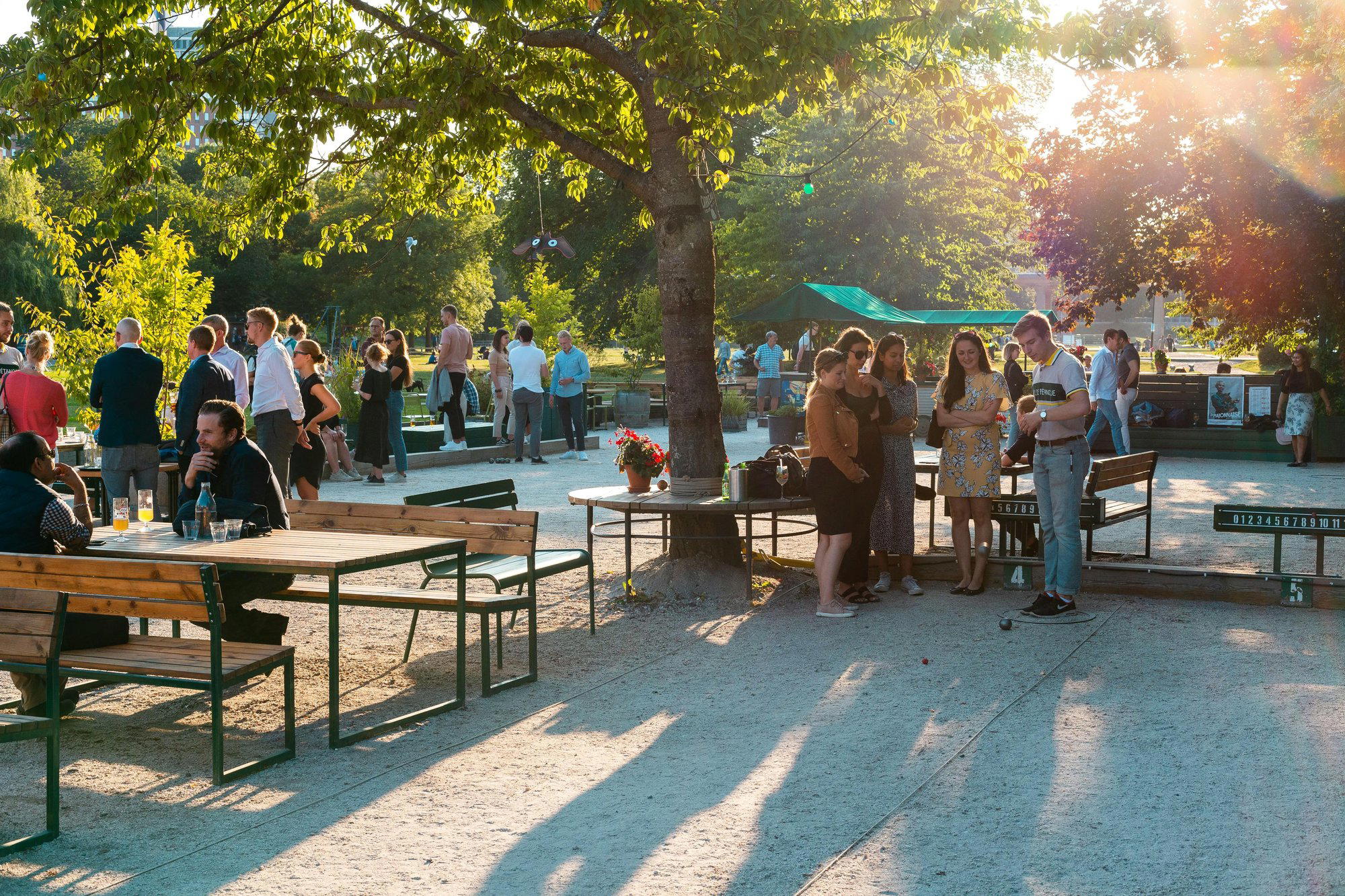
Where the Park Ends and the Evening Begins
Stockholm has a particular gift for blurring the line between public park and social venue, and Rålambshovsparken — the long green corridor stretching along Kungsholmen's southern edge toward Lake Mälaren — is one of the clearest expressions of that tendency. On warm evenings, the park fills in layers: joggers on the path, families on the grass, and then, at the water-adjacent edge on Smedsuddsvägen, the gravel courts and outdoor seating of Boulebar Rålambshov. The venue belongs to a format that has become a fixed part of Stockholm's seasonal social infrastructure: the pétanque bar, where the game and the drink are of roughly equal importance and neither is treated with excessive seriousness.
This is not the Stockholm of Frantzén or AIRA, where the room is designed to hold you in close focus and every element of the evening is composed in advance. Boulebar operates in a different register entirely, one where the physical container is open-sided, changeable with the weather, and oriented around movement rather than stillness. That distinction matters when you are thinking about Stockholm's dining and drinking options as a range rather than a hierarchy.
The Architecture of Looseness
Pétanque venues succeed or fail on the quality of their outdoor design, and Boulebar's Rålambshov location has geography working in its favour. The proximity to the waterfront means the light shifts in a particularly useful way through the evening, the sort of long Nordic dusk that makes outdoor seating feel genuinely different from its equivalent in a southern European city. Gravel courts set the material tone: this is a space that accepts some dust on your shoes and does not ask you to perform refinement.
The open-air format places Boulebar in a different competitive set from Stockholm's enclosed restaurant scene. The comparison venues worth understanding here are not Operakällaren or Aloë, those operate in a tier where the room itself is part of the price signal, with interiors that carry decades of deliberate design. Boulebar's spatial logic is the inverse: impermanence is the point. The seating arrangement shifts with the season, the time of day, and how many courts are in use. That flexibility is a feature of the format, not a gap in the offering.
Across Scandinavia, there are venues that have developed serious culinary programs within similarly informal physical containers. Knystaforsen in Rydöbruk does this in a rural setting; ÄNG in Tvååker builds a whole identity around landscape and agriculture. The pétanque bar format is less ambitious in culinary terms but occupies a specific and legitimate social function that those properties are not trying to fill.
Stockholm's Accessible Evening Tier
The city's premium dining scene, Adam/Albin in its New Nordic register, the contemporary European ambition of AIRA, operates at price points and booking windows that make them planned events rather than spontaneous decisions. Boulebar functions differently: it is the kind of place you arrive at because the park drew you in, or because someone in the group wanted to play. That spontaneity is built into the format. You do not book a pétanque evening the way you book a tasting menu.
For international visitors building a Stockholm itinerary, it is worth understanding what Boulebar represents in the city's social geography. Stockholm is not a city that separates eating, drinking, and outdoor leisure into distinct categories the way some northern European capitals do. The park-adjacent bar with a food offer is a well-established urban format here, and Rålambshovsparken is one of the better settings for it, accessible from the Hornstull and Fridhemsplan metro stops, and within reach of Kungsholmen's residential and café culture.
For visitors who have structured their trip around Sweden's serious culinary circuit, perhaps including Vollmers in Malmö, Signum in Mölnlycke, or PM & Vänner in Växjö, an afternoon or early evening at a pétanque bar in a city park is the kind of tonal counterpoint that makes a trip feel like it has range. Not every meal needs to be a statement.
The Boulebar Network and Format
Boulebar operates multiple Stockholm locations, which means the Rålambshov site sits within a recognisable brand logic rather than as a standalone independent. That context is worth noting because it shapes expectations: the offer is consistent across sites, and what makes Rålambshov interesting is the specific geography, not a proprietary kitchen philosophy. The park setting and water proximity give this location a distinct spatial advantage over more urban Boulebar courts.
The format connects to a broader European pétanque-bar revival that has touched cities from Copenhagen to London, where the game has migrated from its southern French working-class origins into a broadly middle-class urban leisure context. Hoze in Gothenburg and Bistro Jarlen in Halmstad represent different points on the casual-to-serious Swedish dining axis; Boulebar sits at the casual end without apology. The parallel internationally would be something like the communal-table format at Lazy Bear in San Francisco, not in culinary ambition, but in the shared premise that the social format is as important as the food.
Planning a Visit
Boulebar Rålambshov is a venue defined by its season. Stockholm's summer evenings, particularly from June through August, when daylight extends past ten at night, are when the format delivers its full return. Arriving in the early evening on a weekday keeps the energy social without the weekend crowd compression. Court availability and seating are not managed the way a tasting-menu booking is, so flexibility is an advantage here. The address is Smedsuddsvägen 2, on the Kungsholmen side of the park, reachable on foot from several metro and bus connections in the area.
For a fuller picture of where Boulebar sits within Stockholm's eating and drinking options across all price points and formats, the EP Club Stockholm guide maps the city's scene from the Michelin tier down to neighbourhood-level regulars. Elsewhere in southern Sweden, Claesgatan 8 in Malmö, Sydkustens at Pillehill in Skivarp, and VYN in Simrishamn offer a sense of how the broader regional food culture is developing at different scales and price points. And for those calibrating against the global fine-dining reference point, Le Bernardin in New York represents the opposite end of the formality spectrum, useful context for understanding just how wide the range of serious hospitality actually runs.
Price and Positioning
| Venue | Cuisine | Price | Awards |
|---|---|---|---|
| Boulebar RålambshovThis venue — the venue you are viewing | Not listed | This venue | Not listed |
| Operakällaren | Swedish, Modern Cuisine | €€€€ | Michelin 1 Star |
| AIRA | Modern European, Modern Cuisine | €€€€ | Michelin 2 Star |
| Adam / Albin | New Nordic | €€€€ | Michelin 1 Star |
| Ekstedt | Progressive Asador, Grills | €€€€ | Michelin 1 Star |
| Etoile | Contemporary French, Creative | €€€€ | Michelin 1 Star |
Continue exploring
More in Stockholm
Restaurants in Stockholm
Browse all →
Bars in Stockholm
Browse all →
At a Glance
- Lively
- Cozy
- Trendy
- Group Dining
- Casual Hangout
- Brunch
- Open Kitchen
- Terrace
- Craft Cocktails
Current opening hours
- Monday
- 4:30–9 PM
- Tuesday
- 4:30–9 PM
- Wednesday
- 4:30–9 PM
- Thursday
- 4:30–9 PM
- Friday
- 3–11 PM
- Saturday
- 11 AM–11 PM
- Sunday
- 11 AM–5 PM
Hours can change for holidays and private events. Last verified .
Relaxed South of France park atmosphere with large glass sections reflecting the park seasons, lively for socializing and games.
Know Before You Go
- Getting there
- Smedsuddsvägen 2, 112 35 Stockholm, Sweden