Border Grill
Our verdict
Border Grill sits inside Los Angeles International Airport's Tom Bradley International Terminal, bringing Mexican-influenced cooking to one of the most transited dining rooms in Southern California. It occupies a niche few airport restaurants attempt: food rooted in regional Mexican tradition, positioned above the standard terminal offering and serving travelers who want something more considered before a long-haul departure.

Pearl is the En Primeur Club membership app — saves, bookings, and concierge access live there. Same editors, same standards.
- Address
- 1 World Wy, Los Angeles, CA 90045
- Phone
- (310) 307-7529
- Hours
- Daily 6 AM–8 PM
- Website
- bordergrill.com
- Directions
- Get directions
The menu
What to order
- Chile relleno burger
- Grilled fish tacos
- Citrus chicken quesadillas
Terminal Dining, Reconsidered
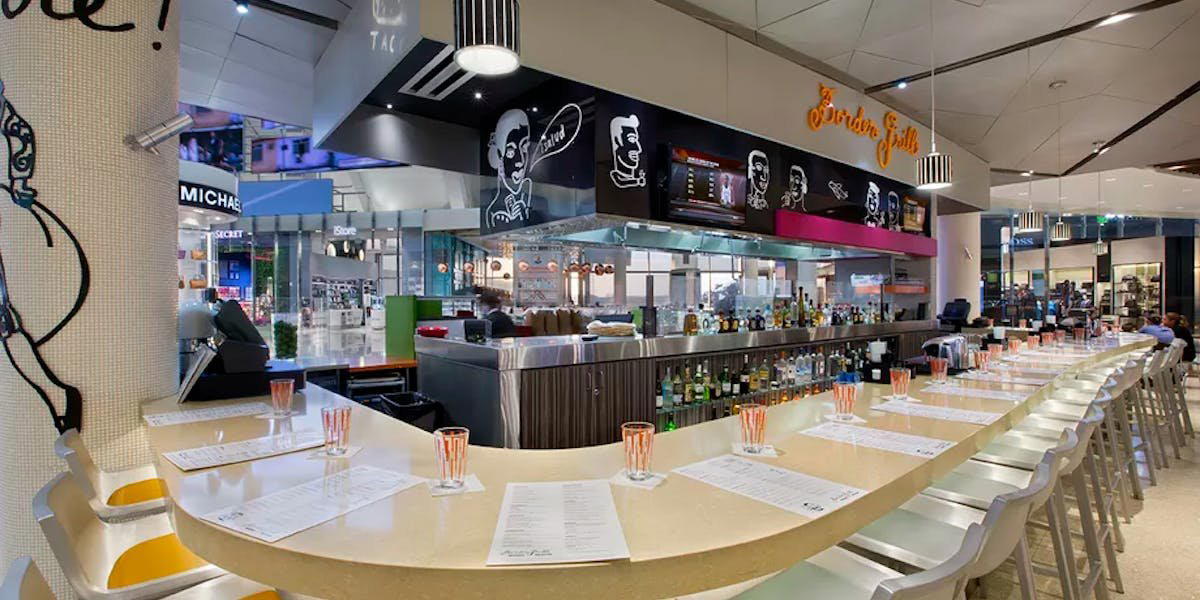
Most airport restaurants make a single concession to the traveler: they are open. Border Grill at LAX asks a different question. Positioned inside the Tom Bradley International Terminal at 1 World Way, it operates in one of the highest-traffic international departure halls in the United States, yet its Mexican-influenced menu puts it in a different competitive conversation than the surrounding grab-and-go counters. The terminal environment is loud, fluorescent in patches, and governed by the rhythms of departure boards, but Border Grill carves out a footprint that feels, at minimum, intentional. That intentionality is what separates it from the broader airport dining tier.
Airport dining in the US has stratified significantly over the past decade. Cities like New York, San Francisco, and Chicago now host outposts of credentialed restaurant brands inside their terminals, a trend driven by both traveler demand and airport authority procurement priorities. LAX's Tom Bradley terminal sits inside that pattern. Border Grill benefits from this positioning: travelers who might otherwise default to a national chain have a Mexican-focused alternative that draws on a longer culinary tradition than most of what surrounds it. For context on how LA's wider restaurant scene positions itself, see our full Los Angeles restaurants guide.
What the Room Tells You Before You Order
The sensory experience of eating at an airport restaurant is shaped almost entirely by forces outside the kitchen's control. The Tom Bradley International Terminal moves thousands of passengers daily through a space designed for flow, not lingering. Announcement cycles, rolling luggage, and the particular acoustic quality of large-span ceilings define the ambient environment. Border Grill operates within these constraints, which makes the question of what it can actually deliver in terms of a coherent dining experience a fair one to ask.
What airport dining venues in this tier tend to do well is compression: delivering enough of the parent restaurant's identity in a format calibrated for time-pressured diners. The Mexican regional tradition Border Grill draws from is well-suited to this, given that the cuisine's building blocks, its chiles, its acid-forward preparations, its contrast between char and brightness, carry across formats. A dish with good structural seasoning survives the airport context better than something that depends on precise tableside execution or highly perishable plating. That is the practical logic behind why Mexican and Southeast Asian formats have proliferated in premium airport dining across the US.
LA's Mexican Food Context
Los Angeles has one of the most developed Mexican food cultures of any North American city, shaped by deep Californian and Baja influences alongside more recent arrivals from Oaxaca, Jalisco, and the Yucatan. The city's taco stands, market vendors, and regional specialists have set a high contextual bar. Dining at the airport version of any concept that draws on this tradition inevitably invites comparison not just to other airport restaurants, but to the wider city ecosystem.
That comparison is where the honest assessment lands. Border Grill at LAX is not competing with what you'd find on Sunset, in Boyle Heights, or across the border in Tijuana. It competes with the terminal tier: with sandwiches, pre-packaged salads, and fast-casual chains that have no culinary argument to make at all. Within that peer group, a menu rooted in Mexican cooking has genuine credentials to deploy. The cuisine is complex, historically layered, and resilient under the temperature and timing pressures of terminal kitchens. That structural advantage is worth acknowledging.
For travelers building a broader sense of how LA's premium dining scene is organized, the city's fine dining tier includes venues like Providence, one of the city's most consistent seafood-focused addresses, and Kato, which has built a significant reputation in New Taiwanese cooking. The tasting menu format is well-represented at Somni and the kaiseki tradition finds serious expression at Hayato. Italian cooking in the city has a long-established anchor in Osteria Mozza. None of these are airport options, but they define the culinary register that regular LA diners carry as a reference point.
The Airport Dining Tier: Where Border Grill Sits
Across the US, airport dining has developed a recognizable hierarchy. At the leading sit full-service outposts of credentialed brands, often operating with modified menus and airport-specific pricing. Below that sits the fast-casual and quick-service layer. Border Grill operates closer to the first tier: a recognizable brand with a defined cuisine position, operating in a full-service format inside a major international terminal.
Comparable airport dining experiments elsewhere in the country provide useful reference points. Lazy Bear in San Francisco and Alinea in Chicago represent the full-service destination model in their respective cities. The airport dining equivalent is a different category entirely, but the underlying logic of bringing a credentialed culinary identity into a captive-audience environment runs through both. Further afield, venues like Le Bernardin in New York City, Emeril's in New Orleans, and The French Laundry in Napa anchor the upper end of their cities' dining hierarchies in ways that inform what travelers expect when they encounter a branded restaurant name in a terminal context.
Farm-driven formats have also become a reference point for premium US dining. Blue Hill at Stone Barns in Tarrytown and Single Thread Farm in Healdsburg represent one end of that spectrum. The broader national scene includes credentialed addresses like Addison in San Diego, Bacchanalia in Atlanta, The Inn at Little Washington, and Atomix in New York City. Internationally, 8 1/2 Otto e Mezzo Bombana in Hong Kong illustrates how premium restaurant branding translates across high-footfall, international contexts. The airport dining niche Border Grill inhabits is, in its own way, a compression of the same challenge these venues face: maintaining a culinary identity under operational pressure.
Planning Your Visit
Border Grill is located post-security in the Tom Bradley International Terminal at LAX, making it accessible only to departing international passengers or those with international terminal access. The terminal is at 1 World Way, Los Angeles, CA 90045. As with any airport restaurant, timing is determined by departure schedules rather than reservation windows; walk-in availability depends on terminal traffic patterns, with off-peak morning windows generally less crowded than mid-afternoon and evening departure surges. No specific booking method, pricing, or current hours data is available from EP Club's verified records for this location, so confirming current operational details directly through LAX's terminal dining directory before travel is advisable.
Frequently asked questions
What do regulars order at Border Grill?
EP Club does not hold verified menu data for Border Grill's current LAX offering, and we do not publish dish-level recommendations without confirmed sourcing. The restaurant's broader culinary identity is rooted in Mexican regional cooking, a cuisine where preparations built around chiles, citrus, and fire-forward technique tend to anchor the menu. For the most current dish information, the venue's own listings through the LAX terminal dining directory are the reliable reference point.
What is the ideal way to book Border Grill at LAX?
Border Grill at LAX operates in a post-security terminal environment, which limits access to departing international passengers at Tom Bradley International Terminal. Given the airport context, walk-in timing around your departure window is the practical approach, with earlier arrival relative to your flight giving more flexibility. Checking the LAX official terminal dining listings before travel will confirm current operating hours and any booking options.
What has Border Grill built its reputation on?
Border Grill has built its broader identity on Mexican regional cooking, a cuisine tradition with deep roots in Los Angeles given the city's proximity to Mexico and its large Mexican-American population. The LAX location extends that identity into the airport dining format, where the cuisine's structural complexity, built on layered chile heat, acid contrast, and char, gives it more to work with than many terminal competitors. The brand's longevity in LA's competitive dining market is itself a credential worth noting.
Is Border Grill at LAX suitable for a full sit-down meal before an international flight?
Border Grill's position inside the Tom Bradley International Terminal makes it one of the more considered dining options available to departing international passengers at LAX, where the alternative full-service options are limited. The Mexican-rooted menu offers more culinary depth than the surrounding quick-service tier, and the post-security location means you can eat without re-clearing security. Allowing at least 45 to 60 minutes before your boarding call is prudent given standard terminal service pacing.
The Quick Read
Comparable venues nearby, for context on price, style, and recognition.
| Venue | Cuisine | Price | Awards | Notes |
|---|---|---|---|---|
| Border GrillThis venue — the venue you are viewing | Modern Mexican | $20–30 | Not listed | Not listed |
| Tocaya Modern Mexican | Modern Mexican | $20–30 | Not listed | Downtown, Modern Mexican |
| Trejo’s Tacos | Modern Mexican Tacos | $20–30 | Not listed | Mid-Wilshire, Modern Mexican Tacos |
| La Serenata Cantina | Traditional Mexican Seafood | $20–30 | Not listed | West L.A., Traditional Mexican Seafood |
| Birriería Gonzalez | Authentic Birria Tacos | $10–20 | LA Taco Best Tacos in LA #39 | East LA, Authentic Birria Tacos |
| Mariscos Corona | Authentic Mexican Seafood | $20–30 | LA Taco Best Tacos in LA #56 | Van Nuys, Authentic Mexican Seafood |
Continue exploring
More in Los Angeles
Restaurants in Los Angeles
Browse all →
Bars in Los Angeles
Browse all →
Hotels in Los Angeles
Browse all →


Wineries in Los Angeles
Browse all →
Details
- Lively
- Energetic
- Casual Hangout
- Group Dining
- Craft Cocktails
- Local Sourcing
- Sustainable Seafood
- A La Carte
- Margaritas
- Vegetarian Friendly
Current opening hours
- Monday
- 6 AM–8 PM
- Tuesday
- 6 AM–8 PM
- Wednesday
- 6 AM–8 PM
- Thursday
- 6 AM–8 PM
- Friday
- 6 AM–8 PM
- Saturday
- 6 AM–8 PM
- Sunday
- 6 AM–8 PM
Hours can change for holidays and private events. Last verified .
Lively cantina atmosphere with bright colors and bold Mexican decor, well-suited for travelers to unwind.