Our verdict
Few addresses on Grafton Street carry as much civic weight as Bewley's, the orientalist café that has anchored Dublin's most walked shopping street since 1927. The stained-glass Harry Clarke windows, the roasting aroma that has seeped into the woodwork over decades, and the ground-floor hustle make it a working document of Dublin's café culture rather than a preserved relic. Come for the coffee, the baked goods, and the particular rhythm of a room that belongs to the city as much as to its operators.

Pearl is the En Primeur Club membership app — saves, bookings, and concierge access live there. Same editors, same standards.
- Address
- 78-79, Grafton Street, Dublin, D02 K033, Ireland
- Phone
- +35315640900
- Hours
- Mon–Sat 8 AM–6 PMSun 8:30 AM–6 PM
- Website
- bewleysgraftonstreet.com
- Directions
- Get directions
- Booking
- Book on OpenTable
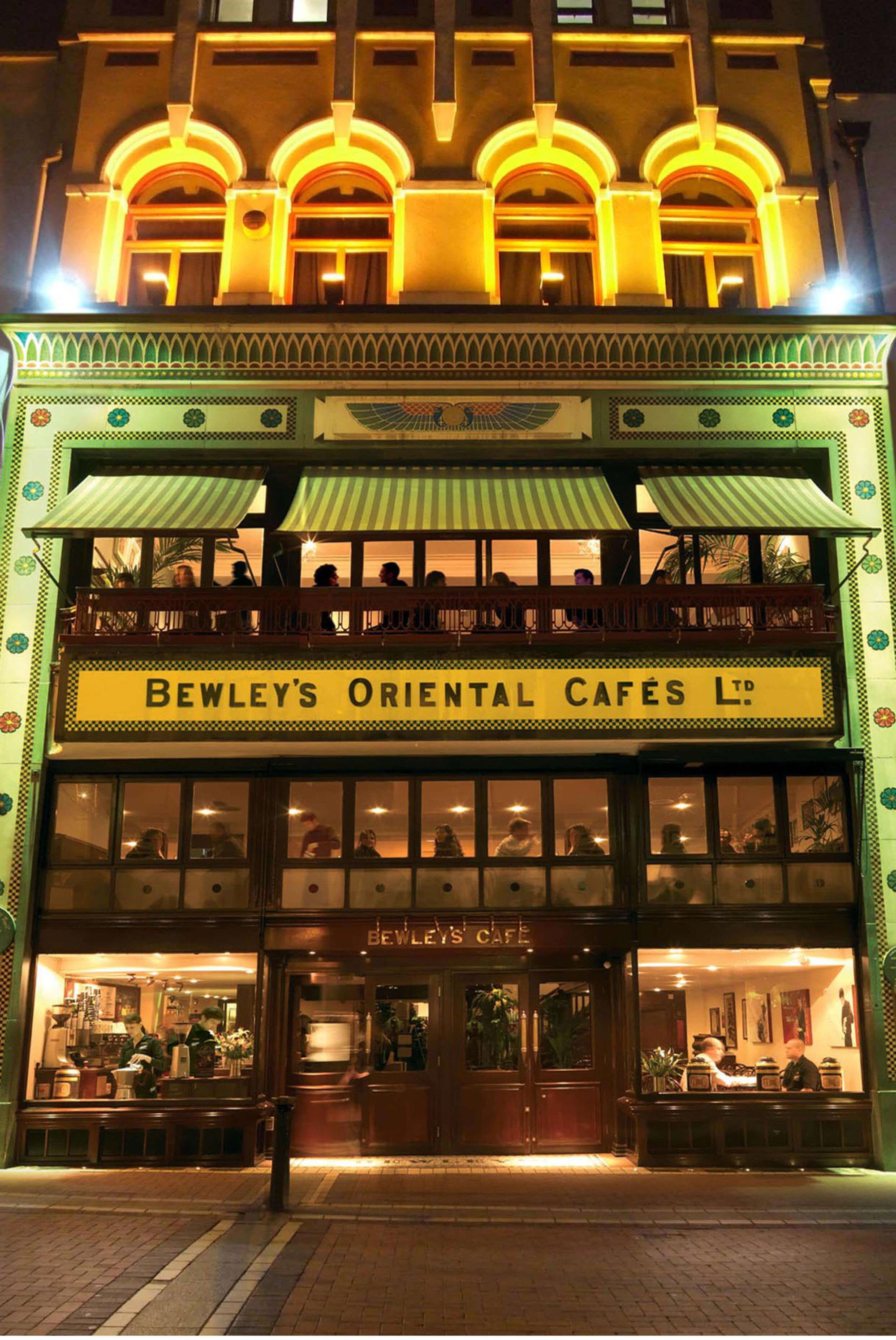
A Grafton Street Fixture and What It Represents
There is a category of café that functions less as a hospitality business and more as civic infrastructure. Bewley's Oriental Café on Grafton Street belongs to that category. Since opening in its current premises at 78–79 Grafton Street in 1927, the building has operated through the full arc of twentieth-century Dublin: economic contraction, cultural revival, and the rapid transformation of the city's food culture from the 1990s onward. The Harry Clarke stained-glass windows, installed in 1925, predate the building's current occupancy and remain among the most significant decorative works in any commercial space in Ireland. Arriving on Grafton Street and stepping through the heavy wooden doors is not a neutral act; the room has a weight of expectation built by generations of Dubliners who treated it as a place to land, think, and eat.
That legacy places Bewley's in a different competitive category than Dublin's contemporary fine dining circuit. Venues like Chapter One by Mickael Viljanen and Patrick Guilbaud operate on Michelin terms; Bewley's operates on cultural ones. The distinction matters when setting expectations for a visit.
The Room: What Clarke's Windows Tell You Before the Food Arrives
Dublin's café culture has historically been shaped by institutions rather than trends, and the physical environment of Bewley's makes the argument better than any menu could. The ground floor moves at the pace of a city-centre café: trays, queues at the counter, the particular clatter of crockery against marble-topped tables. The upper floors, where the Mackerel theatre space now operates within the same building footprint, reflect the layered programming that has kept the address relevant across different audiences.
The stained-glass panels by Harry Clarke, each depicting orientalist scenes that reference the café's original tea-trading identity, are genuinely significant works. Clarke, whose output spans church commissions and book illustrations, completed this commission in the mid-1920s. In the context of a functioning café, they are an anomaly of the leading kind: serious art in an everyday setting, which is rarer in Dublin than the city's cultural reputation might suggest.
Sourcing and the Irish Café Tradition
The editorial angle that matters most for Bewley's is ingredient provenance, specifically how a café operating at city-centre scale in a tourist-dense corridor maintains any meaningful connection to the sourcing values that define the better end of Irish food culture. Ireland's food producer network, which has supplied venues from Bastible to Liath in Blackrock and further afield to Aniar in Galway, is one of the most developed in Europe for a country of Ireland's size. Small dairy producers, heritage grain mills, and artisan bakeries across Munster and Connacht have been feeding a restaurant culture that prizes provenance since at least the early 2000s.
Bewley's own roasting operation, which dates to the company's origins in the nineteenth century when Joshua Bewley imported tea and coffee directly, represents an early and sustained version of what the food industry now calls supply chain transparency. The café continues to roast coffee on the premises, a practice visible and audible from the street, which places it in a different position than cafés sourcing generic wholesale product. This is not a small thing in a city where coffee quality has risen sharply over the past decade; roasting in-house at volume on a central-city site carries operational complexity that most operators avoid.
The baked goods, which anchor the daytime offer, connect to an Irish baking tradition that runs through soda bread, porter cake, and the kind of counter pastry that is less about French technique and more about dairy richness and direct grain. What the venue's documented history does confirm is a longer institutional commitment to sourcing specificity than most of its Grafton Street neighbours.
Dublin Context: Where Bewley's Sits in the Broader Food Map
Grafton Street as a dining corridor has changed. The pedestrianisation of the street in 1982 increased foot traffic and eventually attracted the kind of international chains that now occupy much of the ground-floor retail. Bewley's operates against that backdrop, which makes its continued presence at the same address notable as a commercial fact if nothing else. The Dublin dining scene has bifurcated sharply over the past two decades: at the formal end, venues like Glovers Alley and D'Olier Street compete on seasonal menus and wine lists; at the casual end, independent operators have faced sustained pressure from rents and competition.
Bewley's occupies neither of those poles. It is a mid-register institution in the sense that it serves a genuinely broad public, from tourists arriving via the Luas Green Line to regulars who have been using the room for work and meeting for decades. That cross-section of custom, sustained over nearly a century on the same street, is a form of cultural credential that Michelin stars cannot measure and that even well-regarded regional restaurants like Campagne in Kilkenny or The Oak Room in Adare operate without.
For visitors building a Dublin itinerary, Bewley's functions leading as a daytime anchor rather than a destination meal. The proximity to St. Stephen's Green, the National Museum, and the concentration of galleries along Kildare Street makes the Grafton Street corridor a natural starting point, and a table at Bewley's a reasonable place to reconvene. For the more ambitious end of any Dublin table itinerary, the wider EP Club guide to Dublin restaurants covers the full range from neighbourhood spots to formal tasting menus.
Planning a Visit
Bewley's operates as a walk-in café rather than a booked restaurant, which means the main planning variable is timing relative to the Grafton Street crowds. Weekend midday service, when tourist footfall on the street peaks, produces the longest wait for a table on the upper floors. Weekday mornings and early afternoons move faster. For visitors arriving by public transport, the Luas Green Line stops at St. Stephen's Green, a two-minute walk from the café's entrance. The building sits at 78–79 Grafton Street and is identifiable by the period shopfront and the roasting aroma that carries onto the pedestrian street.
Frequently asked questions
What dish is Bewley's Grafton Street famous for?
Bewley's is most closely associated with its baked goods and coffee, particularly its in-house roasted coffee, which the company has produced on its own premises since the nineteenth century. The café's counter pastry and traditional Irish baking heritage are the strongest food reference points; its identity is built around the daytime café offer rather than any single plated dish.
How far ahead should I plan for Bewley's Grafton Street?
Bewley's operates as a walk-in café, so advance booking is not the relevant variable. The planning factor is timing within the day: Grafton Street foot traffic peaks on weekend afternoons, which is when table availability on the upper floors tightens. Weekday mornings require no particular strategy. For context, the formal dining venues in Dublin that do require advance planning, such as Chapter One, typically need bookings several weeks ahead.
What's the signature at Bewley's Grafton Street?
The in-house coffee roasting operation, visible from the street level, is the clearest differentiator from comparable city-centre café addresses. The Harry Clarke stained-glass windows are a secondary signature of a different kind: significant decorative art in a working café setting, dating from the 1920s. Neither requires a tasting menu booking to experience.
Can Bewley's Grafton Street accommodate dietary restrictions?
Irish café culture generally provides reasonable options for common dietary requirements, but the specific range of options at Bewley's should be confirmed by contacting the venue directly before visiting, particularly for more specific dietary needs. If your requirements are complex, it is worth raising them with the team in advance.
Is eating at Bewley's Grafton Street worth the cost?
Bewley's sits at the mid-register café price point rather than the formal dining tier where cost-versus-value calculations require more careful weighting. The value proposition here is less about food-to-price ratio and more about what the physical space and cultural continuity of the address provides alongside the meal. For price-per-plate comparison with Dublin's formal dining circuit, venues like Bastible or Glovers Alley operate at a different cost level and with a different purpose.
Is there a connection between Bewley's and Ireland's broader artisan food movement?
Bewley's predates the contemporary Irish artisan food movement by several decades, but shares with it a documented commitment to sourcing specificity: the company's history of direct tea and coffee importing, and its sustained in-house roasting, represent an early version of the supply-chain transparency that producers supplying venues like dede in Baltimore and Bastion in Kinsale now prioritise. The institutional scale and city-centre location place it in a different operational context than farm-adjacent producers in West Cork or Connacht, but the sourcing orientation is historically legible.
Reputation First
| Venue | Cuisine | Price | Awards | Notes |
|---|---|---|---|---|
| Bewley's Grafton StreetThis venue — the venue you are viewing | Irish Café with Bakery & Breakfast | $20–30 | Not listed | Not listed |
| Patrick Guilbaud | Modern French Fine Dining | $150–200 | 2 Michelin Stars · La Liste Top Restaurants | Irish - French, Modern French |
| Bastible | Modern Irish | $100–150 | 1 Michelin Star · The Sunday Times Ireland’s 100 Best Restaurants | Modern Cuisine |
| Host | Modern Italian | $50–100 | Michelin Plate | Not listed |
| mae | Modern Irish Fine Dining | $50–100 | Michelin Plate · The Sunday Times Ireland’s 100 Best Restaurants | Not listed |
| Matsukawa | Authentic Edomae Omakase | $100–150 | Michelin Plate · La Liste Top Restaurants | Not listed |
Continue exploring
More in Dublin
Restaurants in Dublin
Browse all →
Bars in Dublin
Browse all →

Hotels in Dublin
Browse all →
Wineries in Dublin
Browse all →
Details
- Classic
- Well Known
- Cozy
- Brunch
- Casual Hangout
- Family
- Historic Building
- Extensive Wine List
- A La Carte
- Vegetarian Friendly
Current opening hours
- Monday
- 8 AM–6 PM
- Tuesday
- 8 AM–6 PM
- Wednesday
- 8 AM–6 PM
- Thursday
- 8 AM–6 PM
- Friday
- 8 AM–6 PM
- Saturday
- 8 AM–6 PM
- Sunday
- 8:30 AM–6 PM
Hours can change for holidays and private events. Last verified .
Timeless Grand European Café style interior with Art Deco influences, stained glass art, and a warm, lively atmosphere.