Aurora Restaurant sits at Luppokeino 1 in Luosto, Finnish Lapland, where the surrounding fell wilderness shapes what ends up on the plate. Dining here means engaging with subarctic ingredient traditions, foraged, hunted, and cold-climate grown, in a setting where the nearest city is a considerable distance away. For travellers already in Luosto, it is the natural first choice for dinner.
Pearl is the En Primeur Club membership app — saves, bookings, and concierge access live there. Same editors, same standards.
- Address
- Luppokeino 1, 99555 Luosto, Finland
- Website
- santashotels.fi
- Directions
- Get directions
 Saves & bookings on Pearl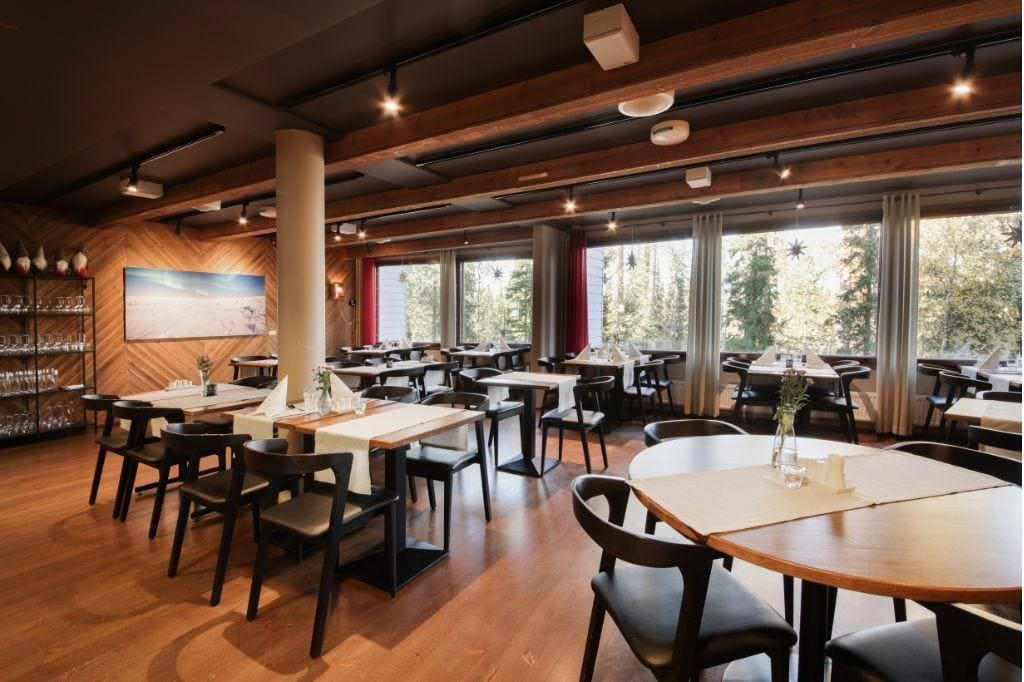
Where the Fell Feeds the Kitchen
Aurora Restaurant in Luosto serves Lappish Scandinavian fine dining at Luppokeino 1, 99555 Luosto, Finland, with a smart casual dress code and recommended reservations. When you arrive at Aurora Restaurant on Luppokeino 1, the physical context does most of the orienting work before you've read a menu. The building sits within a landscape defined by birch forest, open tunturi fell, and a sky that, depending on the season, carries either the midnight sun or the aurora borealis. That environment is not decorative backdrop, in subarctic Finland, it is the primary supply chain.
Lapland's dining character has always been shaped by geography more than culinary fashion. The growing season is compressed and extreme, pushing kitchens toward preservation, fermentation, and cold-smoking as year-round techniques rather than seasonal affectations. Game, freshwater fish, wild berries, and foraged fungi are not artisan additions here, they are the structural ingredients that kitchens in this region have organised around for generations. Aurora Restaurant operates inside that tradition by geography alone, whatever the current menu format.
The Subarctic Pantry: What Lapland Puts on the Table
Understanding what to expect at a restaurant like Aurora requires understanding what the land around Luosto actually produces. Reindeer is the axis around which much Lappish cooking turns. Herded by Sámi and Finnish reindeer farmers across vast fell territories, it arrives in kitchens as a genuinely local protein with a flavour profile shaped by lichen grazing, lean, mineral, and distinct from farmed alternatives. Restaurants across Finnish Lapland have built menus around it not because it is fashionable but because it is abundant, meaningful to the region's culture, and logistically proximate in a way that imported proteins are not.
Arctic char and freshwater whitefish from Lapland's lake systems represent a second pillar. These cold, clear-water fish carry a delicacy that warmer-water equivalents lack, and in a region where fly-fishing remains a serious local pursuit, the supply relationship between lake and kitchen is often short and direct. Wild cloudberries, picked in August from boggy fell terrain, appear across Lappish dessert courses with a frequency that reflects genuine abundance rather than trend-chasing. Lingonberries, crowberries, and bilberries fill out the berry register across autumn menus.
Foraging adds the third dimension. Chanterelles and funnel chanterelles emerge from birch and pine forest from midsummer through early autumn. Pine shoots are harvested in spring. Yarrow, angelica, and juniper appear as seasoning in kitchens that treat the forest floor as a spice rack. In this context, ingredient sourcing is not a marketing position, it is the structural reality of cooking in a place this remote, where the local pantry is often more accessible than the supply truck.
Luosto in the Finnish Fine-Dining Context
Finland's most formally recognised restaurants cluster in the south. Palace in Helsinki and Kaskis in Turku hold Michelin recognition and operate within the urban New Nordic lineage that has defined Scandinavian fine dining internationally. VÅR in Porvoo works a similar register, while Gastropub Tuulensuu in Tampere and Pöllöwaari in Jyväskylä anchor regional dining in their respective cities. None of those venues operate in conditions remotely like Luosto's, and the comparison is largely irrelevant.
The restaurant belongs to a different category: resort destination dining in Finnish Lapland, where the competitive set is thin and the dining proposition is inseparable from the travel experience that surrounds it. Guests are not choosing between Aurora and a dozen alternatives within walking distance. They are choosing Aurora because they are in Luosto, and Luosto is where they have come for the fell hiking, the snowmobile routes, or the northern lights. The restaurant's relevance is amplified by that context in a way that urban venues simply cannot replicate. For broader reference points in Finnish regional dining, see venues like Musta lammas in Kuopio, Popot in Lahti, or Filipof in Joensuu, each operating in a regional context that shapes their offer distinctly from the Helsinki flagships.
Internationally, the closest analogues in terms of remoteness-as-ingredient-driver are the destination restaurants in rural Scandinavia and the American wilderness dining model, places like Lazy Bear in San Francisco, which built its identity around communal, locality-rooted cooking, or the precision sourcing ethic that underpins Le Bernardin in New York City for fish. The common thread is that geography dictates the pantry.
Timing and Seasonality
Luosto's seasons are hard divisions, not gradations. Winter runs from roughly November through April, bringing reliable snow cover, downhill and cross-country skiing, and the optimal window for northern lights viewing, with statistical aurora probability highest in the shoulder periods of March and late September to October. Summer brings continuous daylight from late May through July, with hiking on the open fell and fishing in the lake systems. The restaurant is open daily from 2 to 11 PM.
For those travelling the Finnish restaurant circuit more broadly, the north-south contrast is instructive. Other EP Club-listed venues like Lucy in the sky in Espoo, Hejm in Vaasa, and DeLorean in Jyväskylä operate year-round in urban settings with consistent supply chains. Aurora's subarctic position means the menu's character shifts substantially between seasons in ways those venues simply do not experience.
Planning Your Visit
Luosto is accessible by car from Rovaniemi, approximately 120 kilometres north, or via Sodankylä, the nearest town of any size. Hai Long in Rovaniemi offers a useful dining contrast if you're routing through that city. Rovaniemi airport connects to Helsinki with multiple daily flights, making Luosto reachable within a day from most European hubs. Accommodation in the village is resort-oriented, and most visitors are staying in the immediate area when they dine at Aurora. Reservation is recommended, and pricing is around $50 per person. See our full Luosto restaurants guide for broader context on eating and drinking in the area, alongside regional options including Viinitupa Vuorenmaja in Mänttä, Gösta in Mänttä, and JJ's BBQ in Salo for reference across the Finnish regional dining spectrum.
Side-by-Side Snapshot
Comparable venues nearby, for context on price, style, and recognition.
| Venue | Cuisine | Price | Notes |
|---|---|---|---|
| Aurora RestaurantThis venue — the venue you are viewing | Lappish Scandinavian Fine Dining | $$$ | Not listed |
| Rakas Restaurant & Bar | Modern Lapland Scandinavian | $$$ | Arctic Circle |
| Laanilan Kievari | Scandinavian Lappish with French influences | $$$ | Saariselka |
| DeLorean | Cocktail Bar | $$$ | city centre |
| Ravintola Heinätori | Traditional Finnish Fine Dining | $$$ | Pyynikki |
| Birdie Numnum | Modern Scandinavian Fine Casual | $$$ | Linjat |
At a Glance
- Cozy
- Rustic
- Intimate
- Special Occasion
- Open Kitchen
- Hotel Restaurant
- Extensive Wine List
- Local Sourcing
- Mountain
Current opening hours
- Monday
- 2–11 PM
- Tuesday
- 2–11 PM
- Wednesday
- 2–11 PM
- Thursday
- 2–11 PM
- Friday
- 2–11 PM
- Saturday
- 2–11 PM
- Sunday
- 2–11 PM
Hours can change for holidays and private events. Last verified .
Pleasant and warm ambiance with a cozy lobby bar by the fireplace.