
Tabelog 100 #51
Our verdict
AROMAS of INDIA places Kanda Sudacho’s Indian-curry scene in a practical, occasion-friendly bracket: serious enough for a planned dinner, relaxed enough for family tables and weekday lunch. Tabelog selected it for Asian cuisine and Ethnic cuisine TOKYO “Tabelog 100” in 2022, 2023, and 2024, with Indian and Indian curry as its public categories.

Pearl is the En Primeur Club membership app, where members save venues, book tables and use the concierge.
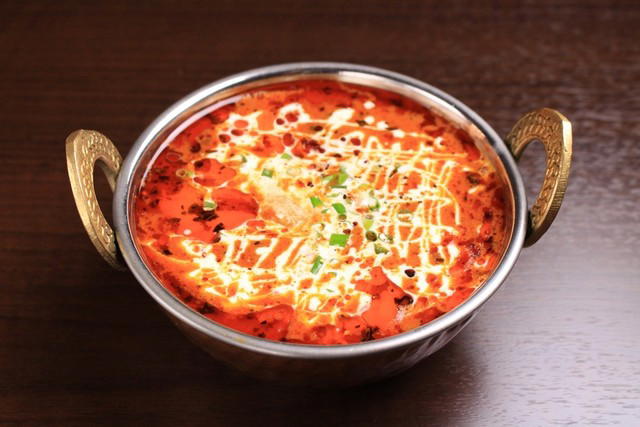
The menu
What to order
- Rogan Josh
- Aloo Gobi
- Black Chicken
- Chicken Butter Masala
- Mutton Vindaloo
- Fish65
Kanda Sudacho shifts quickly between office workers, Akihabara electronics traffic, old Kanda food culture, and a neighbourhood rhythm that eats early, fast, and often well. Indian curry fits because Tokyo treats it less as novelty than as a working lunch and casual-dinner staple. AROMAS of INDIA sits at the more serious end of that everyday category: consistent enough for family meals, small celebrations, and repeat weekday use without pretending to be formal dining.
The signal is consistency, not luxury. Tabelog selected the restaurant for Asian cuisine and Ethnic cuisine TOKYO “Tabelog 100” in 2022, 2023, and 2024, and its public score is 3.65. In Tokyo’s crowded Indian and curry field, repeat selection separates a reliable neighbourhood address from the many competent curry counters serving the city’s lunch economy. Pricing keeps the occasion casual: lunch is JPY 1,000–1,999, dinner JPY 2,000–2,999, making it better for birthdays with children, office send-offs, and low-pressure group dinners than grand anniversary theatre.
Kanda curry with enough structure for a celebration table
Tokyo runs several curry cultures at once: Japanese roux comfort, South Asian cooking adapted to lunch sets, and a broader Asian and ethnic category where spice, rice, vegetarian cooking, and shared plates shape the meal. AROMAS of INDIA is in the Indian and Indian curry lane, but its occasion appeal comes as much from format as flavour: 50 seats, private use for 20–50 people, no private rooms, and a non-smoking policy. That suits groups needing comfort and predictability rather than ceremony.
The menu also works for mixed tables. Vegetarian and vegan options are listed, and the restaurant notes particular attention to vegetables. In Tokyo, that matters when one guest avoids meat, another wants a full curry meal, and a family brings children. English menus, English-speaking staff, and menus with photos reduce friction for visitors who want Indian food without making dinner translation work.
The local comparison set is revealing. Topca Kanda honten shares a nearby curry price band, while Kanda Yunrin moves into a much higher dinner bracket. Takemura and CHOPIN belong to the low-cost Kanda snack-and-café economy, and Kanda Yabu Soba carries the area’s older Japanese dining memory. AROMAS of INDIA is neither splurge nor quick stop alone; it is a mid-priced, group-capable Indian option in a neighbourhood where casual need not mean careless.
Biryani, vegetables, and the Tokyo group-dinner test
Indian restaurants suit Tokyo occasions because the table scales. Curries, rice, breads, vegetable dishes, and biryani let guests share without tasting-menu choreography. Public notes mention biryani and a weekday lunch format from 1 PM, where diners choose from five curries with a Chicken Biryani and curry set. That is not a single fixed signature claim; it shows biryani has enough weight in the operation to anchor repeat orders.
For celebrations, the practical details help. Parties over 2.5 hours are listed, take-out is available, and payment covers major credit cards, transport IC cards, several e-money systems, PayPay, Rakuten Pay, au PAY, Alipay, and WeChat Pay. In Tokyo, these details shape the meal as much as the food: group dinners work better when nobody must manage cash, split awkwardly, or leave early because the format is built only for turnover.
Accessibility broadens its use. Sofa seating, power outlets, and wheelchair access are listed, while children, babies, preschoolers, school-age children, and strollers are welcome. That makes it more useful than many narrow counter formats around Akihabara and Kanda, especially for families marking a small milestone rather than staging a formal banquet. It suits a birthday after Akihabara shopping, a casual office celebration near Awajicho, or a multi-generation meal where vegetarian choices and stroller access are not side issues.
How to place it within a Tokyo dining plan
Location is an advantage. Awajicho, Kanda, Ogawamachi, and Akihabara are close enough to make it a flexible stop between business districts, transport hubs, and retail-heavy streets. The restaurant is listed as a short walk from JR Akihabara Station, Tokyo Metro Marunouchi Line Awajicho Station, Tokyo Metro Ginza Line Kanda Station, and Toei Shinjuku Line Ogawamachi Station, making it easier than destination curry rooms requiring a single-purpose trip.
Planning should match the occasion. Lunch is the sharper value play, especially for diners comparing Indian curry with Tokyo’s casual lunch scene. Dinner works better for groups, families, and celebrations needing time, seats, and wider ordering. Public hours run through lunch and dinner daily, with Sunday evening closing earlier than other nights, and reservations are available. Parking is not provided, though coin parking is listed nearby, so train access is cleaner.
For wider itineraries, this is a restaurant that pairs with a Tokyo day rather than dominating it. Akihabara can supply the afternoon; Kanda supplies older food culture; Awajicho and Ogawamachi keep transport simple. Nearby and related Tokyo references include . 鮪と炭火焼き うお炭 秋葉原店, 12/10 Shinjuku ten, 124. KAGURAZAKA (Yakitori), 2D Cafe, and 3 Chome no Curry Ya San. Broader planning sits in Our full Tokyo restaurants guide, with parallel city coverage in Our full Tokyo hotels guide, Our full Tokyo bars guide, Our full Tokyo wineries guide, and Our full Tokyo experiences guide.
For Japan and overseas comparisons across casual dining formats, see -Grilled beef Sukiyaki- KAMAKURA TANUKIAN 鎌倉 たぬき庵 in Kamakura.cafe in Osaka.know in Kumamoto, (Shoku) Vietnam in Kawasaki, [Curry Senmon Ten] Maruyama Kyoju. in Sapporo, [ki:] in Kyoto, Jōdo Saké Bar in Los Angeles, and Onigiri Time in Pasadena. The editorial read is simple: choose AROMAS of INDIA when the brief is Indian curry in central Tokyo with enough recognition, seating, and group practicality to carry a modest celebration.
Similar Picks
Comparable venues to calibrate price, style, and recognition.
| Venue | Cuisine | Price | Awards | Notes |
|---|---|---|---|---|
| AROMAS of INDIAThis venue (the venue you are viewing) | Traditional North Indian Curry House | $20–30 | Tabelog 100 #51 | Not listed |
| Takemura | Traditional Japanese sweets café (kanmi-dokoro) | $1–10 | Tabelog 100 #6 | JPY 999 - JPY 999 |
| CHOPIN | Not listed | Not listed | Tabelog 100 #51 | JPY 999 - JPY 999 |
| Topca Kanda honten | Japanese & Indian-style Curry House | $10–20 | Tabelog 100 #50 | JPY 1,000 - JPY 1,999 JPY 1,000 - JPY 1,999 |
| Kanda Yabu Soba | Edo-Style Soba | $10–20 | Not listed | Not listed |
| Kanda Yunrin | Seasonal Chinese (Shanghai/Sichuan influence) Fine Dining | $100–150 | Tabelog 100 #5 | JPY 10,000 - JPY 14,999 JPY 1,000 - JPY 1,999 |
Recognition history
Dated appearances from independent guides and award organizations, with the underlying list record or original source where available.
Tabelog 100 #51 · No. 51
Tabelog · Tabelog 100 - Asian cuisine / Ethnic cuisine - TOKYO - 2024
Continue exploring
More in Tokyo
Restaurants in Tokyo
All restaurants in Tokyo →

Bars in Tokyo
All bars in Tokyo →




Details
- Lively
- Cozy
- Solo
- Group Dining
- Family
- Casual Hangout
- After Work
- Standalone
- A La Carte
- Vegetarian Friendly
- Vegan Options
Current opening hours
- Monday
- 11 AM–3 PM, 5–11 PM
- Tuesday
- 11 AM–3 PM, 5–11 PM
- Wednesday
- 11 AM–3 PM, 5–11 PM
- Thursday
- 11 AM–3 PM, 5–11 PM
- Friday
- 11 AM–3 PM, 5–11 PM
- Saturday
- 11 AM–3 PM, 5–11 PM
- Sunday
- 11 AM–3 PM, 5–10 PM
Hours can change for holidays and private events. Hours as of .
Casual and lively neighborhood Indian restaurant with a stylish yet relaxed interior, suited to solo diners, coworkers, and small groups rather than formal occasions.