Tinajani




Travel + Leisure It List Hotels · Town & Country Hotel Awards · TIME 2026 TIME World's Greatest Places
A six-bedroom tented camp set inside Tinajani Canyon at 12,900 feet, Andean's sixth Peruvian property was conceived as a transit stop and became something far more considered. Restored hacienda architecture anchors canvas campamentos with private hot tubs and wool-blanketed beds, while guided hikes through red-rock formations and community visits to local textile weavers fill the days. Doubles from $1,217, all-inclusive.

Pearl is the En Primeur Club membership app — saves, bookings, and concierge access live there. Same editors, same standards.
- Address
- Cañon de Tinajani, 21865, Peru
- Phone
- +51 974 446 764
- Website
- tinajani.pe
- Directions
- Get directions
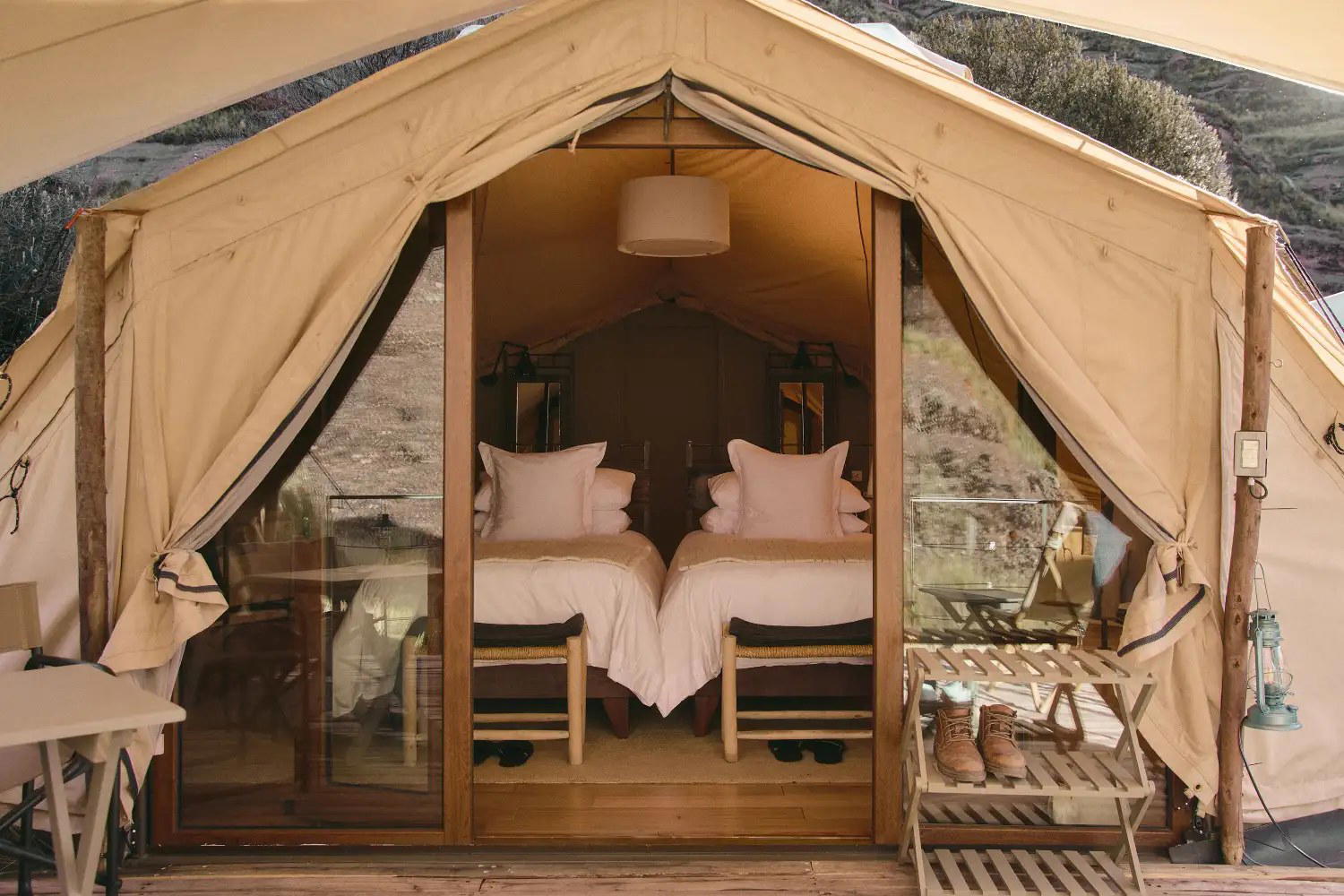
Where the Canyon Becomes the Architecture
The approach to Tinajani Canyon sets up what the camp itself then delivers. From Juliaca Airport, the drive crosses high mountain plains past llama herds and weather-beaten villages, then drops into a bottleneck of red rock formations that have been sculpted by millennia of wind and water into shapes that resist easy description. At 12,900 feet above sea level, the air thins noticeably, and the landscape shifts from the recognisable to something that reads as genuinely remote. By the time the tented camp appears against the canyon walls, the physical environment has already done much of the hospitality work.
That relationship between structure and setting is the defining design logic of Tinajani. Peruvian tour operator Andean, whose portfolio of boutique properties spans southern Peru's less-touristed corridors, built this as the sixth in its string of lodges. It was initially planned as a practical overnight break on the eight-hour route between two of the brand's other camps. What was built instead treats the canyon not as backdrop but as the primary architectural material. The six safari-style campamentos are arranged around a hacienda dating to the early 19th century that has been carefully restored, its adobe walls and proportions left largely intact. The tension between that fixed historical structure and the deliberately temporary canvas of the tents around it is not accidental.
The Campamento as a Design Object
In the broader category of high-altitude luxury camping, the instinct is often to approximate hotel-room comfort inside a tent, papering over the environment rather than engaging with it. Tinajani takes a different approach. Each campamento consists of two separate canvas tents connected by a shaded wooden deck: one tent holds a wood-fire stove and lounge space, the other contains the bed and bathroom. The division matters architecturally. It forces movement between interior zones and keeps the outdoor deck as a threshold rather than an afterthought.
Private hot tubs are positioned on each deck, angled toward the canyon. At the altitudes southern Peru operates on, this is not an amenity add-on but a functional response to the climate. The cold at night at nearly 13,000 feet is significant, and the camp's design acknowledges this throughout: beds come with thick wool blankets, turn-down service includes hot water bottles placed between the sheets, and guests receive alpaca-wool socks handwoven by artisans from the Pacobamba community near Cusco. These are not decorative gestures. They are design decisions that reflect the environment the camp sits inside.
For comparison, properties operating in similarly extreme Andean conditions, such as Titilaka on Lake Titicaca or Puqio in Yanque, address altitude through architecture and material choices that prioritise thermal comfort. Tinajani's tented format requires a more active design response to the same challenge, and the layering of wool, wood heat, and hot water across guest-facing touchpoints suggests that response has been thought through with care.
The Canyon as Programme
The 494-acre nature reserve surrounding the camp has remained free of the visitor volumes that reach Cusco and the Sacred Valley. Inca and pre-Inca tombs remain set directly into the canyon's rock faces, and guided hikes move through terrain where red rock pinnacles rise from writhing streams with no crowd infrastructure around them. This is not marketed remoteness of the type sold by properties that are technically accessible by afternoon flight from a capital. The drive from Juliaca alone, across vast mountain plains on dusty dirt roads, constitutes a significant physical commitment.
The camp integrates community relationships into its activity programme. Excursions to nearby towns allow guests to meet textile weavers and ceramists, and local residents who have spent years managing alpaca herds across this terrain advise on hiking routes. The result is a programme structure where the canyon's human history, stretching back through pre-Inca civilisations, is encountered through people still connected to it rather than through interpretation boards.
This positions Tinajani within a broader shift in high-end Andean travel toward what might be called embedded experience. Properties like Andenia Boutique Hotel in the Sacred Valley and Willka T'ika in Urubamba operate on a similar principle of local integration, though in landscapes with considerably more established visitor infrastructure. At Tinajani, the community relationships are not optional programme enrichments but a function of the camp's actual location.
Dining in the Adobe Walls
Meals are served either in the restored hacienda's adobe-walled dining room or as pop-up picnics distributed across the valley. The menu draws on local ingredients and regional cooking traditions: slow-roasted lamb, Peruvian chicken stew, smoked trout with capers and lemon sauce. The approach is neither fusion nor fine-dining performance. It reads as an extension of the same design philosophy that shaped the camp's physical spaces, grounding the experience in what the region actually produces rather than importing a kitchen identity from elsewhere.
After dark, the fireplace in the main hacienda becomes the social anchor. Pisco sours and muña tea, the latter a high-altitude herb used traditionally across the Andes, are the drinks of the evening. Guests can step outside to view a night sky given unusual clarity by the altitude and the absence of light pollution. The canyon walls read as silhouettes against it. This is not a manufactured moment but a direct consequence of where the camp is built.
Peru's broader luxury lodging tier, which includes urban properties like Palacio Nazarenas in Cusco and Miraflores Park in Lima, operates with an entirely different spatial logic. Those properties place historical architecture in dialogue with urban amenity. Tinajani removes urban amenity from the equation almost entirely and asks the hacienda and canyon to carry the experience without that support structure.
Planning a Stay
Tinajani is reached via Juliaca Airport, the nearest commercial hub, with the drive into the canyon taking travellers across high Andean plains before the road narrows toward the camp entrance. The altitude at arrival, 12,900 feet, requires the standard acclimatisation awareness that applies across this region of Peru. Rates start from $1,217 per double, all-inclusive, with some sources citing from $1,320 depending on season and configuration. The all-inclusive structure covers meals, activities, and guided excursions, which is the appropriate format for a camp this remote, given that no alternative dining or activity infrastructure exists within reach.
The six-bedroom scale keeps the camp small enough that it should be booked with meaningful lead time, particularly during the high Andean dry season running roughly May through October, when hiking conditions are clearest and night-sky visibility is at its sharpest. A single night is possible, reflecting the camp's original transit-stop design brief, but the activity programme, community excursions, and hiking routes make a two-to-three night stay the more considered choice.
Travellers building a broader southern Peru itinerary will find Tinajani sits logically between the Lake Titicaca region, where Titilaka in Puno operates on the lake's edge, and Arequipa, served by properties including Las Casitas in Arequipa and Cirqa in the city itself. For those extending to the Amazon corridor, Inkaterra Reserva Amazonica in Tambopata and Inkaterra Hacienda Concepción in Puerto Maldonado represent the logical continuation in another register entirely. See our full Canon de Tinajani guide for additional context on the region.
Comparable Spots, Quickly
Comparable venues nearby, for context on price, style, and recognition.
| Venue | Cuisine | Price | Awards | Notes |
|---|---|---|---|---|
| TinajaniThis venue — the venue you are viewing | Restored 19th-century farmhouse with safari-style tented campamentos on stilts for low-impact luxury. | $750–1,000 | Travel + Leisure It List Hotels · Town & Country Hotel Awards | Not listed |
| Titilaka | Contemporary luxury lodge integrated with natural environment on private peninsula | Not listed | 2 Michelin Keys · Virtuoso Luxury Hotel Partner | Luquina |
| explora Valle Sagrado | Hacienda-style lodge with contemporary Andean design integrated into Inca terraces | Not listed | 1 Michelin Key · La Liste Top Hotels | Huayllabamba |
| Pullman Lima Miraflores | Contemporary high-rise blending modern design with traditional Peruvian elements | Not listed | Michelin Selected | Miraflores |
| Rio Sagrado, A Belmond Hotel | Contemporary Andean village-inspired luxury resort | $500–750 | 1 Michelin Key · La Liste Top Hotels | Urubamba |
| Iberostar Selection Miraflores | Urban oceanfront luxury hotel with strong sustainability positioning in Lima’s Miraflores district. | $100–200 | Not listed | Miraflores |
Recognition history
Dated appearances from independent guides and award organizations, with the underlying list record or original source where available.
Conde Nast Hot List Hotels
Conde Nast
TIME 2026 TIME World's Greatest Places
TIME
Town & Country Hotel Awards
Town & Country
Travel + Leisure It List Hotels
Travel + Leisure
Details
- Scenic
- Rustic
- Intimate
- Quiet
- Romantic Getaway
- Wellness Retreat
- Weekend Escape
- Panoramic View
- Wi Fi
- Pool
- Mountain
Cozy and serene with crackling fires in communal spaces, warm heritage textiles, artisan crafts, and immersive natural sounds from canvas tents under far-reaching Andean skies.