
Occupying a restored Thanjavur heritage property, Svatma places itself at the intersection of Chola architecture and contemporary hospitality. Recognised by La Liste Top Hotels 2026 with 91 points, it operates within a small tier of heritage properties in Tamil Nadu that treat the built environment as the primary offering. For travellers routing through the Kaveri delta, it is one architecturally coherent base in the city.
Pearl is the En Primeur Club membership app — saves, bookings, and concierge access live there. Same editors, same standards.
- Address
- No. 4/1116, Blake Hr Sec School Road, Q4JX+CC7, 265, Mission Church Rd, Maharnonbu Chavadi, Thanjavur, Tamil Nadu 613001
- Phone
- +91 76010 04004
- Website
- svatma.in
- Directions
- Get directions
 Saves & bookings on Pearl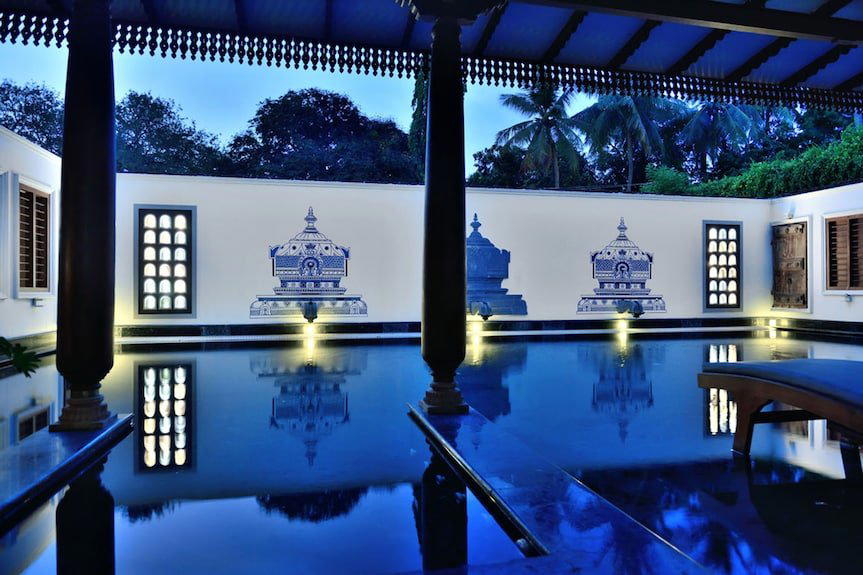
Where Chola Architecture Sets the Terms
Thanjavur rewards the patient traveller. The city built its identity across centuries of Chola, Nayak, and Maratha patronage, and that layered past is legible in its streets, temples, and surviving courtyard houses in ways that more-trafficked heritage destinations in India no longer manage. Arriving at Svatma, on Mission Church Road near the old Maharnonbu Chavadi quarter, the transition from the city's ambient noise into a structured interior calm is architectural in origin: thick laterite walls, shaded colonnades, and a compound logic that privileges enclosure over spectacle. This is how Tamil Nadu's traditional agraharam and palace-adjacent residences were designed to function, and Svatma works within that grammar rather than around it.
India's heritage hotel category has split over the past decade into two broadly different propositions. The first, represented by properties like The Leela Palace Jaipur or The Oberoi Amarvilas in Agra, anchors itself to monument adjacency and international luxury conventions. The second, smaller group treats the building itself as the experience, subordinating amenity counts to spatial authenticity. Svatma belongs firmly in the second group. Its competitive comparable set is not the business-class hotels of Chennai or the resort properties of coastal Tamil Nadu; it aligns more closely with restoration-led properties like Haveli Dharampura in Delhi or Chapslee in Shimla, where the structure's age and integrity constitute the primary value proposition.
The Architecture as Programme
The design approach at Svatma reflects a documented strand of South Indian domestic architecture: the multi-courtyard agraharam typology, in which public, semi-public, and private zones are delineated by successive thresholds rather than corridors or lobbies. Columns with traditional bracket capitals, lime-plastered walls, and teak joinery signal the Thanjavur Maratha period, during which the city's merchant and Brahmin residential architecture reached a distinct local refinement. The property's conversion to a hotel has preserved this spatial hierarchy rather than dismantling it in favour of uniform room layouts, which means that different parts of the building function at different scales and with different acoustic and light qualities.
In the broader context of heritage conversion in Tamil Nadu, this matters. The delta region between Thanjavur, Kumbakonam, and Karaikudi contains particularly architecturally significant domestic structures in South India, many of which are now in advanced states of disrepair. Properties that have undergone credible restoration, retaining original materials and proportional systems rather than applying surface-level heritage aesthetics, are rare. Svatma's La Liste Top Hotels 2026 recognition, at 91 points, places it within a global ranking that weights quality of experience rather than brand affiliation, a meaningful signal for a 5-star property of this type in a city of Thanjavur's modest international profile.
Thanjavur as Context
Understanding what Svatma offers requires understanding what Thanjavur is and is not as a destination. The city is the home of the Brihadeeswara Temple, a UNESCO World Heritage Site and among the more architecturally significant structures in India, completed under Raja Raja Chola I around 1010 CE. It is also the source of Thanjavur painting, the Saraswati Mahal manuscript library, and among the more sophisticated Carnatic music traditions on the subcontinent. What it is not is a city with broad international hospitality infrastructure. Visitors arriving by train from Chennai or Madurai, or overland from Kumbakonam and Gangaikonda Cholapuram, are entering a cultural geography that has not been substantially curated for mass tourism. That makes the quality of one's base disproportionately important.
Travellers building a Tamil Nadu itinerary that extends southward toward Anantya By The Lake in Kaliyal or northward toward Bengaluru will find Thanjavur most productive when given two to three nights rather than a single transit stop. The Brihadeeswara complex alone merits more than one visit at different times of day, when the granite tower reads differently against morning and evening light. Placing Svatma within that itinerary, rather than treating it as a waypoint, changes how the city accumulates meaning.
Situating Svatma in the Wider India Heritage Hotel Conversation
India's premium heritage accommodation market ranges from the Rajasthan-heavy concentration of properties, including Amanbagh in Ajabgarh, Aman-i-Khas in Ranthambore, and Suján Jawai in Pali, to Himalayan retreats such as Ananda in the Himalayas, and urban palace conversions like The Taj Mahal Palace in Mumbai. South India's contribution to this market is comparatively underrepresented in international travel coverage, despite the architectural density of the Tamil Nadu delta and the Chettinad region. Svatma sits at the point where that underrepresentation becomes an advantage: travellers already familiar with the Rajasthan circuit or the Leela Palace New Delhi register are unlikely to have encountered a property of this type in this city, which sharpens the experience considerably.
Planning Your Stay
Thanjavur is accessible by train from Chennai (approximately six to seven hours on express services) and from Madurai (roughly three hours), with Tiruchirappalli the nearest airport at around 55 kilometres. Booking several weeks in advance for these windows is advisable. The cooler and drier months between October and February are particularly comfortable for temple visits and extended time outdoors. With rates from about $120 a night, Svatma sits at the premium end of Thanjavur's hotel market.
Fast Comparison
Comparable venues nearby, for context on price, style, and recognition.
| Venue | Cuisine | Price | Awards | Notes |
|---|---|---|---|---|
| SvatmaThis venue — the venue you are viewing | Heritage luxury resort celebrating Tamil Nadu's cultural legacy with curated antiques, contemporary art, and Siddha wellness traditions. | $$$$ | 5-Star | Not listed |
| Taj Fort Aguada Resort & Spa | Portuguese-colonial heritage resort with modern luxury | $$$$ | 5-Star | Candolim |
| The Oberoi Vindhyavilas Wildlife Resort, Bandhavgarh | Tented luxury wildlife resort inspired by Vindhya mountains and tribal heritage | $$$$ | 5-Star | Bandhavgarh National Park |
| Taj Exotica Resort & Spa, Goa | Luxurious beachfront resort with colonial-inspired architecture sprawled across 56 acres of lush greenery | $$$$ | 5-Star | Benaulim |
| Taj Taal Kutir | Urban lakeside sanctuary fusing colonial elegance with modern luxury | $$$$ | 5-Star | New Town |
| Taj Bekal Resort and Spa, Kerala | Contemporary classic resort with Kettuvallam houseboat-inspired architecture blending local Kerala elements and modern luxury. | $$$$ | 5-Star | Bekal |
Recognition history
Dated appearances from independent guides and award organizations, with the underlying list record or original source where available.
La Liste Top Hotels
La Liste
Continue exploring
More in Thanjavur
Restaurants in Thanjavur
Browse all →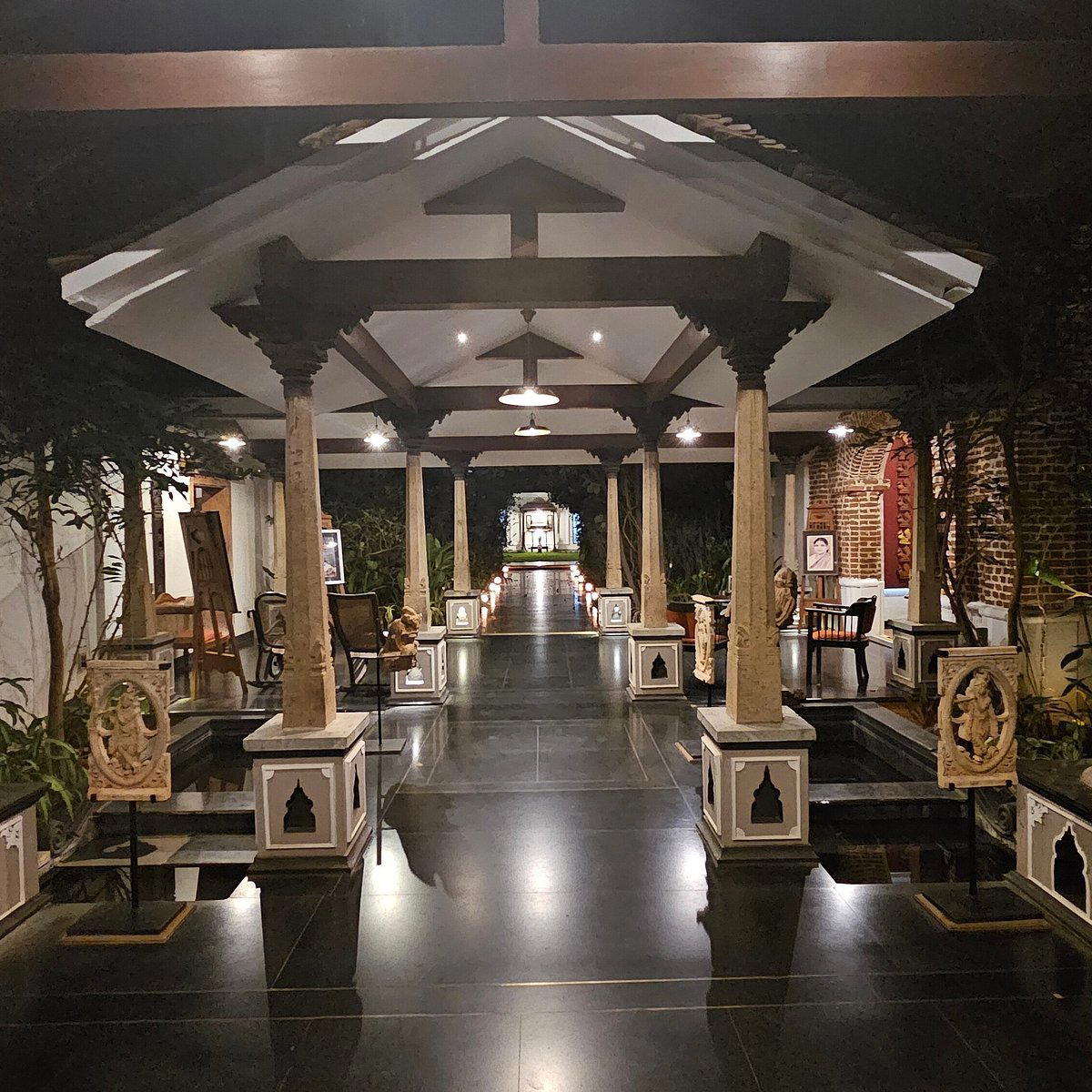
At a Glance
- Romantic
- Elegant
- Classic
- Sophisticated
- Romantic Getaway
- Wellness Retreat
- Family Vacation
- Garden
- Terrace
- Historic Building
- Destination Spa
- Wi Fi
- Pool
- Spa
- Fitness Center
- Room Service
- Concierge
- Business Center
- Restaurant
- Bar
- Laundry Service
- Garden
- Wi Fi
- Pool
- Spa
- Fitness Center
- Room Service
- Concierge
- Business Center
- Restaurant
- Bar
- Laundry Service
Serene and culturally immersive with warm lighting, antique furnishings, and a peaceful garden atmosphere that evokes old-world charm and mystique.