
A Michelin Selected hotel in the Supramonte foothills above Oliena, Su Gologone operates as a working showcase for Sardinian craft, art, and food. Whitewashed rooms double as gallery space for regional artists, while the terrace kitchen draws on island ingredients and family tradition. For travellers seeking interior Sardinia rather than its coastline, this property makes a credible base.
Pearl is the En Primeur Club membership app — saves, bookings, and concierge access live there. Same editors, same standards.
- Address
- Loc. Su Gologone, Oliena, Italy
- Phone
- 39 0784 287512
 Saves & bookings on Pearl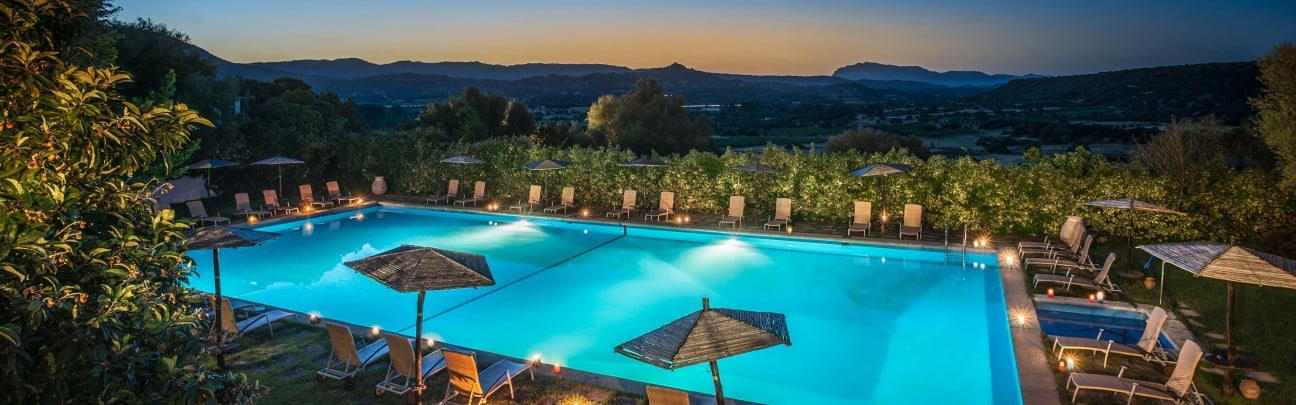
Supramonte as Setting: Why Interior Sardinia Produces a Different Kind of Hotel
Most visitors to Sardinia arrive with the coast in mind: the Emerald Coast's granite outcrops, the clear shallows of Villasimius, the summer crowds that turn Cagliari's port into a holding pattern. The interior is a different proposition entirely. The Supramonte massif, a limestone and dolomite formation rising above Oliena in the Nuoro province, defines one of the least-trafficked corners of the western Mediterranean: sparse, severe, and quietly spectacular. Hotels that operate against this backdrop tend to be shaped by it rather than despite it, and Su Gologone, sitting at the foot of those spiky peaks, belongs firmly to that tradition.
The property is a 4-star hotel in Oliena, with a Michelin Selected designation in the 2025 hotel guide.
Architecture of Accumulation: How the Spaces Work
The design logic at Su Gologone is accumulative rather than singular. Whitewashed walls function as a neutral ground against which Sardinian colour asserts itself: the bright textile traditions of Nuoro province, the ceramic work, the handwoven textiles that have defined Barbagia craft production for centuries. This is not museum-style display. The works are in the rooms, on the walls, in the functional objects. Regional artists have contributed directly to the interior, which means the collection grows with the hotel rather than being fixed at a single curatorial moment.
Italy has a tradition of hotels that treat their physical space as an argument about where they are. Castello di Reschio in Lisciano Niccone makes a similar move with Umbrian craft and architectural restoration. Castel Fragsburg in Merano leans into Tyrolean identity through its setting and materials. Su Gologone belongs in that grouping: hotels where the design is a form of position-taking about local culture, not an exercise in generic luxury signalling. The whitewash-and-craft combination avoids the more common Mediterranean hotel trap of decorative regionalism, where local motifs become surface ornament. Here, the textile and ceramic traditions of Barbagia are structural to the aesthetic, not applied to it.
The gardens extend the logic outdoors. Structured art classes are available on-site, and guests can work en plein air facing the Supramonte.
The Kitchen's Position in the Island Tradition
Sardinian cooking occupies a specific place in Italian food geography. It shares the broader Italian emphasis on ingredient quality and regional specificity, but draws on a pastoral tradition that diverges sharply from the coastal and agricultural patterns of the mainland. Pork from the Barbagia highlands, sheep's milk cheeses, bread traditions with no direct parallel elsewhere in Italy, and a wine culture centred on Cannonau and Vermentino: these are not minor regional variations but genuinely distinct culinary forms.
The hotel's kitchen is run within a family framework, with dishes prepared according to the approach of the family matriarch and served on a terrace that looks out over the Supramonte terrain. The format is consistent with how serious Sardinian cooking has historically been transmitted: through household tradition rather than professional kitchen lineage. Sardinian wine features alongside the food, which at this altitude and location means Cannonau from the Nuoro province with the kind of provenance clarity that matters to guests who arrive knowing something about the island's viticulture.
Where Su Gologone Sits in the Italian Hotel Field
Italy's independent hotel sector has fragmented into several recognisable types. At one end: urban palazzo conversions with international clientele, high-production design, and branded-restaurant anchors. Properties like Portrait Milano in Milan or Passalacqua in Moltrasio operate in that mode. At another: coastal resort properties that lead with beach access and pool infrastructure, from Borgo Santandrea on the Amalfi Coast to JK Place Capri and Il San Pietro di Positano. And at another: place-rooted rural or mountain properties where the surrounding terrain and local culture are the primary product, with hospitality structured around them.
The hotel belongs to that third group. Properties in this category, including Bellevue Hotel and Spa in Cogne, Borgo San Felice Resort in Castelnuovo Berardenga, and Corte della Maestà in Civita di Bagnoregio, tend to attract guests who have moved past destination-agnostic luxury and want a stay that could not be replicated in another location. The hotel's proposition is specifically Sardinian, specifically Barbagia, and specifically tied to the Supramonte in a way that makes its Michelin Selected status a signal of cultural coherence as much as physical comfort.
For travellers building a broader Italian itinerary, it pairs logically with properties that share a similar commitment to local specificity. Casa Maria Luigia in Modena works from a comparable premise in Emilia-Romagna, as does Il Pellicano in Porto Ercole along the Tuscan coast. Grand Hotel Tremezzo in Tremezzo and Il Sereno in Torno demonstrate what the Lake Como equivalent of place-specific design looks like, while Savoia Excelsior Palace Trieste shows the Adriatic counterpart.
Planning a Stay
The hotel is located at Località the hotel outside Oliena, accessible by car from Nuoro in roughly twenty minutes. Reservations are recommended. Art classes and garden access are part of the in-house programming, so building time into the itinerary for the property itself, rather than treating it purely as a base for day trips, is consistent with how the hotel operates.
Fast Comparison
Comparable venues nearby, for context on price, style, and recognition.
| Venue | Cuisine | Price | Awards | Notes |
|---|---|---|---|---|
| Su GologoneThis venue — the venue you are viewing | Countryside resort blending Sardinian tradition with artistic expression | $$$$ | 4-Star | Not listed |
| Boutique Hotel Torre di Cala Piccola | Contemporary boutique retreat blending modern design with traditional Italian charm and Tuscan heritage elements. | $$$$ | 4-Star | Cala Piccola, Monte Argentario |
| Palazzo Arone dei Baroni di Valentino | Historic aristocratic residence turned boutique B&B | $$$$ | 4-Star | Palermo Historical Center |
| Villa Le Barone | Historic Tuscan manor house blending 16th-century authenticity with refined luxury, maintaining period character while offering modern comfort. | $$$$ | 4-Star | Panzano in Chianti |
| Palazzo Marziale | Historic family-owned palazzo turned luxury boutique hotel | $$$$ | 4-Star | Sorrento City Centre |
| Seehotel Ambach | 1970s modernist Gesamtkunstwerk embedded in the landscape like a ship on the lake shore | $$$$ | 4-Star | Campi al Lago |
Recognition history
Dated appearances from independent guides and award organizations, with the underlying list record or original source where available.
Mr & Mrs Smith Smith Seal of Approval
Mr & Mrs Smith
Michelin Selected
Michelin
Continue exploring
More in Oliena
Restaurants in Oliena
Browse all →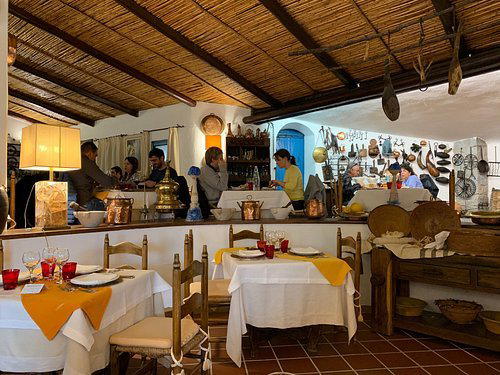
At a Glance
- Rustic
- Romantic
- Scenic
- Cozy
- Romantic Getaway
- Wellness Retreat
- Weekend Escape
- Panoramic View
- Terrace
- Historic Building
- Pool
- Spa
- Fitness Center
- Concierge
- Restaurant
- Wi Fi
- Mountain
- Garden
- Pool
- Spa
- Fitness Center
- Concierge
- Restaurant
- Wi Fi
Rustic charm with whitewashed walls, lively textiles, handcrafted pottery, and lantern-lit outdoor dining under olive trees.