


On the island of Yao Noi in Phang Nga Bay, Six Senses operates 56 villa-style rooms with private infinity pools against a backdrop of limestone karsts rising from calm water. The property earned 2 Michelin Keys in 2024 and a 96.5-point score from La Liste in 2026, placing it firmly in Thailand's upper tier of design-led, low-density resorts. The journey in — luxury car to motorboat from Phuket Airport — sets the register before you arrive.
 Discover on Pearl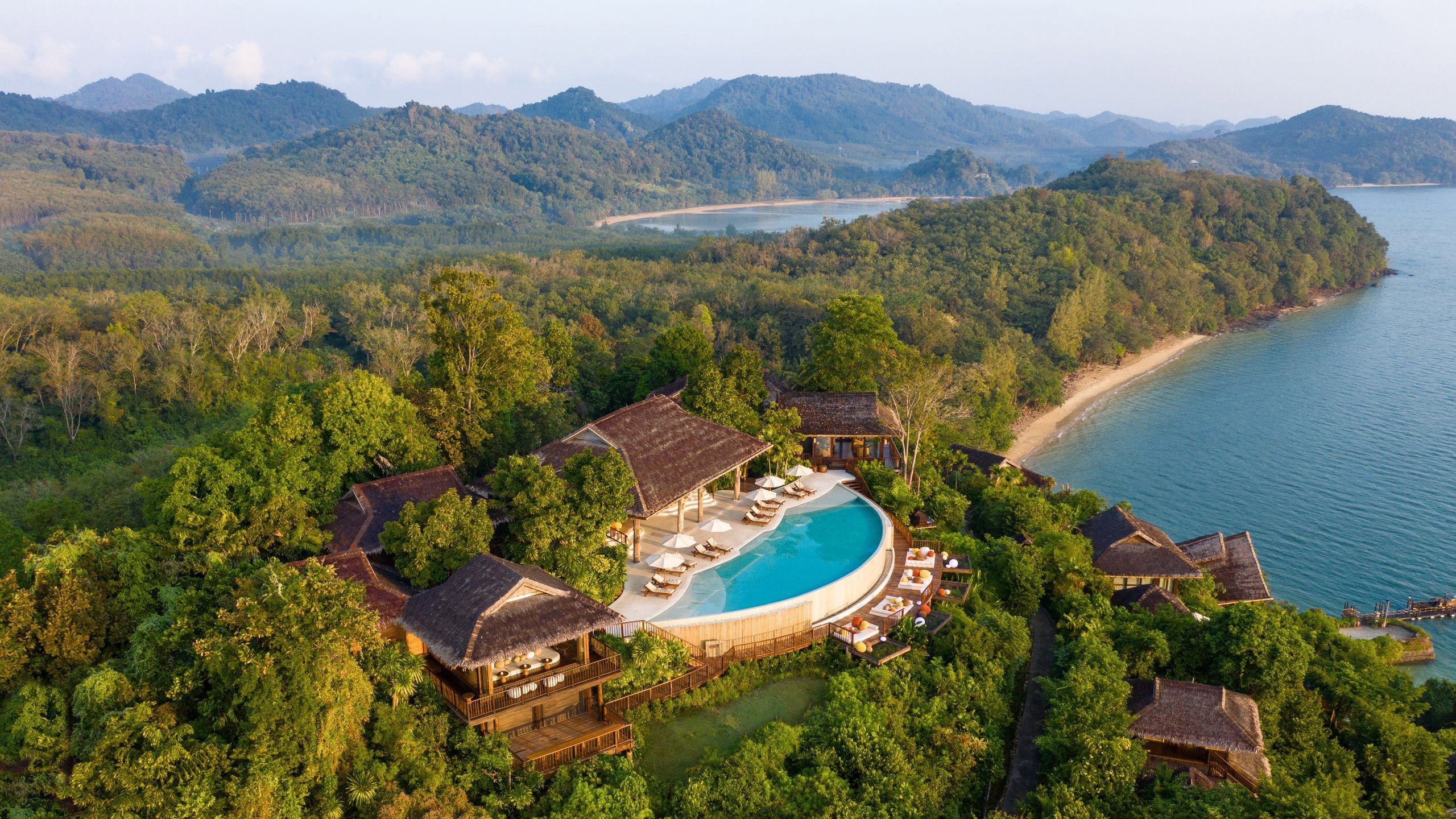
Phang Nga Bay and the Logic of Deliberate Distance
There is a category of Thai resort that earns its premium not from proximity to infrastructure but from strategic removal from it. Yao Noi operates on that logic. The island sits inside Phang Nga Bay, roughly equidistant from Phuket and Krabi, surrounded by the limestone karst formations the bay is known for — vertical rock columns rising from flat water, the visual shorthand for a certain kind of Southeast Asian grandeur. Phuket is close enough to reach in an hour, far enough that its congestion and commercial density don't register. That gap is not incidental. The island's low development profile is what makes the bay views coherent and the water calm, and Six Senses Yao Noi is positioned to hold that advantage for as long as Yao Noi itself does.
The arrival sequence matters here. The transfer from Phuket International Airport combines a luxury car ride with a motorboat crossing — approximately 60 minutes total , and functions as a decompression corridor as much as a logistical step. By the time the karsts are visible from the water, the resort has already made its first impression. This kind of designed arrival is common at the leading end of Thai island hospitality, and Six Senses executes it without visible effort, which is precisely the point.
The shortlist, unlocked.
Hard-to-book tables, cellar releases, and concierge-planned trips.
Get Exclusive Access →What a Score of 96.5 Points Signals in This Market
Thailand's premium resort market has consolidated around a handful of recognisable groups , Aman, Four Seasons, Anantara, and Six Senses among them , while a smaller cohort of independent properties operates in the same price territory with fewer keys and tighter editorial identity. Six Senses Yao Noi sits within the group tier but behaves like the independent cohort: 56 villas, a spa program with genuine depth, and a location that resists commodification. The 96.5-point score awarded by La Liste in 2026 places it among the highest-rated hotels in Thailand and signals recognition that goes beyond regional reputation. The 2024 Michelin 2 Keys award adds a separate credential from a different evaluative framework, and the two together suggest consistent performance across the metrics that matter to high-end travellers. Google reviews reflect 4.7 stars from 717 ratings, a sample large enough to carry weight.
Within Phang Nga specifically, the property occupies a different competitive register from properties like The Sarojin Thailand (also Michelin 2 Keys) or Iniala Beach House and Aleenta Resort & Spa, Phuket. Each property interprets the bay differently; Six Senses brings group infrastructure and a global spa methodology to a location that could otherwise support a more stripped-back product. The combination gives guests operational reliability alongside genuine remoteness.
The Villas: Traditional Exterior, Contemporary Interior
Thai resort architecture at this level has settled into a recognisable grammar: thatched rooflines, open-sided sala structures, materials that reference local building traditions without replicating them literally. Six Senses Yao Noi follows this grammar on the outside , thatched roofs, natural textures , and then places contemporary interiors within. Private sun decks and infinity-edge pools face the bay; bathrooms include indoor-outdoor shower configurations that use the physical environment as a design element rather than just scenery. Satellite television and DVD players are present as baseline amenities, though the setting is clearly structured to make the room itself less the point than the view from it.
Fifty-six villas is a meaningful number. It is enough to support full-service infrastructure , multiple dining options, a full spa, activities programming , without tipping into the operational scale where individual attention becomes difficult. Properties with fewer than 20 keys often feel more personal but may underdeliver on service breadth; properties with more than 100 feel more like hotels and less like island retreats. The mid-50s range represents a considered position in that spectrum, and it is one that several of Thailand's high-performing resorts have settled on. For comparison, Amanpuri in Phuket operates around 40 suites and pavilions and sets the regional template for low-density luxury; Six Senses Yao Noi is slightly larger but operates with similar intent.
Service Architecture: Anticipation as the Operating Standard
Six Senses as a group has built its brand identity around a wellness and service philosophy that treats anticipation as its primary mode. At Yao Noi, this plays out in the gap between what a guest requests and what arrives before they have to ask. The mechanisms behind this , staff-to-guest ratios, pre-arrival profiling, GEM (Guest Experience Maker) programs common across the Six Senses network , are less visible than their outcomes. The outcome is a guest experience where the environmental isolation, which might otherwise produce friction, instead produces calm.
This model places Six Senses in a different service tradition from properties where personalisation is handled at the room level through technology. The Six Senses approach is more human-capital intensive and depends on staff training depth. It is the same philosophy at work whether the property is in Bhutan, the Maldives, or Phang Nga Bay, and the consistency is what justifies the group's expansion without dilution. In a region where the distance from infrastructure is real , there is no hospital on Yao Noi, no airport, no high street , the staff's ability to solve problems before guests encounter them is not a luxury add-on; it is structural to the offer. Properties like Soneva Kiri in Trat operate on a comparable model in a similarly remote Thai island setting, where service depth compensates for geographic isolation.
The Spa and Wellness Program
Across the premium Thai resort market, spa quality varies less in philosophy and more in execution. Branding distinctions between major spa programs are largely marketing constructs; what differentiates a top-tier spa in practice is the skill level of individual therapists and the physical environment in which treatments are delivered. Six Senses has built considerable credibility in this area by treating the spa as an anchor offering rather than a supplementary amenity. At Yao Noi, the spa benefits from the same environmental conditions that make the villas compelling: the bay views, the natural materials, the physical quiet. Whether the specific treatment menu is a differentiator from peer properties , Four Seasons Resort Chiang Mai, Phulay Bay, A Ritz-Carlton Reserve in Krabi , is a question of personal preference, but the physical setting and operational consistency are harder to replicate.
Planning a Stay: Getting Here and When to Come
The most direct routing is through Phuket International Airport, from where the resort arranges a combined car and motorboat transfer of approximately 60 minutes. The dry season months from November through April align with the calmest sea conditions and clearest visibility in Phang Nga Bay , the leading window for experiencing the limestone karst landscape at its most legible. The bay's sheltered geography means conditions are generally more stable than the open Andaman coast, but shoulder-season travel (May or October) is viable for travellers who want lower occupancy in exchange for occasional rainfall. Room availability data was not confirmed at time of publication, so direct contact with the property is necessary for current pricing and booking windows. Those planning the broader region should consult our full Phang Nga hotels guide, full Phang Nga restaurants guide, and full Phang Nga experiences guide.
Further afield, the wider Thailand circuit connects logically to properties including Mandarin Oriental Bangkok as an urban base before or after the island leg, and Anantara Golden Triangle in Chiang Rai or Pimalai Resort & Spa in Koh Lanta for those extending the trip into different terrain. Other regional comparisons worth considering include Samujana Villas in Koh Samui, Anantara Rasananda Koh Phangan Villas, Anantara Layan Phuket Resort, and Cape Kudu Hotel in Phang Nga Province. For those building a longer itinerary with a different starting point, Aleenta Resort & Spa, Hua-Hin in Pranburi and Anantara Hua Hin Resort & Spa offer credentialed alternatives on the Gulf coast. The full Phang Nga bars guide and full Phang Nga wineries guide are available for those extending their research into the broader provincial offer.
The shortlist, unlocked.
Hard-to-book tables, cellar releases, and concierge-planned trips.
Get Exclusive Access →Frequently Asked Questions
Cuisine and Recognition
A fast peer set for context, pulled from similar venues in our database.
| Venue | Cuisine | Awards | Notes |
|---|---|---|---|
| Six Senses Yao Noi | Michelin 2 Keys, La Liste Top Hotels: 96.5pts | This venue | |
| The Sarojin Thailand | Michelin 2 Key | Michelin 2 Keys | |
| Aleenta Resort & Spa, Phuket | |||
| Iniala Beach House |
Preferential Rates?
Our members enjoy concierge-led booking support and priority upgrades at the world's finest hotels.
Get Exclusive AccessThe shortlist, unlocked.
Hard-to-book tables, cellar releases, and concierge-planned trips.
Get Exclusive Access →