Scarista House
Scarista House sits on the Atlantic edge of the Isle of Harris, a small Georgian house turned guest accommodation where the dining room faces one of Scotland's most exposed and least-visited coastlines. The kitchen draws on the immediacy of its location, and the stillness of the setting shapes the whole experience. For travellers willing to reach it, the journey itself reframes what a hotel stay can mean.

Pearl is the En Primeur Club membership app, where members save venues, book tables and use the concierge.
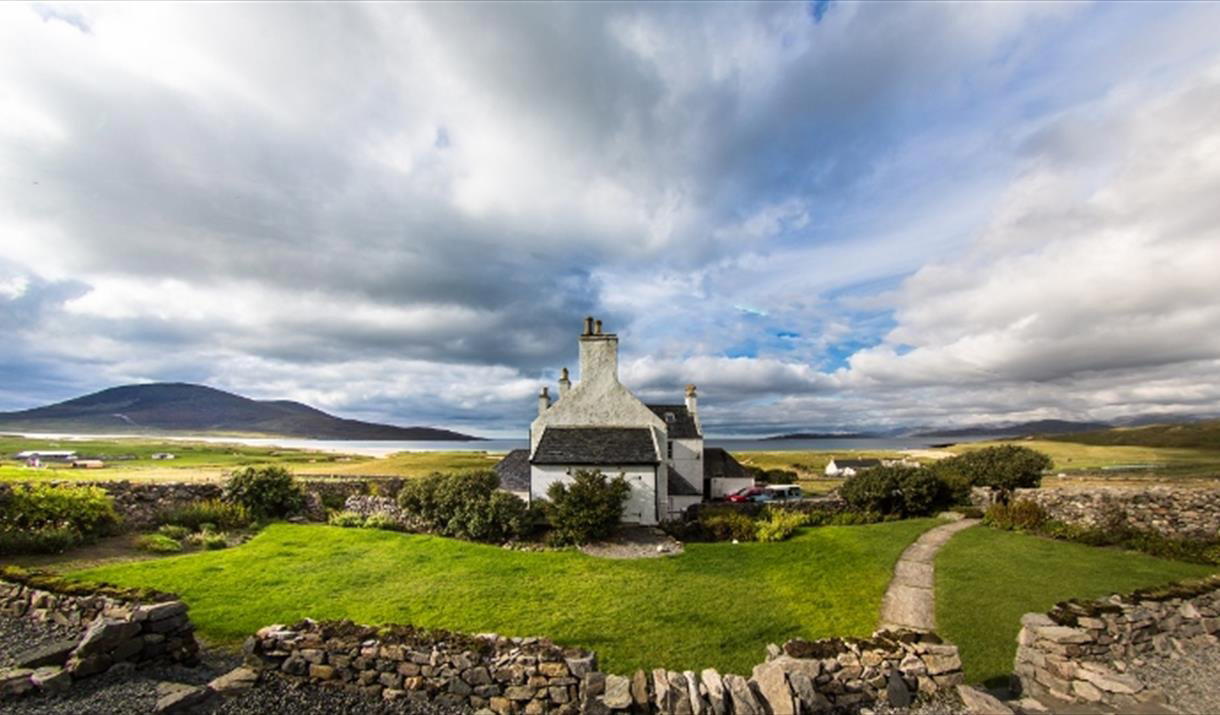
Where Harris Ends and the Atlantic Begins
The western coast of the Isle of Harris is one of the least populated stretches of land in the British Isles. The road narrows, the machair grassland opens toward the shore, and the horizon becomes an unbroken line of ocean. Scarista House sits in this geography not as a destination imposed upon the landscape but as something that has grown alongside it: a Georgian manse converted into a small guesthouse, its white facade visible against the hills long before you reach it. The approach alone establishes what kind of stay this will be.
Harris belongs to Na H-Eileanan An Iar, the Outer Hebrides council area, and occupies a specific position in Scotland's accommodation map. It lies beyond the ferry crossing from Ullapool or the causeway routes through Lewis, and that distance functions as a filter. The guests who arrive at Scarista have, by definition, made a deliberate journey. That self-selection shapes the atmosphere in ways that no amount of interior design can manufacture. Properties at this latitude and remoteness, like Langass Lodge further north on North Uist, operate inside a hospitality category defined less by brand affiliation than by the quality of local knowledge and the sincerity of welcome.
The Dining Programme: Kitchen at the Edge of the Map
In the British country house hotel tradition, the dining room is rarely a secondary consideration. At properties of Scarista's scale and remoteness, it becomes the gravitational centre of the stay. When the nearest town of any size is Tarbert, roughly twelve miles to the north, and the next ferry back to the mainland doesn't leave until morning, the kitchen absorbs an outsized amount of the guest's attention and trust.
The supply logic of Harris cooking is worth understanding as context. The island sits within reach of some of the North Atlantic's most productive shellfish grounds. Harris langoustines, crab, and sea urchin move through local fishing operations in volumes that larger mainland kitchens can only access through multi-step supply chains. A kitchen positioned here, cooking for a small number of covers, can work with that produce at a level of freshness and specificity that would be structurally impossible in a city restaurant. The same logic applies to lamb raised on the rough pasture of the hills above Scarista beach. This is not a locavore positioning statement; it is a practical reality of cooking at the edge of the map.
Small country house hotels across the British Isles have pursued this argument to varying degrees of success. Monachyle Mhor Hotel in Stirling has built a well-documented identity around estate-sourced produce and loch-edge setting. The Newt in Somerset has scaled the same argument into a broader estate operation. Scarista works at the opposite end of the size spectrum, where the intimacy of the kitchen-to-table relationship is a structural feature rather than a marketing claim.
The dining room at a property of this nature also carries the full weight of the evening. With no village pub to walk to and the beach serving as the primary entertainment after dark, dinner becomes an extended event by necessity. That format, long and unhurried, is one that larger hotel restaurants try to manufacture and smaller remote ones inherit naturally.
The Setting as Amenity
Scarista beach, directly in front of the house, is one of the Hebrides' least-visited Atlantic strands. The sand is white and the water, on clear days, reads as a blue that most visitors associate with warmer latitudes. The light in the Outer Hebrides at midsummer doesn't fully darken until past eleven at night, which extends the usable hours of the landscape considerably. For guests arriving in late spring or early summer, this is one of the stay's defining conditions rather than incidental detail.
The broader Harris landscape, a combination of ancient Lewisian gneiss, open moorland, and coastal machair, has been drawing landscape painters, writers, and bird watchers for generations. The Outer Hebrides hold one of the densest concentrations of designated nature sites in the United Kingdom, and the coastal area around Scarista falls within that protected geography. For stays built around walking, the territory immediately accessible from the guesthouse is extensive and, by mainland standards, empty.
Properties in this tier of remote Scottish hospitality, which would include Dun Aluinn in Aberfeldy and Burts Hotel in Melrose at a different scale and geography, share a common characteristic: the natural environment is not a backdrop but an active component of the stay's value. The contrast with urban hotels, whether Malmaison Edinburgh or Glasgow Grosvenor Hotel, is absolute and intentional.
Planning the Stay
Getting to Harris requires advance planning in a way that travel to most British destinations does not. The primary ferry route runs from Ullapool on the Scottish mainland to Stornoway on Lewis, from where Harris is reached by road heading south. A second CalMac route connects Uig on Skye to Tarbert directly. Both crossings require vehicle booking, particularly in summer when availability narrows considerably, and weather can affect sailings. Flying into Stornoway from Inverness or Edinburgh is an alternative that reduces surface travel time but still leaves a road journey to the south of Harris.
The season matters. The Outer Hebrides are accessible year-round but the window of reliable weather for coastal walking and daylight dining sits between late April and September. Outside that period, the island is quieter, the light is shorter, and the Atlantic weather more assertive. Travellers who have experienced remoter Scottish island stays, including those who know Ardbeg House on Islay or Hell Bay Hotel on Bryher, will calibrate expectations accordingly.
Booking directly through the guesthouse is the standard approach for properties of this type, where third-party platforms often lag behind on availability. The small scale of the operation means rooms fill early for the high season months, and enquiring several months ahead is the practical approach rather than an abundance of caution. For travellers comparing this type of stay against more conventional hotel formats, our full Na H Eileanan An Iar guide maps the range of accommodation across the islands.
Budget and Context
| Venue | Price | Awards |
|---|---|---|
| Scarista HouseThis venue (the venue you are viewing) | $300–500 | Not listed |
| Lime Wood | Not listed | 2 Michelin Keys · La Liste Top Hotels |
| Muir, A Luxury Collection Hotel, Halifax | $300–500 | 1 Michelin Key · Forbes 4-Star |
| Raffles London at The OWO | $1,000–1,500 | 3 Michelin Keys · World's 50 Best #28 |
| The Connaught | $1,000–1,500 | 3 Michelin Keys · World's 50 Best #49 |
Continue exploring
More in Na H Eileanan An Iar
Hotels in Na H Eileanan An Iar
All hotels in Na H Eileanan An Iar →
Restaurants in Na H Eileanan An Iar
Browse all →
Wineries in Na H Eileanan An Iar
Browse all →
Details
- Romantic
- Quiet
- Classic
- Elegant
- Intimate
- Scenic
- Romantic Getaway
- Weekend Escape
- Family Vacation
- Waterfront
- Historic Building
- Panoramic View
- Private Dining
- Garden
- Beach Access
- Waterfront
- Mountain
Relaxed elegance with open fires in library and drawing room, intimate dining rooms, and access to usually deserted sandy beaches opposite the property.