Rosewood Miyakojima

Rosewood's first Japanese property occupies the remote northwest coast of Miyako-jima, where 55 private-pool villas face a crescent of white sand and coral sea. Interiors draw on Ryukyu stone, pale woods, and understated bronze to translate the archipelago's material heritage into a contemporary register. The property positions itself in the small-keys, design-led tier of Japan's luxury resort market.
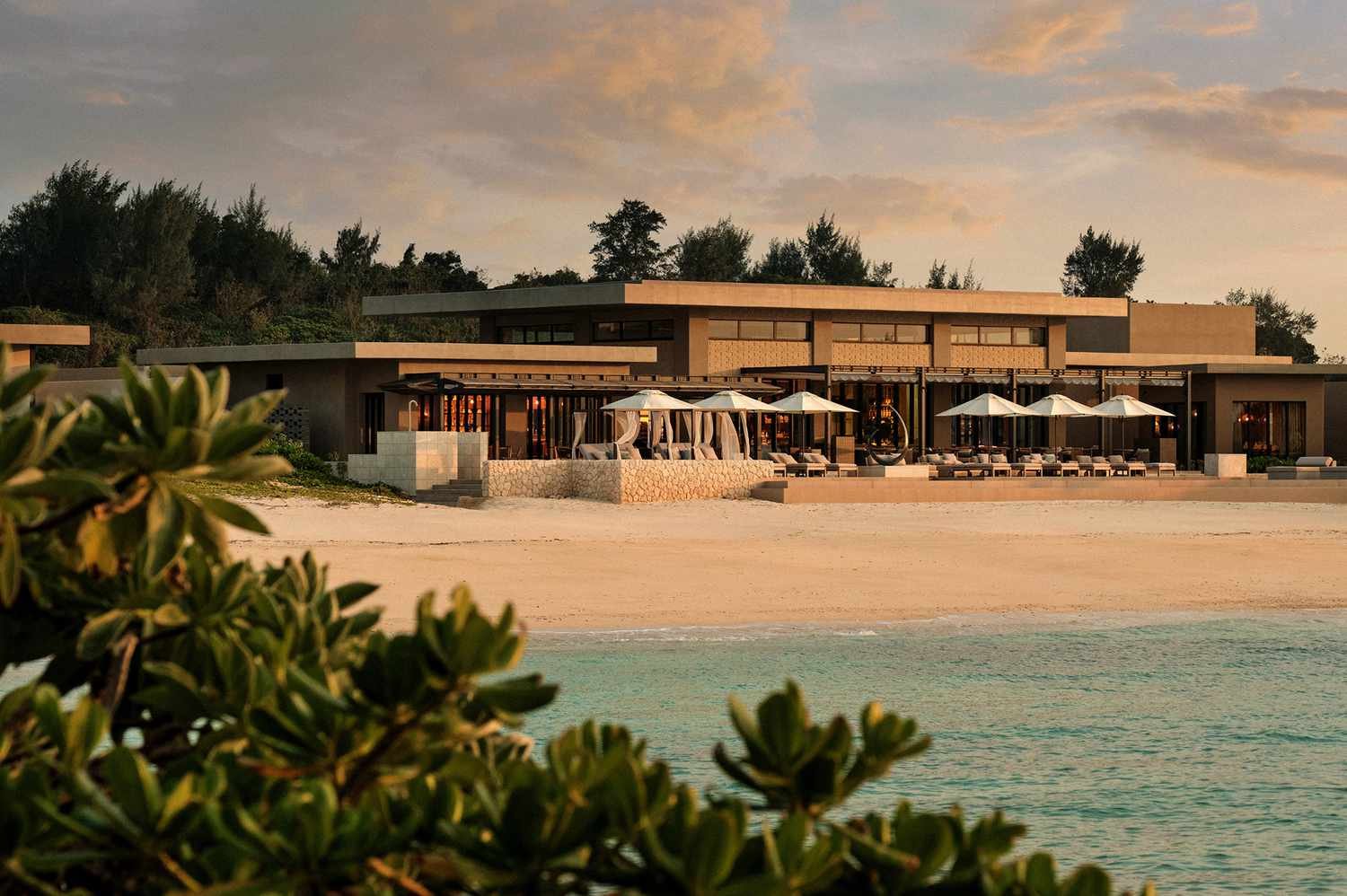
Where the Ryukyu Archipelago Meets International Resort Standards
The northwest coast of Miyako-jima receives fewer visitors than the island's more photographed eastern beaches, which is precisely the point. The approach to Rosewood Miyakojima — across a low coastal road where salt grass gives way to open sea — sets expectations before the lobby does. This is not a resort that competes on proximity to town or ease of access. It competes on the quality of what it places between the guest and the horizon.
Japan's premium resort category has split decisively in recent years. One tier consolidates under large international flags, maximising keys and amenity breadth. A smaller tier, the one that includes properties like Amanemu in Mie and Zaborin in Hokkaido, deploys limited inventory, site-specific materials, and a slower operational tempo as its primary distinctions. Rosewood Miyakojima, with 55 villas, sits in that second cohort. Its competitive references are not the large Okinawa resort hotels , a different market altogether , but other small-footprint properties designed around a particular landscape and cultural inheritance.
Ryukyu as Design Language
The Ryukyu Kingdom's material culture is not a decorative detail here; it functions as the structural logic of the interiors. Ryukyu stone baths, soft-toned textiles, pale woods, and understated bronze touches are consistent throughout the 55 villas rather than concentrated in public spaces where guests are most likely to notice them. That distribution matters: it signals a design programme applied with discipline rather than deployed selectively for first impressions.
Each villa carries a private pool, which in the context of Miyako-jima's year-round warmth and the property's coastal position is less an amenity and more a spatial given. The coral sea visible from the northwest coast carries the particular blue-green of shallow Okinawan waters, a function of reef depth and water clarity that no design decision can replicate or substitute. The resort's placement on this specific stretch of coast is its most consequential asset.
For context on how other Miyakojima properties handle the relationship between accommodation and natural setting, Hotel Shigira Mirage, Shigira Bayside Suite Allamanda, and The Shigira each represent different points on the scale between resort-complex scale and boutique restraint. The full picture is in our Miyakojima hotels guide.
The Dining Position
Rosewood's dining programmes across its Asian portfolio have tended to anchor around a strong local culinary identity rather than importing celebrity names. The Miyakojima property draws on a food culture that is among Japan's most distinctive regional traditions: Okinawan cuisine reflects Chinese, Southeast Asian, and Japanese influences accumulated across centuries of Ryukyu trade routes, producing a table defined by bitter melon, awamori spirit, sea grapes, and slow-braised pork preparations that bear little resemblance to mainland washoku.
The island itself is a modest dining destination by Japan's metropolitan standards. There are no Michelin-starred establishments in Miyakojima, and the local restaurant scene is characterised by small, family-run operations serving Okinawan standards at modest price points. A resort property at Rosewood's tier therefore plays a particular role: it functions as the primary fine-dining reference for guests who are on the island specifically to disconnect from the rhythms of Tokyo or Osaka. The expectation at this level is that the food and beverage programme can hold a guest's attention for multiple consecutive evenings without requiring excursions into town.
That dynamic is worth noting for itinerary planning. Guests staying three or more nights will likely rely on the in-house programme for the majority of their meals. Our Miyakojima restaurants guide covers the external dining options worth the trip, but on this part of the island, proximity to the resort's own kitchens is the practical reality.
Among the broader Japanese luxury hotel set, the properties that have made the strongest dining argument are typically those with defined culinary identities rather than broad international menus. HOTEL THE MITSUI KYOTO and Gora Kadan in Hakone both operate in that mode, using kaiseki tradition and local ingredient sourcing as the organising logic for their food programmes. Whether Rosewood Miyakojima pursues a similar Ryukyu-specific culinary identity or takes a more internationally calibrated approach is a question the property's specific menus will answer over time.
Positioning Within the Rosewood Network
Rosewood Miyakojima represents the brand's first foothold in Japan, which carries weight in a market where international hotel groups have often struggled to find the right calibration between global standards and local expectation. Japan's high-end traveller, both domestic and international, measures luxury resorts against a very specific internal benchmark: the traditional ryokan at its most refined. Properties like Asaba in Izu and Nishimuraya Honkan in Kinosaki-cho define that standard , ritualised service, architecture that disappears into landscape, food that is a direct expression of place.
Rosewood does not attempt to replicate the ryokan format, and attempting to do so in Miyakojima, which has its own distinct Ryukyu rather than mainland Japanese heritage, would be architecturally and culturally misaligned. The property instead applies the brand's design-hotel logic to a Ryukyu material vocabulary, positioning itself closer to the international resort category while using local heritage as its differentiator. That is a defensible position, particularly on an island where the alternative luxury references are large resort complexes rather than intimately scaled heritage properties.
For comparison with how the brand performs in other international markets, Aman New York and Bvlgari Hotel Tokyo illustrate how different international luxury brands handle the Japan and New York luxury questions, respectively. The full picture of what Japan's design-led luxury tier now encompasses runs from urban addresses like HOTEL THE MITSUI KYOTO to island properties like Jusandi in Ishigaki, each making different arguments about what Japanese luxury hospitality can be.
Planning a Stay
Miyakojima is accessible via direct flights from Tokyo, Osaka, and Naha, with Miyako Airport sitting roughly in the island's centre. The northwest coast, where the resort sits, requires onward ground transfer from the airport; the island is compact enough that the journey is short, but guests should arrange transfers in advance given the property's remote coastal position. Okinawa's climate makes the March-to-May window and October-to-November period the most reliable for combining water clarity with moderate temperatures; the July-to-September typhoon season carries real disruption risk for any island itinerary in this part of the Pacific. Availability at 55 keys moves quickly for peak dates, and this is not a property where walk-in flexibility is a realistic option. Plan a minimum of three nights to justify the travel investment and allow the pacing of the property to register properly.
For broader Miyakojima planning beyond accommodation, our bars guide, wineries guide, and experiences guide cover what the island offers beyond the resort perimeter. Halekulani Okinawa provides a useful comparison point for those weighing Miyakojima against Okinawa's main island for a similar calibre of stay.
Frequently Asked Questions
- What is the standout thing about Rosewood Miyakojima?
- The property's position on the remote northwest coast of Miyako-jima is its most consequential characteristic. With 55 villas facing open coral sea, it operates in the small-inventory, design-led tier of Japan's luxury resort market, using Ryukyu stone, local textiles, and site-specific materials to ground an international hospitality standard in a distinct regional heritage. As Rosewood's first Japanese property, it also carries significance within the brand's Asia-Pacific development.
- What is the leading suite at Rosewood Miyakojima?
- Specific villa and suite categories with individual room details are not confirmed in current available data. The property operates 55 villas, each with private pools and Ryukyu stone baths, which suggests a consistent floor standard across the inventory rather than a sharp tiering between room types. For current availability and room-category specifics, direct enquiry to the property is the appropriate route.
- What is the leading way to book Rosewood Miyakojima?
- Given that no rooms are currently listed as available through standard booking channels, direct contact with the Rosewood reservations team is the practical approach. For a property of this scale and remote location, booking well in advance of intended travel dates is advisable, particularly for peak Okinawan travel windows in spring and autumn. A travel specialist with Rosewood access can often surface allocations that do not appear through public-facing channels.
- How does Rosewood Miyakojima handle the Ryukyu cultural heritage in its food and beverage programme?
- Okinawan cuisine sits apart from mainland Japanese food traditions, shaped by centuries of Ryukyu trade with China and Southeast Asia and characterised by ingredients like bitter melon, awamori, and sea grapes. A property at this tier on a relatively isolated island serves as the primary dining reference for most guests across multi-night stays, which means the food and beverage programme carries more operational weight than it would at an urban property. The resort's use of Ryukyu materials throughout its interiors suggests the same regional specificity is the intended direction for its culinary identity.
Price and Positioning
A quick look at comparable venues, using the data we have on file.
| Venue | Price | Awards | Notes |
|---|---|---|---|
| Rosewood Miyakojima | Price: No rooms available Rooms: 55 Rooms On the remote northwest coast of Miyako-jima, Rosewood’s first Japanese property is set across a crescent of white sand and coral sea. Its 55 villas are expansive yet finely detailed, with private pools, Ryukyu stone baths, and interiors defined by soft-toned textiles, pale woods, and understated bronze touches. Inspired by the history of the Ryukyu archipelago, the resort feels far from the mainland in more ways than one, a place where salt air, slow rituals, and silence are part of the design. | This venue | |
| Hotel Shigira Mirage | |||
| Shigira Bayside Suite Allamanda | |||
| The Shigira |
Preferential Rates?
Our members enjoy concierge-led booking support and priority upgrades at the world's finest hotels.
Access the Concierge