One&Only Cape Town





One&Only Cape Town transforms two private islands at the V&A Waterfront into South Africa's premier urban resort, where 131 redesigned rooms and suites frame Table Mountain views while Africa's only Nobu restaurant and the exclusive Spa Island redefine luxury hospitality in the Mother City.
 Discover on Pearl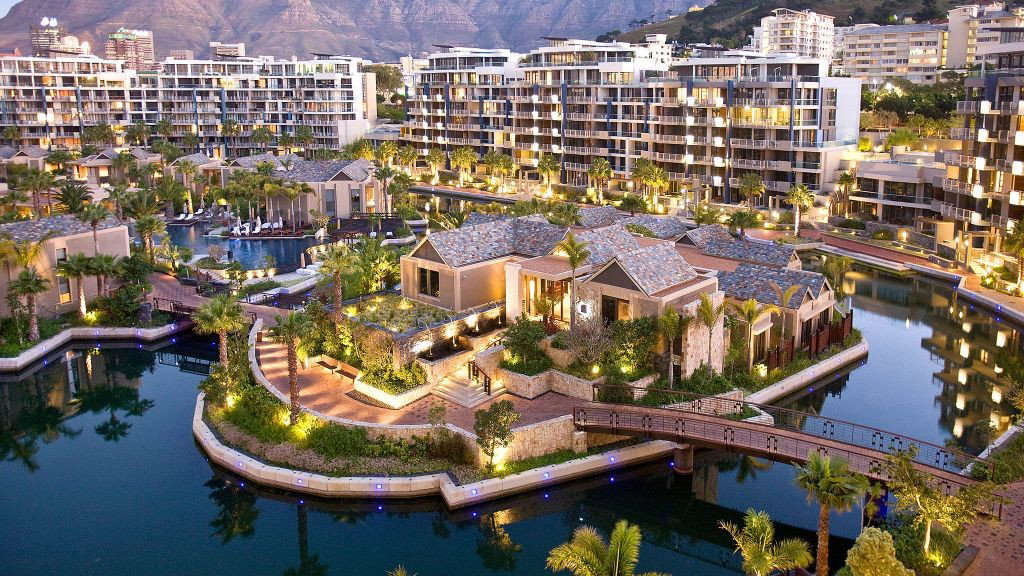
Architecture as Statement: The Physical Logic of One&Only; Cape Town
The approach to One&Only; Cape Town does a specific kind of work before you have checked in or ordered a drink. Positioned on Dock Road at the Victoria & Alfred Waterfront, the property occupies one of Cape Town's most spatially advantaged addresses: floor-to-ceiling windows frame Table Mountain directly, and the building's orientation means that relationship between glass and mountain face is not incidental but structural. The resort was conceived around that view as a fixed anchor, and the interior architecture organises itself accordingly. This is the first signal that the property belongs to a tier of Waterfront hotel that treats location not as backdrop but as load-bearing element of the design.
The physical footprint divides into two buildings connected across a central lagoon and an artificial island carrying palm-lined waterways, additional suites, and a spa facility accessed independently from the main structure. That island configuration is unusual among Cape Town's luxury hotels, which more typically compress amenities into a vertical stack. Here the horizontal spread across water creates a resort grammar closer to Maldivian or Southeast Asian models, transplanted to an urban harbour setting. The result is a property that reads simultaneously as city hotel and island retreat, a spatial tension that defines the guest experience throughout.
131 Rooms, Ranging from Functional to Architectural Event
With 131 rooms, One&Only; Cape Town sits at the smaller end of what would be considered a full-service luxury resort, but the range of accommodation formats within that count is wide. Standard rooms begin at approximately 650 square feet; the Lion's Head Penthouse reaches close to 3,000. That spread produces an accommodation hierarchy that functions almost as a separate property within a property at the upper end.
Contemporary art pieces and warm tonal palettes run through the rooms, and every category includes either Table Mountain or V&A; Marina waterway views from private balconies. The design vocabulary avoids the anonymous international luxury register that characterises many brand-operated properties in this price bracket. Two-Bedroom Family Suites connect via generous living spaces and offer both bedrooms private terraces with large bathrooms fitted with rain showers; the master configuration adds a soaking tub. Island Suites sit on the artificial island and look directly over the waterways or the infinity pool, giving them a degree of acoustic and visual separation from the main building that the Marina Rise rooms cannot match.
The Lion's Head Penthouse operates at a different scale altogether. Spread across two storeys with four bedrooms, two lounges, two television rooms, an indoor and outdoor dining configuration, a glass plunge pool on an outdoor terrace, a study, two bars, and a full kitchen with its own service entrance, it frames unobstructed panoramas covering Table Mountain, Robben Island, Devil's Peak, Lion's Head, the Cape Town Harbour, and the V&A; Waterfront simultaneously. Butler service is included. For guests arriving at that level of the property, the penthouse is less a room category than a private floor plan sitting above the rest of the resort.
Rates begin around $1,135 per night, placing the property firmly in the top tier of Cape Town hotel pricing. For context within the city's competitive set, properties such as Ellerman House, 21 Nettleton, and Cape Grace, A Fairmont Managed Hotel occupy adjacent price territory, each with distinct architectural and service propositions. Mount Nelson occupies a different neighbourhood register entirely, its colonial garden setting contrasting with the Waterfront's harbour energy. Camissa House and Compass House Boutique Hotel represent the smaller, more intimate end of the city's luxury accommodation spectrum. Delaire Graff Lodge anchors an entirely different geography, trading urban access for Stellenbosch vineyard positioning.
The Wine Loft and the Dining Configuration
Cape Town's broader hospitality culture has always treated wine seriously, given its proximity to Stellenbosch, Franschhoek, and the Swartland. One&Only; Cape Town's Wine Loft positions that priority architecturally: a three-storey tower housing 5,000 bottles, stocked with producers including Vergelegen Estate, Thelema Mountain Vineyards, and Eben Sadie. The Loft functions as both cellar and tasting destination, and its scale signals a commitment to the Cape's wine culture that goes beyond a standard hotel list. For guests arriving from wine-focused properties such as Babylonstoren in Paarl or the winelands estates, the Loft provides a point of continuity with that regional conversation.
The dining configuration at the property includes Nobu, the Japanese-fusion restaurant operated by Nobuyuki Matsuhisa, which is the only Nobu location on the African continent. The menu follows the format established across Nobu's global network, with black cod miso among the standard reference dishes, alongside preparations built around South African seafood. The continental exclusivity of the franchise here is a commercial and cultural fact worth noting: access to a Nobu restaurant without a long-haul flight to another continent is a practical differentiator for international guests routing through Cape Town. A separate restaurant by South African chef Reuben Riffel occupies the property alongside Nobu, offering locally grounded cooking that draws on the region's produce. The two restaurants cover distinct registers, and neither requires guests to leave the property for a serious dinner.
The Spa Island and the Activity Architecture
The spa occupies the artificial island as its own destination, positioned beside the waterways and the infinity pool, designed so that access involves a short transfer across water. Treatments combine local ingredients, including sweet orange and baobab-scented oils, with products from ESPA and Biologique Recherche. The separation of the spa from the main building is a design decision that carries operational weight: it creates a genuine transition between hotel and treatment, rather than the adjacent-corridor arrangement common to urban luxury properties.
Curated activity programme extends the property's reach considerably beyond its physical footprint. Table Mountain guided hikes use the property's location as a direct departure point. Stand-up paddleboarding runs through the marina waterways. Cage-diving excursions with great white sharks are offered as a high-intensity option. The KidsOnly clubhouse provides supervised programming for children across games, sports, crafts, and cooking, allowing parents to access the spa or other facilities independently. Airport transfers arrive in Mercedes vehicles, and the property has historically offered Maybach Zeppelin town car transfers as part of its ground transport offering.
Where One&Only; Cape Town Sits in the South African Luxury Picture
Within South Africa's premium accommodation tier, One&Only; Cape Town anchors the urban, high-service end of a market that extends across very different geographies. Safari properties such as Singita in Kruger National Park, andBeyond Kirkman's Kamp, andBeyond Ngala Safari Lodge, andBeyond Phinda Forest Lodge, and andBeyond Phinda Private Game Reserve represent a wilderness-first model that prioritises ecological immersion over urban access. Abelana River Lodge sits within the same bush-camp tradition. One&Only; operates from the opposite pole: dense amenity concentration, direct city access, and a brand infrastructure that includes international F&B partnerships and a scaled spa.
The 2026 La Liste Leading Hotels recognition at 94.5 points places the property within a small group of South African hotels receiving consistent international critical attention. A Google rating of 4.7 across 3,451 reviews suggests that the property's performance holds broadly across the full guest volume rather than representing only a narrow set of high-spend visitors. For guests planning itineraries that combine Cape Town with Johannesburg, AtholPlace Hotel & Villa offers a comparable level of boutique luxury in a northern city context. For the winelands extension, Akademie Street Boutique Hotel in Franschhoek and Erinvale Estate Hotel & Spa provide strong regional transitions from the Waterfront base.
For guests building a Cape Town programme around dining, drinking, and cultural experiences beyond the property itself, the V&A; Waterfront's walking-distance position gives access to one of the city's highest concentrations of restaurants and bars. Our guides to Cape Town restaurants, Cape Town bars, Cape Town wineries, and Cape Town experiences map the full picture, and our Cape Town hotels guide covers the competitive set in detail for those still deciding on a base. For guests comparing against properties in other major international cities, Aman New York, The Fifth Avenue Hotel, and Aman Venice represent the tier against which One&Only; Cape Town competes internationally.
Frequently Asked Questions
Peer Set Snapshot
A quick peer snapshot; use it as orientation, not a full ranking.
| Venue | Cuisine | Price | Awards | Notes |
|---|---|---|---|---|
| One&Only Cape Town | La Liste Top Hotels: 94.5pts | This venue | ||
| Taj Cape Town | ||||
| Mount Nelson | World's 50 Best | |||
| Delaire Graff Lodge | ||||
| Ellerman House | ||||
| The Cellars-Hohenort |
Preferential Rates?
Our members enjoy concierge-led booking support and priority upgrades at the world's finest hotels.
Get Exclusive Access