Hotel Principe Forte dei Marmi




A 28-room boutique hotel on the Versilia coast where Italian design, a Michelin-starred rooftop restaurant, and a private beach club form a coherent whole. Lux Lucis holds one Michelin star and one Michelin Key (2024), sommelier-curated in-room wine fridges signal the level of personalisation throughout, and a nearly 80-foot private yacht extends the property well beyond its address.
 Discover on Pearl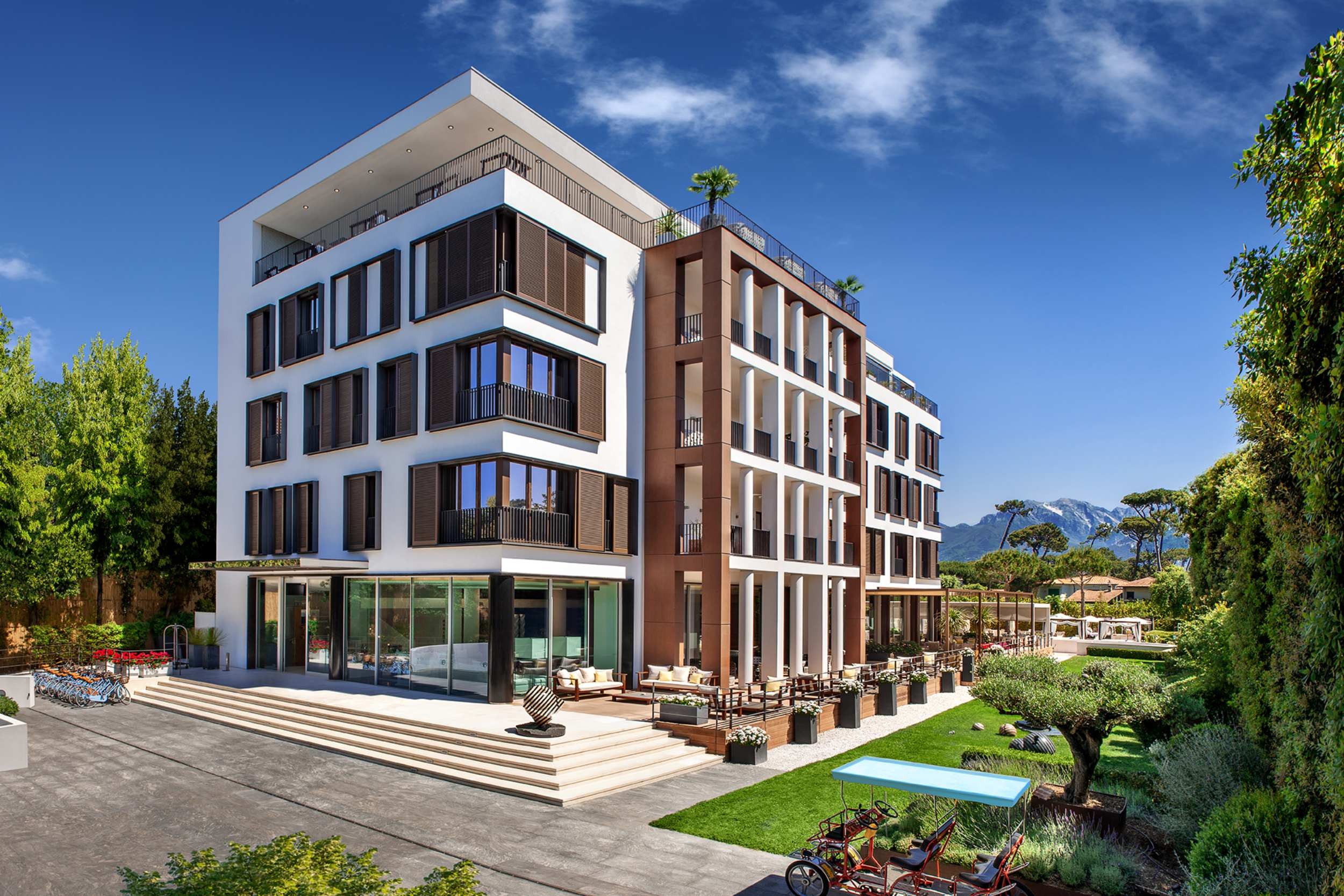
Where the Apuan Alps Meet the Tyrrhenian Sea
The approach to Forte dei Marmi sets expectations before you reach Viale Ammiraglio Morin. Pine-lined avenues give way to a low-rise townscape that has been drawing Milanese and Florentine money since the nineteenth century, when the marble quarries above Carrara were already financing summer retreats on this stretch of coast. The town has never gone fully commercial in the way that Rimini did, which is precisely why the hotels here compete on refinement rather than scale. Hotel Principe Forte dei Marmi sits inside that tradition: 28 rooms, glass-and-steel architecture that reads as contemporary against the surrounding Liberty-era villas, and a rooftop that frames both the sea and the alpine ridge behind it simultaneously.
The building's geometry does something intentional. Floor-to-ceiling glass on multiple elevations means that natural light reads differently hour by hour, and the visual connection between interior and exterior is maintained whether you are in the spa, the lobby, or your room. Italian design properties in this tier typically resolve the tension between minimalism and warmth through material selection, and Principe follows that logic: parquet flooring, marble bathrooms with glass walls, leather chairs, and earth-toned textiles signed by designers whose names appear in the furniture credits rather than in marketing copy. The effect is closer to a considered private residence than a hotel corridor.
The shortlist, unlocked.
Hard-to-book tables, cellar releases, and concierge-planned trips.
Get Exclusive Access →A Service Architecture Built Around Anticipation
Forte dei Marmi's upper hotel tier has converged on a particular service model: small staff-to-guest ratios, personalisation that goes beyond monogrammed robes, and the kind of pre-arrival intelligence gathering that means preferences are addressed before requests are made. Principe operates within this model and takes it a step further in the rooms themselves. Sommelier Sokol Ndreko personally curates the wine refrigerator in every room, selecting bottles against the guest profile rather than filling the fridge with whatever moves fastest. That detail is worth pausing on: it shifts the in-room minibar from a transactional afterthought into an extension of the sommelier's table. It is the kind of gesture that signals how the property thinks about service more broadly.
The same logic applies across the property's spread of amenities. The beach club, Dalmazia, sits a short walk from the hotel and operates with the same service standard as the rooms, meaning the shift from marble bathroom to sand-side gazebo does not require a corresponding drop in expectations. The club's 46 gazebos are overseen by the hotel's kitchen team, and the beach restaurant serves what the local tradition calls "starry lunch or dining" — meals taken outdoors after dark, a practice that speaks to how seriously this coast takes the ritual of eating well by the sea.
Lux Lucis and the Rooftop as Restaurant
Italy's coastal fine dining scene has long wrestled with the question of whether a view can coexist with serious cooking, or whether one inevitably compromises the other. Lux Lucis answers that question without hedging. Chef Valentino Cassanelli runs a one-Michelin-star kitchen on the hotel's rooftop, and the restaurant earned a Michelin Key in 2024 as part of the new hotel recognition framework. The format is ambitious: floor-to-ceiling glass walls, an extensive wine wall, and what the property's inspector describes as one of Italy's more serious chef's table experiences. The panorama takes in Versilian coastline on one side and the Apuan Alps on the other, but the kitchen is operating at a level where the food competes with rather than defers to the setting.
Cassanelli's programme at Dalmazia beach club extends the same culinary thinking to a more casual register, which matters for guests who want consistency of quality across different moments of the day. The rooftop's 67 Sky Lounge Bar operates alongside Lux Lucis, offering signature cocktails and aperitivo at a height where the coastal light at dusk is, factually, one of the better arguments for the hotel's location. Sunset service here is cited specifically by the property's inspector as a moment not to skip.
The Spa, the Pools, and the Yacht
Italian spa culture at the leading end of the market has moved away from simple treatment menus toward what the industry calls "wellbeing circuits": sequenced thermal experiences designed to be navigated as a programme rather than a single appointment. Principe's Egoista Spa covers more than 4,300 square feet and runs a circuit that includes a Finnish sauna, a Russian banya, a Turkish hammam, a Jacuzzi, cold lavender mist shower, and a tea room for recovery. The circuit sits alongside an indoor pool and a heated outdoor pool, with Technogym-equipped fitness facilities completing the wellness offer.
The yacht option sits in a different category altogether. A nearly 80-foot Mazarine with three cabins is available for private charter, with itineraries that reach Cinque Terre and Portofino. This is not a shared excursion product; it is a private charter extension of the hotel's service, and it repositions what "a day trip from Forte dei Marmi" can mean at this level. For guests who want the Ligurian coast without the logistics of public ferries and crowded harbour towns, this is a practical alternative that few hotels in Versilia can match.
Forte dei Marmi in Context
Versilia's hotel market divides roughly into historic grand hotels, family-run pensioni, and a smaller group of design-led modern properties. The Grand Hotel Imperiale and Hotel Byron represent the town's longer-established luxury offer, while Pensione America and Villa Roma Imperiale occupy different points on the scale. Principe competes in neither the historic nor the budget segment; its 28 rooms, Michelin-starred kitchen, and Leading Hotels of the World membership (2025) place it at the contemporary design end of the local luxury tier, pricing from approximately $412 per night.
Within Italy more broadly, properties that combine a boutique footprint with serious food programming and a private beach offer include Il Pellicano in Porto Ercole, Borgo Santandrea in Amalfi Coast, and JK Place Capri in Capri. Each operates in a different coastal register, but Principe's Versilian position, with flat cycling terrain and a walkable town centre, is distinct. Guests who want the aesthetic of Aman Venice in Venice or the food credentials of Casa Maria Luigia in Modena but prefer a seaside context will find Principe covers meaningful ground from both directions.
For those planning wider Italian travel, Four Seasons Hotel Firenze in Florence is an hour by car, making a Florence-to-coast itinerary direct. Alternatively, Rosewood Castiglion Del Bosco in Montalcino and Borgo San Felice Resort in Castelnuovo Berardenga work as inland Tuscan bookends to a coastal stay. See our full Forte dei Marmi restaurants guide for dining beyond the hotel.
Further afield, travelers comparing coastal Italy to other Italian design properties might also consider Portrait Milano in Milan, Bulgari Hotel Roma in Rome, Passalacqua in Moltrasio, Bellevue Syrene 1820 in Sorrento, Castello di Reschio in Lisciano Niccone, Il San Pietro di Positano in Positano, Borgo Egnazia in Savelletri di Fasano, Corte della Maestà in Civita di Bagnoregio, and Castel Fragsburg in Merano. For those cross-referencing international benchmarks at the boutique luxury tier, The Fifth Avenue Hotel in New York City, Aman New York in New York City, and Amangiri in Canyon Point offer useful comparison points for what design-led service looks like at the leading of the market globally.
Planning Your Stay
Galileo Galilei Airport in Pisa sits approximately 30 minutes from the hotel by car; Amerigo Vespucci Airport in Florence is around 60 minutes. Querceta train station, at roughly 6 kilometres from the hotel, connects to the broader Italian rail network. The town is flat and designed for cycling, so a bicycle is a practical tool for reaching restaurants and the beach rather than a leisure option. Peak season in Forte dei Marmi runs July and August, when the Milanese exodus south makes reservations at Lux Lucis essential well in advance. Shoulder months, particularly June and September, offer comparable weather with considerably more room to plan. The hotel carries Leading Hotels of the World membership (2025) and a Google rating of 4.6 across 464 reviews, with rooms starting from approximately $412 per night across 28 keys.
The shortlist, unlocked.
Hard-to-book tables, cellar releases, and concierge-planned trips.
Get Exclusive Access →Frequently Asked Questions
Cuisine-First Comparison
A short peer set to help you calibrate price, style, and recognition.
| Venue | Cuisine | Awards | Notes |
|---|---|---|---|
| Hotel Principe Forte dei Marmi | Michelin 1 Key | This venue | |
| Grand Hotel Imperiale | |||
| Hotel Byron | |||
| Pensione America | |||
| Villa Roma Imperiale |
Preferential Rates?
Our members enjoy concierge-led booking support and priority upgrades at the world's finest hotels.
Get Exclusive AccessThe shortlist, unlocked.
Hard-to-book tables, cellar releases, and concierge-planned trips.
Get Exclusive Access →