A 19th-century working hacienda in Colima's volcanic foothills, Hacienda de San Antonio occupies a class of Mexican heritage hospitality where the architecture does most of the talking. Set within coffee and fruit plantations outside Comala, it places guests inside a preserved estate rather than a resort approximation of one. For travellers moving through western Mexico, it represents a distinct tier of place-rooted accommodation.
Pearl is the En Primeur Club membership app — saves, bookings, and concierge access live there. Same editors, same standards.
- Address
- Domicilio Conocido, San Antonio, Comala, 28463 Colima, Col., Mexico
- Phone
- +52 312 316 0300
- Website
- haciendadesanantonio.com
- Directions
- Get directions
 Saves & bookings on Pearl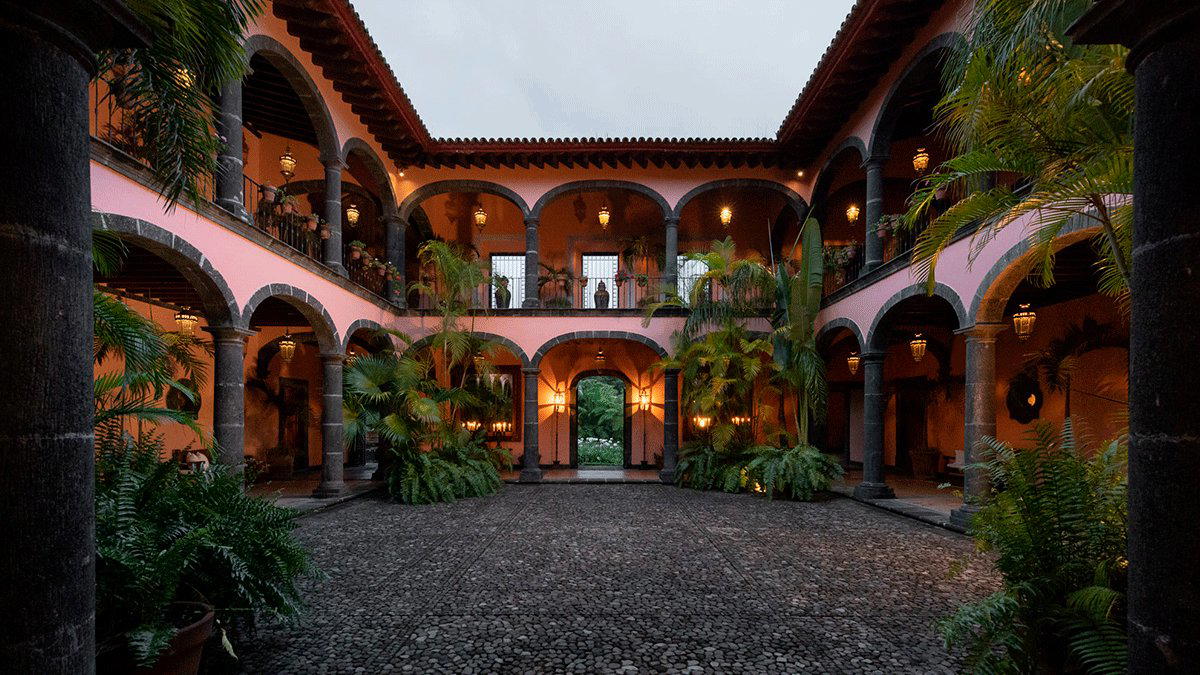
Where the Volcanic Foothills Shape the Stay
The approach to Hacienda de San Antonio tells you most of what you need to know before you arrive. The road from Comala climbs through sugar cane and coffee groves with the Volcán de Colima holding the horizon, its profile present enough that the mountain functions less as scenery and more as orientation. This is the kind of arrival sequence that larger resort properties spend considerable effort trying to manufacture. Here, it is simply geography.
Comala itself sits about 10 kilometres north of Colima city, a colonial town with whitewashed facades and a central plaza that has become something of a benchmark for well-preserved provincial Mexico. The hacienda occupies land to the south of the town, within the municipality, on an estate that has operated as a working agricultural property since the 19th century. That continuity of use is not incidental, it is the structural logic of what the property offers. This is not a heritage conversion in the decorative sense. The plantation context remains active.
The Architecture of a Working Estate
Hacienda architecture in western Mexico follows a recognisable grammar: thick volcanic stone walls, colonnaded corridors, interior courtyards oriented to catch prevailing wind, and a chapel that typically anchors the compound's social and spatial hierarchy. The Hacienda de San Antonio belongs to this tradition in full. The chapel at the estate is among the more photographed elements of the property, and the broader compound reflects the layered construction logic of a property built for agricultural productivity first and habitation second, then gradually amended over generations to accommodate a more domestic scale of life.
This architectural sequence matters for how guests experience the space. The rooms occupy converted estate buildings rather than purpose-built accommodation blocks, which means spatial variation between rooms is significant. Wall thicknesses, ceiling heights, and fenestration patterns differ from one part of the compound to the next. In the broader category of converted hacienda hotels across Mexico, a category that includes well-regarded properties like Casa de Sierra Nevada, A Belmond Hotel, in San Miguel de Allende, this kind of variation is a feature rather than a deficiency. The absence of architectural uniformity is itself evidence of authenticity.
The estate grounds extend across a working plantation, with coffee, mangoes, and other tropical crops grown on the surrounding slopes. The integration of productive land with the accommodation footprint positions Hacienda de San Antonio within a small cohort of Mexican properties where the land use itself is part of the guest experience. Properties operating at a comparable register of place-rootedness, though in different geographies, include Cuixmala in La Huerta and Playa Viva in Juluchuca, both of which similarly prioritise estate-scale ecology over resort-scale amenity.
The Colima Context Most Visitors Skip
Colima state receives a fraction of the international tourism that flows to Jalisco and Oaxaca, which positions the hotel as an option for travellers who have already covered the more frequented registers of Mexican hospitality. The state capital is accessible by road from Guadalajara in roughly two hours, and the region's relative anonymity on international itineraries has preserved both its pricing dynamics and its character. Comala specifically carries a designation as one of Mexico's Pueblos Mágicos, a federal programme recognising towns with notable cultural and historical heritage, which gives the town a maintained quality of public space without the commercial density that affects more heavily visited Pueblos Mágicos.
For guests approaching western Mexico from the coast, the hacienda sits at a plausible distance from Manzanillo's international airport, making it a viable inland counterpoint to coastal properties. The Pacific coast options in this region represent a different tier of luxury product entirely: Las Alamandas in Costalegre and Four Seasons Resort Punta Mita both operate with the amenity infrastructure and price points of established international resort brands. The hotel operates with a different proposition entirely: the draw is the estate, the setting, and the architectural specificity of a place that could not exist anywhere other than where it does.
Planning the Visit
The dry season in Colima runs roughly from November through April, which aligns with the period when the plantation grounds and surrounding landscape are most accessible and the volcanic views clearest. Travel from Guadalajara by road is one practical approach for most international visitors, with the journey taking approximately two hours via the autopista.
For context on what comparable levels of place-specificity look like across other parts of Mexico, it is worth examining properties like Chablé Yucatán in Merida, another hacienda conversion operating at the high end of the category, or Casa Silencio in San Pablo Villa de Mitla for the Oaxacan register of heritage accommodation. Both offer a useful sense of what hacienda-style stays look like when the product is fully realised and the architecture is doing the primary work. Also worth considering in the broader Mexico luxury context are Hotel Esencia in Tulum, Maroma in Riviera Maya, Etéreo, Auberge Resorts Collection in Punta Maroma, and One&Only; Mandarina in Riviera Nayarit, all of which represent the resort end of the spectrum and serve as useful reference points for understanding where the hotel sits in relation to mainstream luxury options.
Quick Comparison
Comparable venues nearby, for context on price, style, and recognition.
| Venue | Cuisine | Price | Awards | Notes |
|---|---|---|---|---|
| Hacienda de San AntonioThis venue — the venue you are viewing | Colonial Mexican hacienda with European design influences, blending 19th-century architecture with contemporary luxury and family ownership heritage. | $$$$ | 5-Star | Not listed |
| Hacienda Uayamon | Restored 18th-century henequen hacienda with colonial stone architecture and jungle surroundings | $$$$ | 5-Star | Uayamon |
| One&Only Palmilla Resort | Classic hacienda-style architecture with Baja-chic interiors blending traditional Mexican charm and contemporary design. | $$$$ | 5-Star | Palmilla |
| Playa Viva | Regenerative luxury eco-resort with open-air construction using traditional techniques and locally harvested sustainable materials; designed as an immersive nature experience without modern technological distractions. | $$$$ | 5-Star | Juluchuca |
| Rosewood Mandarina | barefoot luxury resort with suite-style accommodations | $$$$ | 5-Star | Riviera Nayarit |
| Fairmont Heritage Place Acapulco Diamante | Luxury private residence club within a 5-star beach resort setting on Acapulco’s Riviera Diamante. | $$$$ | 5-Star | Granjas del Marqués / Riviera Diamante |
At a Glance
- Romantic
- Scenic
- Elegant
- Classic
- Intimate
- Romantic Getaway
- Honeymoon
- Wellness Retreat
- Anniversary
- Historic Building
- Garden
- Terrace
- Panoramic View
- Private Dining
- Destination Spa
- Wi Fi
- Pool
- Spa
- Room Service
- Restaurant
- Bar
- Tennis
- Fitness Center
- Airport Shuttle
- Concierge
- Mountain
- Garden
- Wi Fi
- Pool
- Spa
- Room Service
- Restaurant
- Bar
- Tennis
- Fitness Center
- Airport Shuttle
- Concierge
Warm, inviting colonial elegance with hand-crafted Mexican textiles, art-filled common spaces, and natural light throughout; guests describe it as feeling like a wealthy friend's private estate rather than a formal hotel.