
Six private Jabu villas set among the green forests of Pererenan place Desa Hay in the smaller, design-led tier of Canggu-area accommodation. The property sits in Kabupaten Badung, where Bali's villa hospitality tradition runs deepest, and its architecture draws directly from the surrounding landscape rather than importing a generic luxury template.
 Discover on Pearl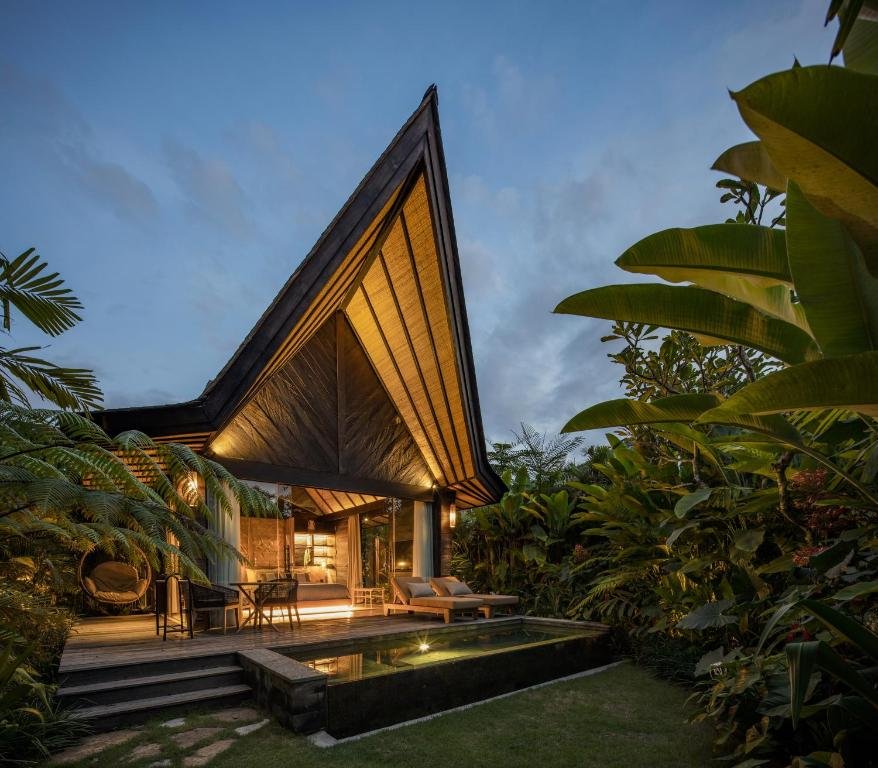
Where Pererenan's Forest Begins to Feel Like Architecture
The road from central Canggu toward Pererenan changes character quickly. Within a few kilometres of the surf-break cafés and co-working spaces that define the area's better-known face, the density drops and the rice paddies and tree canopy reassert themselves. Desa Hay sits along Jl. Raya Tumbakbayuh in this greener, quieter stretch of Kabupaten Badung, a location that positions it at a remove from the commercial activity of Batu Bolong while still placing guests within reach of Canggu's broader dining and nightlife corridor. The approach through vegetation is not incidental — it is the first design statement the property makes.
Bali's luxury accommodation market has split along a clear axis over the past decade. On one side sit the large-footprint international brands — properties with hundreds of keys, full F&B programs, spa complexes, and the operational infrastructure that institutional travel demands. On the other sit smaller, design-specific villa compounds where the architecture and setting carry weight that a loyalty program cannot. COMO Uma Canggu operates in the first register; Desa Hay, with six Jabu villas, belongs firmly to the second. At six keys, it competes on density of experience rather than breadth of amenity.
The shortlist, unlocked.
Hard-to-book tables, cellar releases, and concierge-planned trips.
Get Exclusive Access →The Jabu Villa: A Design Argument Made in Timber and Garden
The Jabu , a term that carries Balinese resonance around the idea of an inner household compound , is the unit around which Desa Hay's architectural logic is organised. Villa compounds that invoke traditional Balinese spatial principles are not a novelty in this region; what matters is how faithfully the execution holds. The property's documentation describes the six Jabu villas as built in harmony with the surrounding verdant gardens and with deliberate attention to luxurious material detail, a framing that places it in the local-materials, nature-integrated design tradition rather than the imported-materials minimalism that characterises some competitors at the premium end of the Seminyak-to-Canggu corridor.
The distinction matters architecturally. Bali has long been a testing ground for design approaches that treat the boundary between interior and exterior as porous , where a garden is not an amenity attached to a room but an extension of the living space itself. Properties like Buahan, a Banyan Tree Escape in Payangan have pushed this logic to an almost programmatic extreme. Desa Hay's six-villa format allows a comparable attention to spatial quality without the group-retreat scale that defines some jungle escapes. Camaya Bamboo Houses in Selat represents another node in this design tradition, using indigenous materials to anchor the guest in a specific landscape rather than insulating them from it.
Canggu's Accommodation Tier: Where Desa Hay Sits
Understanding Desa Hay requires understanding what Canggu's accommodation market actually looks like in 2024. The area has moved decisively upmarket from its budget-guesthouse origins without yet matching Seminyak's concentration of international luxury brands. La Reserve 1785 occupies the design-boutique end of the Canggu spectrum alongside Desa Hay. Further afield, the benchmark properties for Bali luxury include Mandapa, a Ritz-Carlton Reserve in Ubud, which deploys full resort infrastructure around a river gorge setting, and Alila Villas Uluwatu in Uluwatu, which built its reputation on clifftop architecture. Against these comparators, Desa Hay's proposition is narrower and more specific: a small number of private villas in a forested setting in the quieter northern fringe of the Canggu zone.
For travellers who have moved through Indonesia's broader accommodation spread , from Nihi Sumba in Sumba at the remote-luxury end to AYANA Resort Bali in Jimbaran at the full-service resort end , Desa Hay reads as a deliberately intimate counterpoint. The six-villa count signals a particular kind of experience: one where privacy is structural rather than arranged by request.
The Pererenan Context: Why This Part of Badung Matters
Pererenan and the northern Canggu edge along Kecamatan Mengwi have attracted a specific kind of hospitality investment over the past several years: smaller, often architecturally ambitious properties that use the remaining tree cover and agricultural land as spatial assets rather than development constraints. This is a different calculus from the dense villas-per-hectare approach visible further south. The address on Jl. Raya Tumbakbayuh places Desa Hay within this newer, lower-density wave of development, which tends to draw a guest profile more interested in environment than in proximity to nightlife.
The broader Canggu area is well served for dining, and EP Club's editorial coverage across restaurants, bars, and experiences reflects the range available. Desa Hay's position at the Pererenan edge means guests staying here are making a conscious choice to be slightly outside the core, with the trade-off of more immediate natural surroundings. For context on the full range of accommodation options in the area, our Canggu hotels guide maps the market from surf-adjacent guesthouses to design-forward villa compounds.
Planning a Stay
Desa Hay sits on Jl. Raya Tumbakbayuh in Pererenan, Kecamatan Mengwi, Kabupaten Badung, Bali 80361. The six-villa format means availability moves quickly, and the property is leading approached by contacting them directly given the small room count. Ngurah Rai International Airport in Denpasar is the standard arrival point for Bali; transfers to the Canggu-Pererenan area typically run 45 to 75 minutes depending on traffic, with the southern approaches through Seminyak or Kerobokan being the most direct routes. Bali's dry season runs broadly from April through October, which represents the most consistent period for villa stays that depend on garden and outdoor living space. The wet season months of November through March bring heavier afternoon rain but also lower occupancy and, in many years, negotiable rates at smaller properties. For reference on how Desa Hay sits within Indonesia's wider premium accommodation picture, peer properties worth understanding include Aman Villas at Nusa Dua in Nusa Dua, Amankila in Manggis, and Amanwana on Moyo Island.
The shortlist, unlocked.
Hard-to-book tables, cellar releases, and concierge-planned trips.
Get Exclusive Access →Frequently Asked Questions
A Quick Peer Check
These are the closest comparables we have in our database for quick context.
| Venue | Cuisine | Price | Awards | Notes |
|---|---|---|---|---|
| Desa Hay | Tucked away amid the green forests of one of Bali’s most spectacular regions, De… | This venue | ||
| Mandapa, a Ritz-Carlton Reserve | World's 50 Best | |||
| COMO Uma Canggu | ||||
| Alila Villas Uluwatu | ||||
| Amandari | ||||
| Amankila |
Preferential Rates?
Our members enjoy concierge-led booking support and priority upgrades at the world's finest hotels.
Get Exclusive AccessThe shortlist, unlocked.
Hard-to-book tables, cellar releases, and concierge-planned trips.
Get Exclusive Access →