
Positioned on Minorca's southern coastline and recognised with a One MICHELIN Key in 2025, Cap Menorca occupies a tier of Balearic rural hotels where address does most of the work. Remote enough to enforce stillness, close enough to the island's interior paths and coves, it sits alongside properties like Alcaufar Vell and Faustino Gran in a small cohort of Minorcan hotels where landscape access is the primary value proposition.
 Discover on Pearl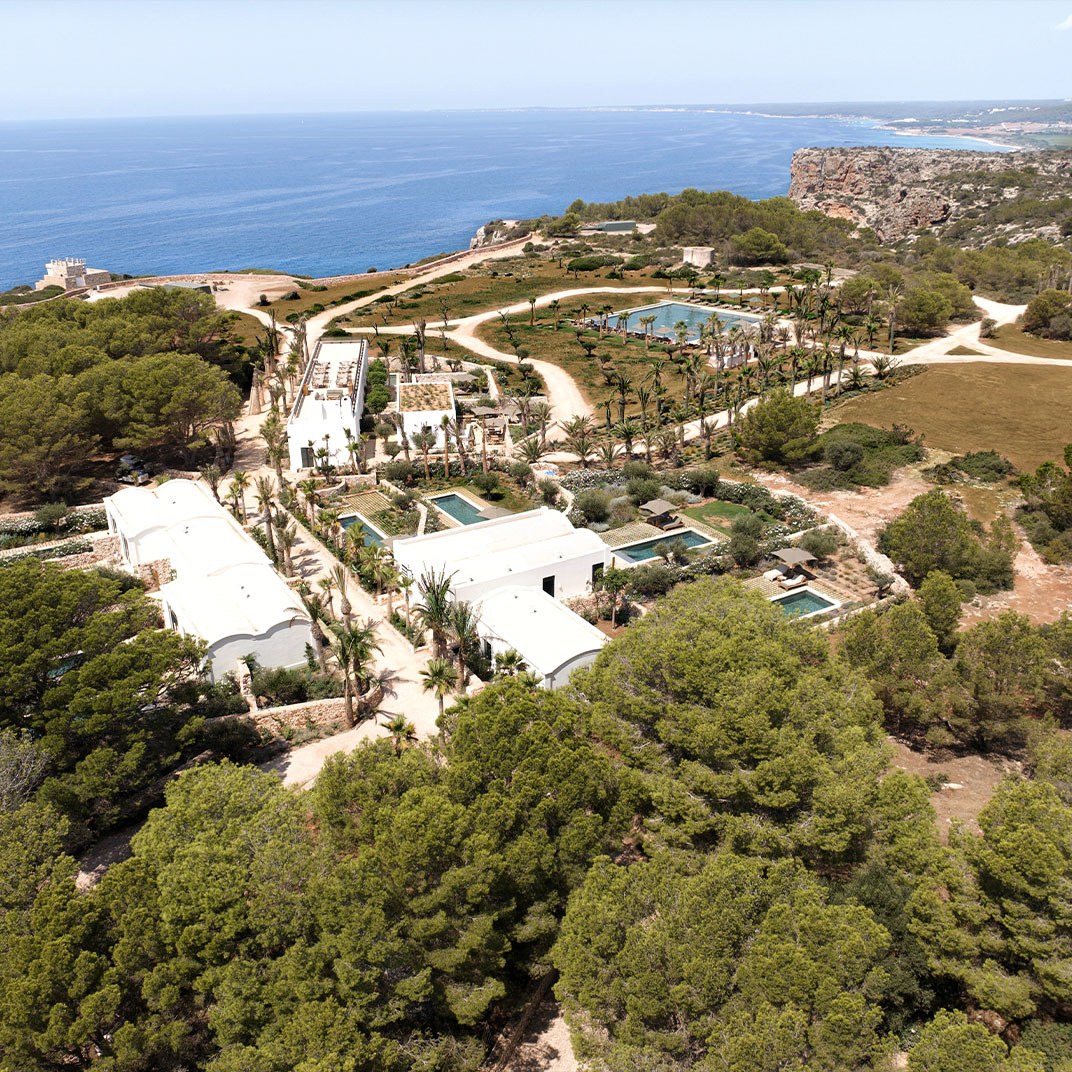
Where the Address Is the Argument
Minorca's southern coast operates at a different frequency from the island's busier northern bays. The roads narrow, the signage thins, and the landscape shifts toward low scrub, dry-stone walls, and the kind of agricultural quiet that the island's UNESCO Biosphere Reserve status was designed to protect. Cap Menorca, reached via the Camí de Llucalari, sits inside this slower geography. The approach alone signals what kind of stay this is: not a resort with curated entertainment, but a property whose primary offering is the particular quality of the place it occupies.
That distinction matters in the Balearics, where the hospitality market has fractured sharply between large-volume coastal resorts and a smaller cohort of rural and design-led properties that price against experience rather than room count. Cap Menorca belongs to the latter group, and the 2025 Michelin Key recognition confirms its position within the tier of Balearic properties that the guide considers worth tracking. The MICHELIN Key programme, launched to evaluate hotels on the same rigorous basis as its restaurant stars, places Cap Menorca in the company of a select number of Spanish rural properties — among them Terra Dominicata in Escaladei, Atrio Restaurante Hotel in Cáceres, and Abadía Retuerta LeDomaine — all of which trade on a strong sense of place as their central asset.
The shortlist, unlocked.
Hard-to-book tables, cellar releases, and concierge-planned trips.
Get Exclusive Access →Minorca's Rural Hotel Tier
To understand Cap Menorca's position, it helps to map the competitive set on the island. Minorcan rural hospitality has developed along two lines: the converted farmhouse, or agroturisme, and the more polished rural retreat that retains agricultural character without sacrificing comfort. Agroturismo Llucasaldent Gran and Alcaufar Vell anchor the farmhouse end of that spectrum, where stone architecture and working-land heritage are the draw. Faustino Gran Relais & Chateaux and Santa Ponsa - Fontenille Collection operate closer to the polished-retreat model. Cap Menorca sits in this second register, where the surrounding terrain is the main draw and the built environment serves to frame it rather than compete with it.
This is also the tier where location specificity matters most. A hotel in this category without a compelling address is just a rural building. Cap Menorca's position on the southern coast, with access to the Camí de Llucalari trail network and proximity to some of Minorca's less-trafficked coves, gives it a functional edge that goes beyond aesthetics. Guests who choose properties in this corner of the island are typically looking for something the northern coast cannot easily offer: extended quiet, low visitor density, and direct access to paths and water without passing through resort infrastructure.
The Balearic Context
Minorca often gets read as Mallorca's quieter sibling, a comparison that undersells what the island actually offers and misframes the choice. Mallorca's premium property market, which includes addresses like La Residencia, A Belmond Hotel, Cap Rocat in Cala Blava, and Hotel Can Ferrereta in Santanyí, is larger, more international in its guest profile, and considerably more developed in terms of infrastructure. Minorca's Biosphere Reserve designation has kept development pressure lower, and that constraint is precisely what sustains properties like Cap Menorca. The island's protected status is not incidental to the appeal; it is the mechanism that keeps the southern landscape intact enough to remain worth visiting.
Within the Balearic rural hotel tier more broadly, the properties that hold long-term relevance tend to be those with an address that cannot be replicated: clifftop positions, access to restricted coastal paths, or working land that produces ingredients. Cap Menorca's location on the southern coast, off a named camí, places it in this category. For travellers already familiar with comparable properties across Spain and the wider Mediterranean, the address anchors the case for the stay.
Planning a Stay
Minorca's season runs hard from late June through August, when the island's limited road network and popular coves absorb the bulk of summer visitors. Properties at Cap Menorca's end of the market tend to book out early for peak weeks; the May and September shoulder windows offer the same landscape access with considerably less pressure on paths and coastline. Reaching the property requires a car: the Camí de Llucalari is rural track country, and the nearest town infrastructure sits at a distance that makes independent transport the practical default. Flights serve Minorca's airport at Mahón directly from several European hubs during the season, with connections available year-round via Mallorca. For travellers combining a Minorca stay with time elsewhere in Spain, the island pairs logistically with a city base , Mandarin Oriental Barcelona or Mandarin Oriental Ritz, Madrid both serve as natural bookends. For those extending into the wider Balearic circuit, Hotel Can Cera in Palma offers a convenient and well-regarded stopover.
Other properties worth comparing on the island include Cristine Bedfor Mahón, Divina Suites Hotel Boutique, Hotel Boutique Can Sastre, and Rural Sant Ignasi. Each occupies a different corner of the island and a slightly different position on the rural-to-polished spectrum, making the choice as much about location priority as style preference. A fuller picture of where each fits is in our Minorca hotels and restaurants guide.
For reference points in premium coastal stays elsewhere in Europe, Marbella Club Hotel on the Costa del Sol and Hôtel de Paris Monte-Carlo represent the large-format end of the Mediterranean luxury spectrum. Cap Menorca's positioning is closer to the opposite pole: low-key by design, where the surrounding territory does the heavy lifting and the property's role is to stay out of its way.
Frequently Asked Questions
- What is Cap Menorca leading at?
- Cap Menorca's primary asset is its location on Minorca's less-developed southern coast, with direct access to the Camí de Llucalari trail network and proximity to the island's quieter coves. Its 2025 One MICHELIN Key recognition places it within the tier of Spanish rural properties that the Michelin guide considers to offer a stay of genuine quality, positioning it in the same bracket as a small number of Balearic addresses where landscape access and low visitor density are the central value. For travellers prioritising solitude and coastal access over amenities and entertainment, the address makes a clear case.
- What is the most popular room type at Cap Menorca?
- Specific room type data is not available in our current records. Properties in this tier and with this MICHELIN Key recognition typically allocate their most-booked rooms to those with direct outdoor access or unobstructed views of the surrounding land and coast , consistent with the location-led proposition that defines Cap Menorca's appeal. For current availability and room category detail, direct contact with the property is the most reliable route. Bookings for peak season (late June through August) fill well in advance.
The Short List
A compact peer snapshot based on similar venues we track.
Preferential Rates?
Our members enjoy concierge-led booking support and priority upgrades at the world's finest hotels.
Get Exclusive AccessThe shortlist, unlocked.
Hard-to-book tables, cellar releases, and concierge-planned trips.
Get Exclusive Access →