Bateen Liwa Resort
Bateen Liwa Resort places the hotel conversation in Mzeer Ah firmly in the desert-design category, where arrival, scale and silence matter as much as service.

Pearl is the En Primeur Club membership app — saves, bookings, and concierge access live there. Same editors, same standards.
- Address
- Mzeer Ah, United Arab Emirates
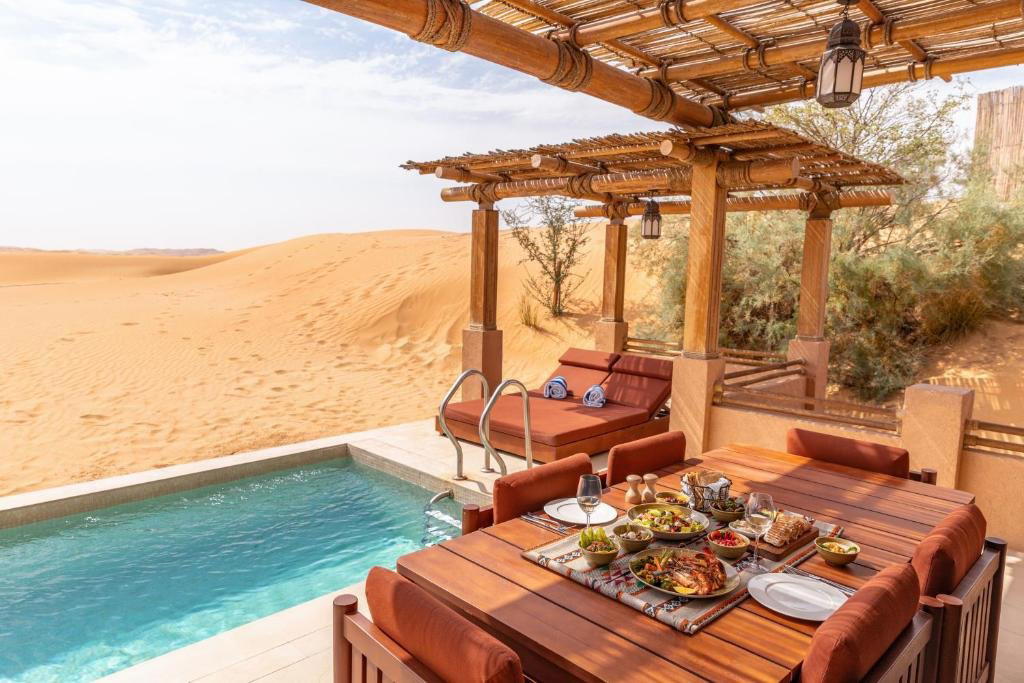
Desert architecture before hotel theatre
The first argument for any resort in Mzeer Ah is not a lobby, a restaurant or a suite category. It is the approach: low horizons, open desert, long light and the sense that a building must justify its presence in a place where scale already belongs to the land. Bateen Liwa Resort enters that conversation through location before amenity. In the United Arab Emirates, desert hospitality has developed into a serious design category, separate from beach resorts in Dubai, island retreats off Abu Dhabi and city hotels built around skyline spectacle.
That distinction matters. A desert resort is judged less by how much it can add and more by what it refuses to interrupt. The architecture has to mediate heat, distance and privacy. Circulation routes become part of the experience, because moving between room, dining space and open-air seating changes with the hour. Shade, orientation and material weight carry more meaning here than decorative flourish. In that setting, Bateen Liwa Resort belongs to a smaller Mzeer Ah and wider Al Dhafra-adjacent hotel conversation where the physical environment is not a backdrop but the main editor.
Without verified rates, suite names or facility lists, the reliable assessment has to come from category context: where it sits geographically, how UAE desert resorts are usually positioned, and what questions need answering before committing to the drive.
Why Mzeer Ah changes the hotel brief
Mzeer Ah is not Dubai, Abu Dhabi Corniche or the Palm. The city field here is quieter, more dispersed and more dependent on route planning. That immediately shifts the hotel brief. In dense urban luxury, a guest can compensate for a weak restaurant or thin bar program by stepping outside. In remote-resort travel, the property has to carry a larger share of the stay. Dining, shade, evening seating, pool access, room privacy and transfer timing become structural, not secondary.
The UAE already offers several models for this. Atlantis The Royal in Dubai represents the high-density vertical resort, where architecture competes with the city and the hotel operates as a complete entertainment district. The Ritz-Carlton Ras Al Khaimah, Al Wadi Desert in Ras al Khaimah belongs to the desert-villa model, with privacy and landscape immersion shaping the stay. Anantara Qasr al Sarab Desert Resort in Liwa Desert is the obvious regional reference point for guests measuring any Liwa-area resort against established desert-hospitality scale. Bateen Liwa Resort is read against that peer group, not against a city business hotel.
Design-led desert hotels also operate differently from coastal UAE resorts. Desert Islands Resort & Spa By Anantara in Sir Bani Yas Island and Desert Islands Resort & Spa by Anantara in Al Dhafra lean into island and wildlife territory, while Fairmont Fujairah Beach Resort in Dibba and Fairmont Ajman in Ajman answer a beach brief. Mzeer Ah asks for another register: slower movement, fewer external distractions and a stronger dependence on the property’s own spatial intelligence.
The design question: restraint or resort staging?
Architecture in the desert can go in two directions. One path uses mass, low profiles and shadow to make the building feel settled. The other turns the desert into a stage set, with theatrical lighting, excessive ornament and interiors that is transferred to a city hotel without consequence. The stronger UAE desert resorts understand that the place already has drama. Design succeeds when it gives the guest comfort without trying to outshout the horizon.
The useful point is what a traveller should inspect when comparing it with the regional field. Look for whether rooms are oriented for privacy or merely view capture. Look for whether outdoor spaces remain usable outside the softest hours of the day. Look for whether dining and lounge areas acknowledge desert light rather than hiding from it. These details separate considered desert hospitality from properties that simply transplant generic resort language into sand.
Internationally, the design conversation has moved toward hotels that take their site seriously. Amangiri in Canyon Point is often cited in the broader travel world because its architecture uses desert geometry as discipline rather than decoration. One&Only Mandarina in Riviera Nayarit works from a different ecological setting but belongs to the same low-impact, site-responsive discussion. The Siam in Bangkok and HOTEL THE MITSUI KYOTO in Kyoto show how architecture can become the organising intelligence of a stay rather than a decorative layer. Bateen Liwa Resort should be judged by that standard of contextual fit, even when public data remains limited.
For a remote resort, food and drink are not optional extras. They determine how long a stay can hold interest and whether the property works for more than a single overnight. That means no responsible editorial claim can be made about a specific menu, beverage list, breakfast format or chef-led concept.
The broader UAE pattern is still useful. City hotels often build dining around imported restaurant brands, celebrity-chef names or high-turnover social rooms. Desert resorts usually face a different challenge: they need all-day practicality, evening atmosphere and enough regional identity to make the setting feel coherent. A strong program might use Emirati ingredients, Levantine references, international resort cooking or private-dining formats, but those specifics should be confirmed directly because they are not present in the venue data.
Travellers using EP Club for a wider Mzeer Ah plan can cross-reference category guides rather than assume the resort handles every meal or drink occasion. Start with Our full Mzeer Ah restaurants guide for dining context, Our full Mzeer Ah bars guide for drinks planning and Our full Mzeer Ah experiences guide for activities that might sit around a resort stay.
How it compares within the UAE hotel field
The Emirates hotel scene has split into clear families. There are statement urban resorts built for spectacle, capital-city grand hotels, coastal leisure properties, desert retreats and small design-led escapes. The St. Regis Abu Dhabi in Abu Dhabi sits in the formal city-luxury lane, where service rituals and address carry weight. Andaz by Hyatt – Palm Jumeirah in Palm Jumeirah occupies the lifestyle-resort lane, tied to Dubai’s beach and dining circuit. Anantara Santorini Abu Dhabi Retreat in Ghantoot shows another direction, a coastal retreat format framed by escape rather than scale.
Bateen Liwa Resort sits closer to the desert-retreat family, where the decision is less about urban access and more about environmental change. Without confirmed room count, facilities, awards or rates, the answer cannot be asserted. What can be said is that Mzeer Ah gives the property a quieter competitive frame than Dubai or Abu Dhabi, and that quiet can be a strength when the architecture, service rhythm and food program are aligned.
Other UAE comparisons help clarify the range. Al Badayer Retreat by Sharjah Collection in Sharjah sits in a heritage-desert register. Jebel Hafeet in Al Ain brings mountain geography into the domestic resort conversation. These properties underline a useful point: UAE travel is not only city towers and beach clubs. The strongest itineraries often combine contrasts, and a Mzeer Ah resort can function as the quiet counterweight to more public-facing hotels.
Planning intelligence for a stay
The planning posture for Bateen Liwa Resort should be cautious and deliberate. That makes advance verification necessary, especially because remote-resort logistics are less forgiving than city stays. Confirm arrival route, check-in timing, dining availability, cancellation terms, transfer options and whether any facilities require advance scheduling before setting out.
Seasonality matters in the UAE desert. Cooler months generally make outdoor terraces, desert activities and longer walks more comfortable, while summer heat changes the rhythm of a stay and places more pressure on indoor spaces, pools, shaded routes and evening programming. This is not a venue-specific claim about Bateen Liwa Resort’s operations; it is a practical reality of the region. The design of a desert resort is tested by heat as much as by photography.
In this category, nightly rates can vary sharply by season, room type, meal plan and package structure. Awards are also unlisted, so Bateen Liwa Resort should not be treated as an award-driven selection in the way Michelin-linked restaurants or ranked hotels sometimes are.
For broader trip planning, Our full Mzeer Ah hotels guide is the natural companion page. If the stay is part of a wider Emirates itinerary, pair the desert with a more urban or coastal contrast: Hotel Plaza Athénée in Paris, La Réserve Paris in Paris, The Fifth Avenue Hotel in New York City and Casa Maria Luigia in Modena are not local peers, but they are useful reference points for travellers who think about hotels through design, food and sense of place rather than brand tier alone. Wine-focused travellers can also scan Our full Mzeer Ah wineries guide, though winery culture is not the primary lens for this destination.
Comparable venues nearby, for context on price, style, and recognition.
| Venue | Cuisine | Price | Awards | Notes |
|---|---|---|---|---|
| Bateen Liwa ResortThis venue — the venue you are viewing | Desert oasis resort of villas and tents designed for relaxed family stays and nature-focused getaways in the Liwa dunes. | $500–750 | Not listed | Not listed |
| Hotel Boulevard, Autograph Collection | Modern boutique hotel blending urban style with Arabic influences | $200–300 | Michelin Selected | Downtown Dubai |
| Nikki Beach Resort & Spa | Luxury beachfront resort with contemporary barefoot luxury. | $300–500 | Michelin Selected · Virtuoso Luxury Hotel Partner | Pearl Jumeira |
| Mercure Dubai Barsha Heights – Hotel Suites & Apartments | Contemporary serviced apartments in a commercial hub | Not listed | World Luxury Hotel Awards WLHA Continent Winner | Barsha Heights |
| Atlantis The Royal, Dubai | experiential oceanfront mega-resort with deconstructed tower design | Not listed | 3 Michelin Keys | Palm Jumeirah |
| Nobu Hotel Saadiyat Island | Luxury lifestyle beachfront resort integrated into Saadiyat Island’s cultural district with branded residences and a focus on gastronomy and wellness. | Not listed | Not listed | Saadiyat Island Cultural District |
Details
- Scenic
- Quiet
- Romantic
- Elegant
- Rustic
- Family Vacation
- Romantic Getaway
- Weekend Escape
- Group Retreat
- Honeymoon
- Celebration
- Infinity Pool
- Private Villa
- Panoramic View
- Terrace
- Wi Fi
- Pool
- Spa
- Fitness Center
- Concierge
- Kids Club
- Restaurant
- Bar
- Parking
- Mountain
- Wheelchair Accessible
- Accessible Parking
Secluded and tranquil desert-resort atmosphere with wide open dune vistas, private villas and tents, soft outdoor lighting around pools and pathways, and an overall relaxed yet upscale feel suited to quiet escapes and stargazing rather than nightlife.