← Guides
Bordeaux 2025 pairs early harvest purity with scarce allocations, 100-point chatter and the strongest en primeur response since 2009.
Bordeaux 2025 pairs early harvest purity with scarce allocations, 100-point chatter and the strongest en primeur response since 2009.
The first tranche had barely opened on 24 April 2026 before merchants began speaking about Bordeaux in a tone many collectors had not heard since the 2009 campaign. Bordeaux 2025 is being framed around precocious budbreak, a hot dry summer, an early September harvest, pristine sanitary conditions and yields down 10-15%. The shorthand is seductive but useful: 2009’s opulence, 2010’s structure and 2016’s precision.
The timing matters. Bordeaux has spent recent campaigns asking collectors to keep faith with en primeur while buyers became more selective and merchants worked through a crowded release calendar. Then 2025 arrived with barrel scores brushing the 100-point line at First Growths and leading Right Bank estates, Sauternes producers invoking 2001, and allocations tight enough to make serious buyers move early. It did not need theatre.
For the collector, the question is not simply whether Bordeaux 2025 is good. The more useful question is where the vintage sits stylistically, how the early market response changes access, and why the same spring season also saw Château Latour 2019, a 100-point Grand Vin, open a slimmer La Place de Bordeaux campaign built around fewer wines and sharper selection.
The Bordeaux 2025 conversation began with unusual alignment between growers, critics and merchants. The UGCB placed the vintage among Bordeaux’s great reference years, while critics and trade reports drew comparisons with 1982, 2009, 2010 and 2016. Those comparisons can become lazy shorthand in weaker campaigns. Here, they map onto concrete features of the year: ripeness without the alcohol heat associated with some recent solar vintages, tannic richness, low disease pressure and a harvest that arrived early under clean conditions.
That response did not arrive in isolation. La Place de Bordeaux had already been trimmed to 56 wines, with Château Latour’s 2019 Grand Vin opening the season on 17 March 2026 after receiving a well-suited 100-point score. A slimmer spring campaign, followed by a high-definition en primeur vintage, gave collectors a cleaner set of choices than the overextended calendars of recent years.
The trade has not abandoned breadth; Bordeaux remains a region of communes, châteaux, second wines and price tiers. But 2025 has put pressure back on hierarchy. First Growths, Right Bank leaders, names with consistent secondary-market demand and Sauternes estates with a rare botrytis year are commanding attention first. The rest of the campaign will have to earn its place bottle by bottle.
The 2025 growing season reads like a concise lesson in why Bordeaux can still stop the fine-wine trade when weather, timing and yield converge. The reports describe precocious budbreak, a hot dry summer, an early September harvest with pristine sanitary conditions and yields down 10-15%. None of those elements alone makes a vintage. Together, they explain why the wines have been framed as ripe, structured and precise rather than simply abundant or solar.
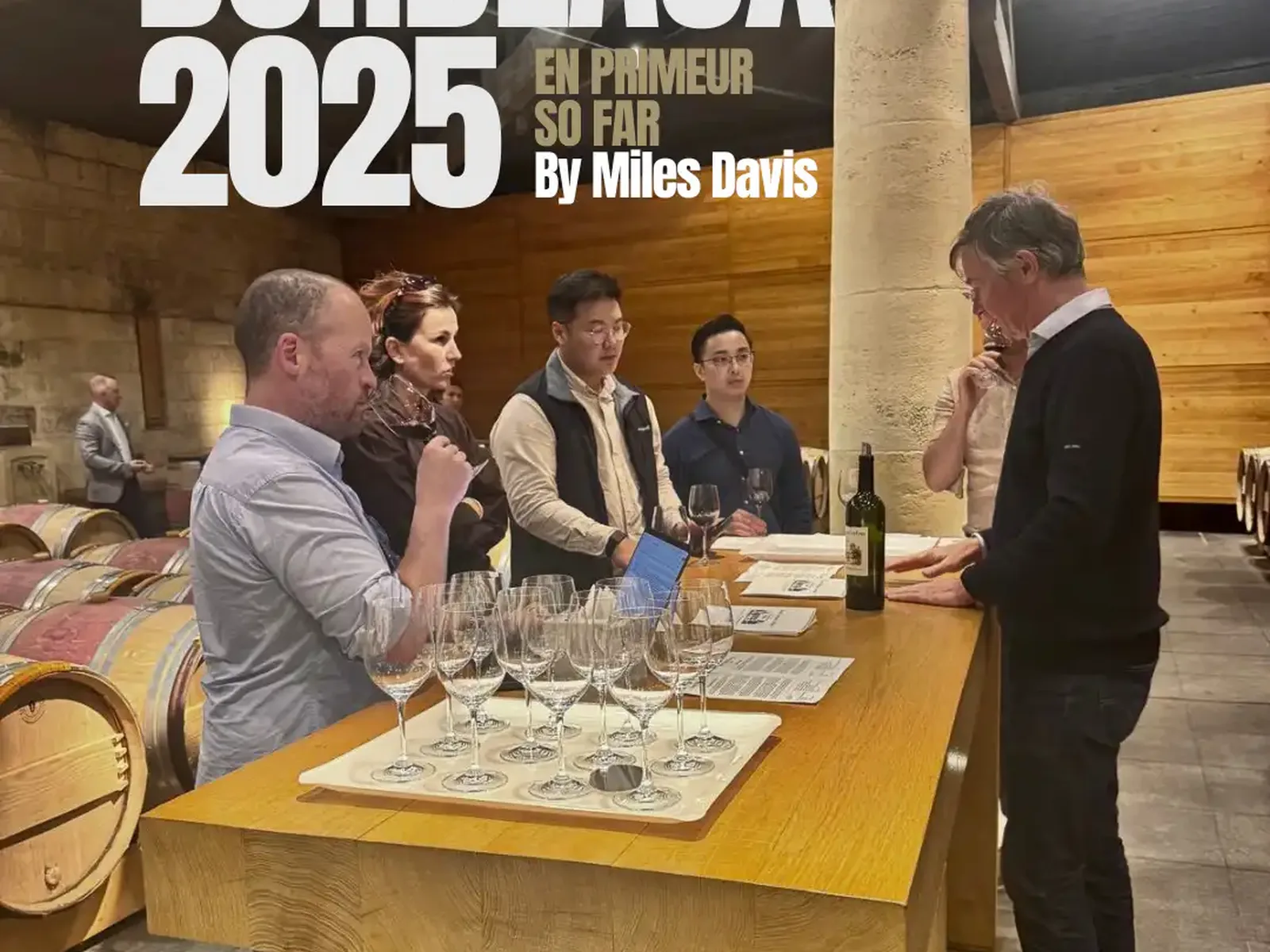
Precocious budbreak set the season in motion early. A hot dry summer then pushed ripening forward, while the early September harvest allowed estates to bring in fruit before late-season pressure complicated the picture. The language around sanitary conditions is especially important in Bordeaux, where the difference between clean fruit and compromised fruit can be the difference between fine-grained architecture and corrective cellar work. In 2025, the reports point to fruit arriving in a state that let châteaux speak about tannic richness, freshness and concentration rather than rescue.
Yields down 10-15% add another layer. A lower crop is not automatically better, but in this case yields are tight in the manner of 2010, allied to concentration and clean ripeness. For collectors, that has two implications. The wines may have the material for long ageing, and access may be less generous than in a high-volume campaign. Scarcity here is not a marketing flourish. It begins in the vineyard.
The vintage’s strongest claim is balance. The reports describe notable tannic richness without the alcohol heat that marked some recent solar vintages. That distinction will matter in cellars. Wines built only on sweetness and scale can dazzle in barrel, then lose definition after a decade. Wines with ripe tannin, clean fruit and a firm internal line have a different arc.
Opulence in this context points to fruit generosity and mid-palate breadth. Structure points to tannin, acidity and the ability to hold that fruit over time. Precision points to definition, the sense that the wine retains its line rather than dissolving into warmth. If 2025 delivers on all three, it will be a vintage for both earlier pleasure in lesser bottlings and long patience at the summit end. That spread is what made 2009 so beloved among some collectors, while 2010 and 2016 became touchstones for those who prize architecture.
Collectors should still resist buying labels as a reflex. A great Bordeaux vintage rewards focus, not panic. If you already have verticals of a First Growth, 2025 will likely become a key chapter because the vintage is being discussed alongside the modern reference years. If your cellar leans toward Right Bank wines, the early language around Pétrus, Ausone, Cheval Blanc and Figeac will make allocations harder to secure and more closely rationed. If you track estates that can overdeliver in strong years, names such as Pontet-Canet and Clinet deserve careful reading as the campaign unfolds.
Sauternes gives 2025 its clearest departure from the red-wine hierarchy. Sauternes and Barsac, led by Suduiraut and Climens, saw strong botrytis and concentrated, age-worthy sweet wines, with producers calling 2025 the vintage since 2001. That comparison has bite. The sweet wines of Bordeaux have spent years fighting for space in cellars increasingly dominated by dry reds, Champagne and Burgundy. A botrytis year of this calibre gives collectors a reason to revisit half-bottles and formats suited to long ageing, foie gras, blue cheese, tarte Tatin or simply a quiet glass after dinner.
Suduiraut and Climens also bring travel into the frame. Sauternes and Barsac offer a different Bordeaux rhythm from the Médoc or Saint-Émilion: morning mist, slower roads, a table where sweetness meets salt and spice rather than dessert alone. If 2025 becomes the sweet-wine vintage producers claim, tasting these wines in situ over the next several years will show a side of Bordeaux that too many itineraries compress into an afterthought.
Critical commentary around the 2019 Grand Vin has framed it in terms of power, precision, minerality, concentration and long ageing potential. That language is useful because it places Latour 2019 in the same vocabulary now surrounding Bordeaux 2025: power, precision, concentration, ageing capacity. It also shows how mature or held-back releases can compete for attention alongside en primeur if the wine has the critical support, provenance and drinking horizon collectors recognise.
That list matters because it shows La Place becoming more selective while retaining global reach. The reduction from around 80 wines to 56 suggests fewer releases competing for the same collector attention. The tilt toward library wines also responds to a buyer who may prefer provenance and readiness over tying up capital in bottles still years from delivery. Latour 2019 gave the campaign a Bordeaux anchor with a well-suited score. Bordeaux 2025 then gave en primeur its own reason to command the room.
The collector’s first task with Bordeaux 2025 is to separate desire from plan. A vintage framed this strongly will tempt broad buying, especially when merchants describe the first tranche as the decisive response since 2009. Yet the stronger purchases will likely come from matching the vintage profile to your cellar’s gaps.
If you lack long-horizon Left Bank structure, the First Growths and top Pauillac names will be natural targets. If you want Right Bank richness with shape, follow the estates already cited near the upper end of the barrel-score conversation. If your sweet-wine shelf is thin, Sauternes and Barsac 2025 may offer especially distinct opportunity among the campaign.
Allocation discipline will matter. Yields are down 10-15%, and market coverage points to strong early demand. That does not mean every wine will disappear at once, but it does mean particularly sought-after names may move through merchant lists quickly. Serious buyers should expect prioritisation: long-standing merchant relationships, prior purchase history, and clarity about formats and quantities. In a campaign with this level of attention, hesitation has a cost.
Drinking windows remain provisional until the wines complete élevage and critics retaste in bottle, but the vintage profile suggests a broad cellar strategy. A leading wines, especially those with the tannic architecture noted this vintage, belong in the long-term section of a cellar. Mid-tier classified growths and second wines may provide the earlier insight into 2025’s fruit and texture. Sauternes should not be treated as an afterthought; concentrated botrytis wines from a year compared with 2001 deserve time, but they also offer a clear way to understand the vintage outside the red-wine hierarchy.
For travellers, Bordeaux 2025 adds a fresh reason to return to the region over the next few years. The Médoc will draw collectors following First Growth narratives, Saint-Émilion and Pomerol will attract those tracing the Right Bank’s barrel-score strength, and Sauternes and Barsac will reward anyone who wants to taste the vintage through botrytis rather than tannin. The next test will come as later tranches, in-bottle scores and eventual drinking windows reveal whether 2025 keeps the precision now promised in barrel.
Get the App
Take the shortlist into the En Primeur Club app for concierge access, saved places, and the next step after discovery.
Get Exclusive AccessMore from the editors