Mi Tierra Cafe y Panaderia
Open around the clock in San Antonio's Market Square, Mi Tierra Cafe y Panaderia has anchored the city's Tejano dining tradition since 1941. The bakery counter, permanent Christmas lights, and paper flowers overhead define a space as recognisable as any monument in the city. For visitors reading San Antonio through its food, this is a foundational address.

Pearl is the En Primeur Club membership app — saves, bookings, and concierge access live there. Same editors, same standards.
The Room That Never Closes
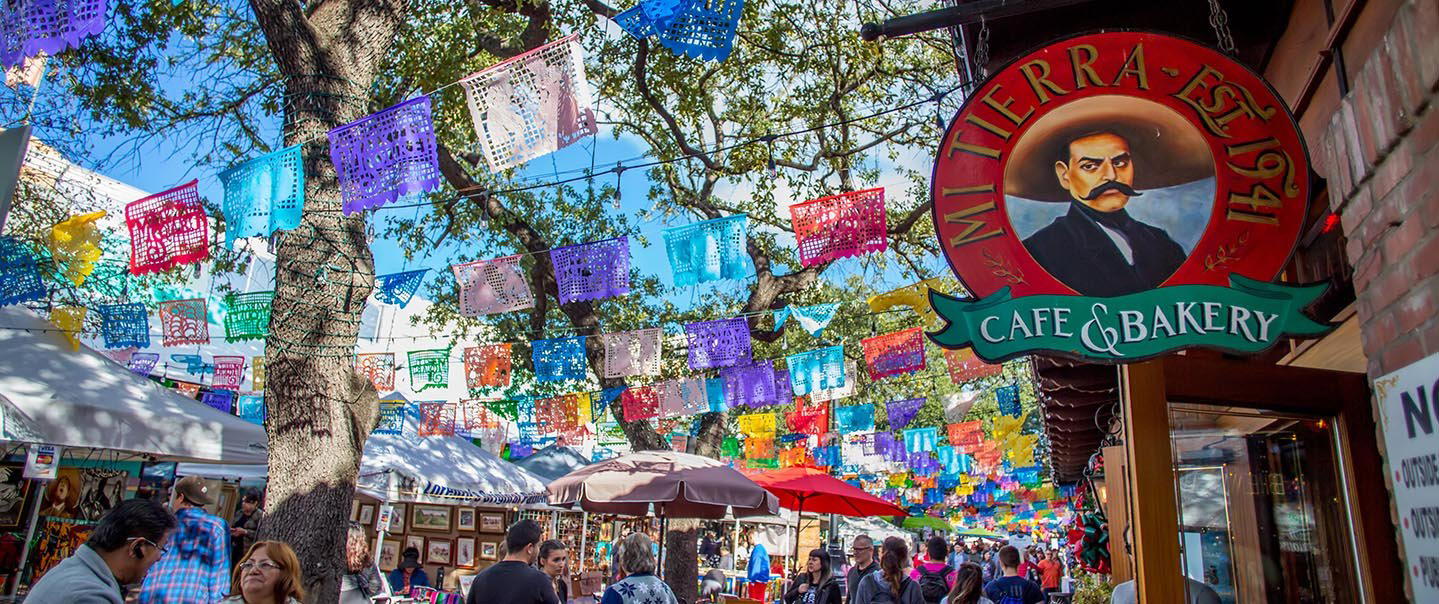
Walk into Mi Tierra at two in the morning and the energy is the same as at noon: the ceiling draped in paper flowers, strings of Christmas lights running year-round across every surface, murals of Mexican cultural figures lining the walls, and a bakery counter near the entrance stacked with pan dulce and decorated cakes. The physical environment here does something that most restaurants cannot buy with renovation budgets or interior designers. It has accumulated. Decades of additions, photographs, memorabilia, and seasonal decorations have layered into a space that reads as genuinely alive rather than art-directed. The effect is chaotic in the leading sense, a room where the decor functions as a kind of ongoing archive.
Mi Tierra has operated at 218 Produce Row in San Antonio's Market Square since 1941, originally as a small cafe serving the produce vendors who worked the market before dawn. That origin explains the 24-hour operating model that, by most accounts, has continued across the decades. A restaurant that opens at midnight to serve workers rather than diners develops a different relationship with its space than one calibrated for dinner service alone. The lighting, the noise, the density of seating, all of it reflects a place built for continuous occupation rather than a curated two-hour experience.
Market Square and the Tejano Dining Tradition
The broader context of El Mercado, which surrounds the cafe on Produce Row, matters here. San Antonio's Market Square is the largest Mexican market in the United States, and Mi Tierra sits at its center as both a practical anchor and a cultural one. The Tejano culinary tradition, distinct from the Tex-Mex category that has been exported and diluted across American chain dining, is rooted in the cooking that developed specifically in South Texas, absorbing Spanish colonial, Mexican regional, and indigenous influences over centuries. Restaurants that carry that tradition credibly tend to be long-established, family-operated, and embedded in specific neighborhoods. Mi Tierra meets all three conditions.
San Antonio's downtown dining has evolved considerably in recent years, with newer openings occupying the Pearl District and the River Walk corridor. Properties like Aleteo, a Yucatán-inspired rooftop restaurant and bar, and cocktail-focused addresses such as Bar 1919 and 1Watson represent the city's current moment in hospitality development. Mi Tierra occupies a different position entirely. It does not compete with that tier on design language or drinks programming. It competes on continuity and cultural authority, two things that cannot be replicated quickly.
The Bakery Counter as Entry Point
The panaderia component of Mi Tierra deserves specific attention because it changes how the space functions. In Mexican and Tejano food culture, the bakery is a daily institution, not a weekend amenity. Pan dulce, the broad category of Mexican sweet breads that includes conchas, cuernos, and polvorones, operates on a different social register than a French patisserie or an American bakery. It is morning food, late-night food, something you bring to a gathering or eat standing up. Mi Tierra's bakery counter, visible immediately on entry, makes the case for this being a place of daily life rather than a dining destination in the conventional sense.
That distinction affects what a visitor should expect. This is not a restaurant where the experience is organized around a tasting arc or a curated menu progression. The appropriate comparison set is not the composed-dining restaurants that have driven San Antonio's recent critical attention. It sits closer to the kind of all-day institution that cities like New Orleans, Houston, and Chicago have maintained around specific cultural communities, places where the value lies in consistency, accessibility, and embeddedness rather than in novelty. If you are mapping the Gulf South and South Texas dining corridor, Mi Tierra belongs in the same conversation as foundational addresses in those cities, though its cultural reference point is specifically Tejano rather than Creole or regional Mexican.
For context on how other American cities maintain institutions of this kind alongside newer cocktail and dining programs, the contrast is instructive. In New Orleans, Jewel of the South represents the new-generation craft tier; in Houston, Julep has built a specific cultural program around Southern spirits. In Chicago, Kumiko operates in the precision-cocktail category. None of these are analogous to Mi Tierra, but they illustrate how cities layer foundational institutions against newer, design-led openings. In San Antonio, Alamo Beer Company represents one version of the newer tier; Mi Tierra represents the anchor layer.
What the Atmosphere Actually Delivers
The question worth asking about any institution of this age and cultural weight is whether the atmosphere has calcified into nostalgia or whether it still functions as a live dining environment. Mi Tierra's answer appears to be the latter, driven by the 24-hour model and the continuity of its role in Market Square. A space that serves families after Sunday mass, tourists from the adjacent market, late-night visitors after River Walk events, and early-morning workers before the city wakes up is not coasting on its history. It is using its history as infrastructure.
The Christmas lights and paper flowers, which might read as kitsch in another context, function here as genuine markers of place. They are not themed in the way that a restaurant chain manufactures atmosphere. They are accumulated, and the difference is legible when you spend time in the room. The murals, the photographs of political and cultural figures who have visited across decades, the mariachi presence during peak hours, all of it operates as a document of the city's Tejano identity rather than a performance of it.
Visitors approaching San Antonio's food culture for the first time are better served by understanding Mi Tierra as a civic institution that serves food than as a restaurant in the conventional critical sense. That framing is not a qualification; it is the accurate one. For anyone building a fuller picture of where San Antonio eats, our full San Antonio restaurants guide covers the current dining range across neighborhoods and price points, from the Market Square corridor to the Pearl District and beyond.
Planning Your Visit
Mi Tierra operates at 218 Produce Row within Market Square, a location that is walkable from the River Walk and accessible by rideshare from most downtown hotels. The 24-hour format means that timing is genuinely flexible, though weekend afternoons and evenings draw the largest crowds. The bakery counter functions independently of the dining room, making a short stop for pan dulce a reasonable option even if a full meal is not the plan. For San Antonio visitors who are also mapping the city's bar and cocktail scene, Bar 1919 is among the more focused spirits programs in the area; for reference points in other cities on how craft drinking culture develops alongside food institutions, ABV in San Francisco, Superbueno in New York City, and Bar Leather Apron in Honolulu each represent distinct regional approaches to the category, as does The Parlour in Frankfurt internationally.
| Venue | Cuisine | Price |
|---|---|---|
| Mi Tierra Cafe y PanaderiaThis venue — the venue you are viewing | This venue | $20–30 |
| Little Death | Not listed | $20–30 |
| Volare Restaurant | Not listed | $30–50 |
Continue exploring
More in San Antonio
Bars in San Antonio
All bars in San Antonio →
Restaurants in San Antonio
All restaurants in San Antonio →
Hotels in San Antonio
All hotels in San Antonio →
Wineries in San Antonio
All wineries in San Antonio →
Mi Tierra Cafe y Panaderia
The drinks
- Tequila
Signature drinks: Bartender's Margarita, Prickly Pear Margarita, Mezcal Margarita.
Details
- Lively
- Well Known
- Group Outing
- Casual Hangout
- Celebration
- Live Music
- Historic Building
- Seated Bar
- Booth Seating
- Tequila
Current opening hours
- Monday
- 8 AM–10 PM
- Tuesday
- 8 AM–10 PM
- Wednesday
- 8 AM–10 PM
- Thursday
- 8 AM–10 PM
- Friday
- 8 AM–11 PM
- Saturday
- 8 AM–11 PM
- Sunday
- 8 AM–10 PM
Hours can change for holidays and private events. Last verified .
Festive and lively with colorful decor, lively Mariachi music, and warm cultural hospitality.