The Löwenbräu Festzelt opens exclusively during Oktoberfest, operating as one of Munich's most recognisable beer tents on the Theresienwiese. The tent draws on the Löwenbräu brewery's centuries-old brewing heritage, serving its flagship lager by the Maß alongside traditional Bavarian food in a setting that runs to thousands of seated guests per session. Booking a reserved table well in advance of the festival opening is the operative rule for anyone serious about securing a seat.

Pearl is the En Primeur Club membership app — saves, bookings, and concierge access live there. Same editors, same standards.
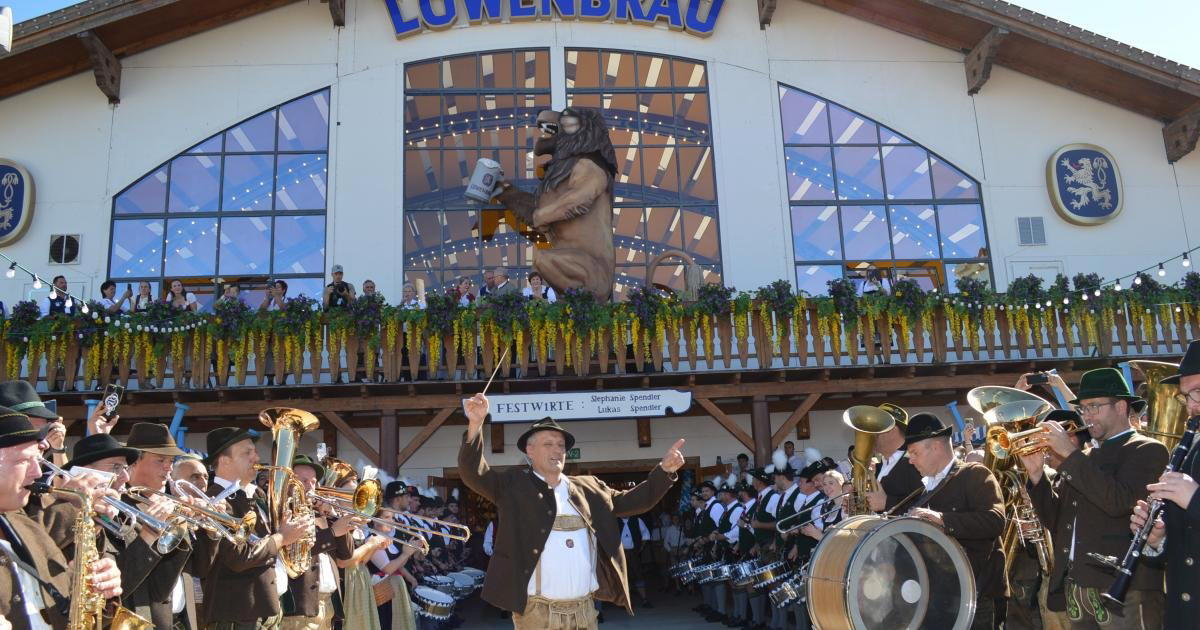
The Tent as Theatre: Approaching the Löwenbräu Festzelt
There are quieter ways to experience Munich in October, and then there is the Theresienwiese at capacity. The approach to the Löwenbräu Festzelt during Oktoberfest carries its own particular atmosphere: brass band music carrying from inside, the smell of roasting meat cutting through the autumn air, and a crowd that mixes Bavarian regulars in Tracht with visitors from every continent. The lion sculpture above the entrance — a long-standing marker of the Löwenbräu brand — functions as a navigation point in a fairground that requires one. Inside, the scale registers before anything else: thousands of seats arranged along long communal tables, a band platform at the centre, and the constant motion of servers carrying multiple Maß steins at once. This is not an intimate setting, and it was never meant to be. The Oktoberfest tent format, developed over more than two centuries on this same site, is built around communal experience at volume.
What the Beer Signals: Löwenbräu in Context
The editorial angle on any Oktoberfest tent starts with the brewery behind it. Löwenbräu holds one of the six brewing licences that restrict official Oktoberfest beer service, a list that has remained closed for decades and that defines the upper tier of Munich's civic brewing identity. The other five, Augustiner, Hofbräu, Paulaner, Hacker-Pschorr, and Spaten, each operate their own tents or tent partnerships on the Wies'n, and the competition between them is as much about heritage positioning as it is about the beer in the glass. Löwenbräu's Oktoberfest Bier is brewed specifically for the festival to the higher alcohol specification that differentiates it from the year-round lager: typically around 6.1% ABV, slightly fuller in body and with a more pronounced malt character suited to the context of a long afternoon on a communal bench.
For visitors accustomed to craft beer culture or premium spirits bars, the kind of curated back-bar experience offered at venues like Goldene Bar or Schuman's Bar in Munich, the Festzelt operates on a different logic entirely. There is no back bar to speak of, no spirits list arranged by provenance or distillery age. The offering is deliberately narrow: Löwenbräu Oktoberfest Bier by the Maß (one litre), Bavarian food, and the collective experience of the tent. That narrowness is the point. The Festzelt does not compete on curation; it competes on authenticity of format and the depth of the tradition it represents.
Food as Supporting Structure
The food programme inside the Löwenbräu Festzelt follows the pattern common across the Wies'n's major tents: roast chicken (Hendl), pork knuckle (Schweinshaxe), pretzels, and Obatzda, the spiced, blended cheese preparation that has been a fixture of Bavarian beer garden culture for generations. These dishes exist to sustain a long session rather than to headline a menu, and they are priced and prepared accordingly. The Hendl in particular, roasted in batches and served in halves, is one of the more consistent renditions of the format available on the Wies'n. None of this is fine dining by any measure, but the execution is calibrated to the setting: food that travels the length of crowded communal tables, served at speed.
Who Sits Here, and How to Reach Them
The Festzelt divides into reserved table sections and standing/unreserved areas, a structure common to all major Oktoberfest tents. Reserved tables are allocated months before the festival opens, typically from late winter or early spring for the following October, and are managed through the tent operator rather than through any centralised booking platform. The practical implication is that international visitors who arrive in Munich hoping to walk into a seated reservation during the festival's peak weekend sessions will find reserved sections full. Unreserved standing areas inside the tent do fill, but they operate on a first-come basis and require arriving well before session opening times.
This logistics reality places the Löwenbräu Festzelt in a similar position to other high-demand Munich institutions: accessible in principle, but requiring advance planning that most casual visitors underestimate. For a broader orientation to Munich's drinking culture, including venues with more flexible access and shorter booking windows, our full Munich guide maps the city's bar and beer scene across the year. Within Munich itself, the Augustiner Stammhaus and Blaue Libelle offer different registers of the city's drinking culture outside the festival window.
The Oktoberfest Tent in Germany's Wider Drinking Scene
Germany's bar culture spans a range far wider than the Wies'n suggests. The precision cocktail bars of Berlin, including Buck & Breck, operate in an entirely different register, as does Le Lion Bar de Paris in Hamburg, which built its reputation on restrained, technique-led drinks in a small-capacity format. Cologne's Bar Trattoria Celentano, The Parlour in Frankfurt, and Uerige in Dusseldorf each represent distinct regional approaches to drinking culture. Farther north, Kieler Brauerei am Alten Markt in Kiel connects brewing heritage to a very different coastal context. And for a point of comparison entirely outside the German framework, Bar Leather Apron in Honolulu shows how far the craft bar format has travelled from its European roots.
The Löwenbräu Festzelt sits outside all of these comparisons, which is precisely what defines its position. It is not competing for the same traveller as a curated spirits bar or a chef-driven restaurant. It is competing for the traveller who wants to sit inside a tradition that is, by now, more than two hundred years old and that still draws millions of visitors to the same patch of Munich every autumn.
Planning Your Visit
Oktoberfest runs for approximately sixteen to seventeen days each year, opening in late September and closing on the first Sunday in October (or October 3rd if that falls earlier). The Löwenbräu Festzelt operates within that window only; it has no year-round presence. Tent sessions run in two daily blocks: a lunchtime session opening late morning, and an evening session. Weekend sessions, particularly during the opening days, represent the highest-demand periods. Anyone travelling specifically for the tent experience, rather than as an incidental part of a Munich visit, should treat the reserved table process as a non-negotiable first step, initiated as early as the preceding spring.
Cost Snapshot
A quick peer reference to anchor this venue in its category.
| Venue | Cuisine | Price | Awards |
|---|---|---|---|
| Löwenbräu Festzelt (nur während Oktoberfest geöffnet)This venue — the venue you are viewing | Not listed | $30–50 | Not listed |
| Goldene Bar | Not listed | $20–30 | World's 50 Best #31 · Falstaff Bar - 94 Falstaff Points |
| Schuman's Bar | Cocktail Bar | $30–50 | World's 50 Best #34 · Falstaff Bar - 87 Falstaff Points |
| Champagne Characters München | Not listed | $50–100 | Star Wine List · Falstaff Wine Bar - 89 Falstaff Points |
| Frank Weinbar | Not listed | $20–30 | Star Wine List · Falstaff Wine Bar - 91 Falstaff Points |
Continue exploring
More in Munich
Bars in Munich
All bars in Munich →

Restaurants in Munich
All restaurants in Munich →
Löwenbräu Festzelt (nur während Oktoberfest geöffnet)
The drinks
- Craft beer
Details
- Lively
- Energetic
- Rustic
- Well Known
- Group Outing
- Celebration
- Beer Garden
- Historic Building
- Communal Tables
- Outdoor Terrace
- Craft Beer
Festive Bavarian hunting lodge with traditional woodwork, deer heads, and 16,000 twinkling lights creating a cozy daytime conviviality that transforms into a high-energy party vibe at night.