Augustiner Stammhaus on Neuhauser Strasse sits at the heart of Munich's oldest brewing tradition, where the house lager arrives from wooden barrels rather than pressurised tanks. This is the city's most historically grounded beer hall experience, closer to 19th-century Bavarian drinking culture than anything in the tourist corridor. Come for the unfiltered Edelstoff, stay for the vaulted rooms and the company of locals who treat this as a weekly ritual.
 Discover on Pearl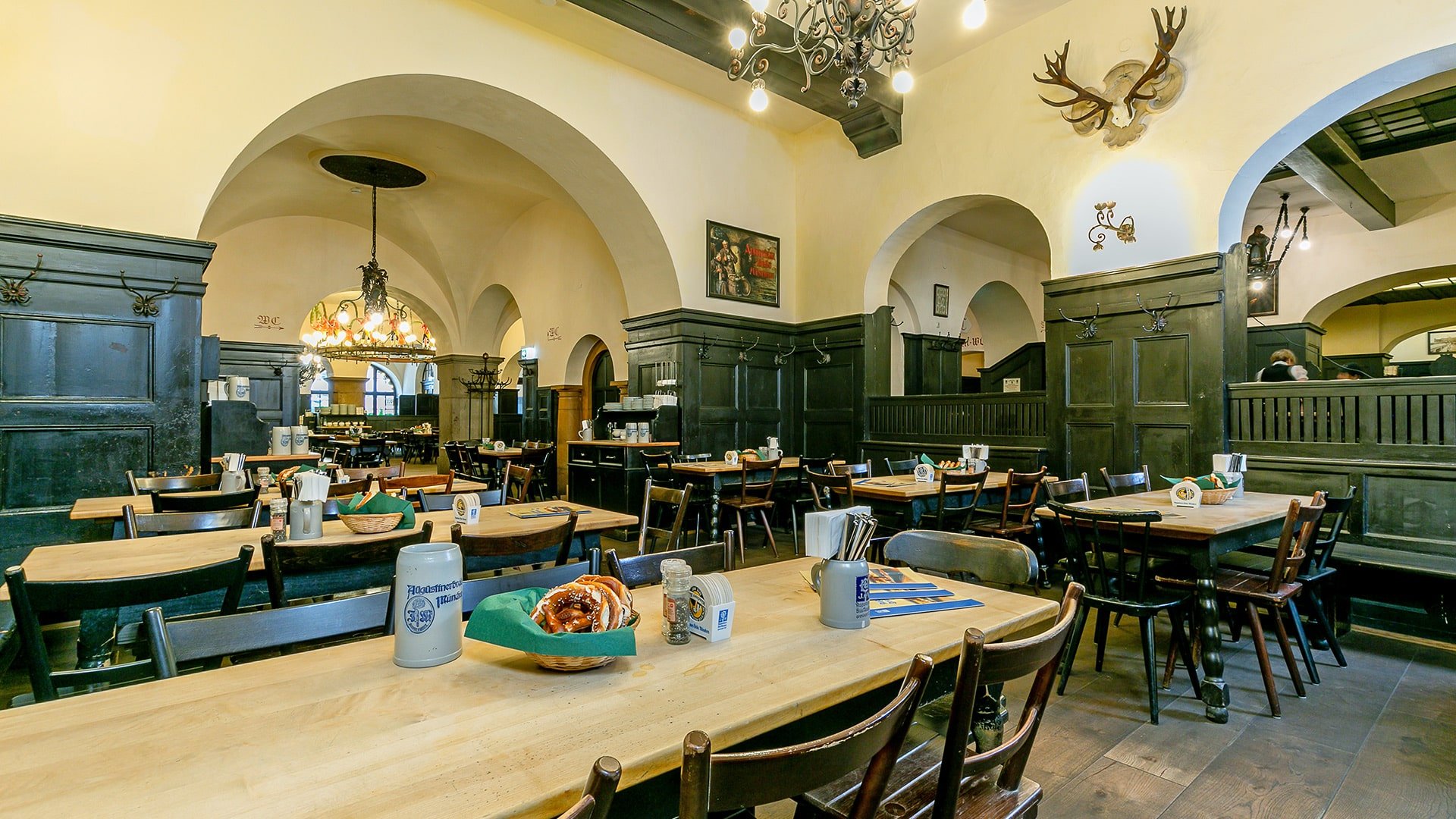
Where Beer Drinking Becomes Ritual
Approaching Augustiner Stammhaus on Neuhauser Strasse, Munich's main pedestrian artery, the building announces itself through scale rather than signage. The facade sits within the commercial stretch running from Karlsplatz toward Marienplatz, a corridor that sees as much tourist foot traffic as any in Bavaria. Yet inside, the tone shifts. Long wooden tables, vaulted ceilings, and the particular acoustic density that only comes from a room genuinely full of regulars distinguish Augustiner Stammhaus from the performance-Bavarian spaces that have multiplied around it. This is the home house of one of Munich's oldest independent breweries, and it reads like one.
Munich's beer hall tradition sits in a different category from the beer garden or the festival tent. The Stammhaus format, a permanent, year-round institution tied to a single brewery, carries a social logic that predates modern hospitality entirely. In the nineteenth century, brewery tap houses served as the primary distribution point for fresh lager, and the architecture of those spaces, deep cellars, thick walls, heavy timber, was designed around temperature management as much as dining. Augustiner Stammhaus is one of the few remaining examples of that format operating with genuine continuity rather than reconstruction.
The shortlist, unlocked.
Hard-to-book tables, cellar releases, and concierge-planned trips.
Get Exclusive Access →The Beer Programme and What It Eats With
The editorial angle here is the relationship between what arrives in the glass and what arrives on the plate, and at Augustiner Stammhaus that relationship is unusually coherent. Augustiner Bräu operates without external shareholders, a distinction that has kept its production volumes lower than the other major Munich houses and preserved a brewing approach less oriented toward consistency-at-scale. The lagers that reach the table, Helles and Dunkel being the anchors, are characterized by a freshness that makes them genuinely food-responsive rather than simply thirst-quenching.
Bavarian food pairings are often discussed in terms of heartiness, which misses the actual structure of the cuisine. Obatzda, the spiced aged cheese preparation, is built on fat and paprika and requires a beer with enough carbonation and mild hop character to cut through without competing. A well-conditioned Helles does exactly that. Weisswurst, the white veal sausage that Munich treats with near-ceremonial seriousness, is a subtler pairing than its reputation suggests: the protein is delicate enough that a Dunkel's roasted malt notes can overwhelm it. The Helles, poured fresh from the wooden barrel on the days it is available in that format, sits at the right register. These are not arbitrary observations about what goes with what; they reflect a food programme and a beer selection that have been refined alongside each other over generations.
The broader Munich drinking scene offers a range of alternatives for those calibrating their evening. Goldene Bar operates in a different register entirely, as does Schuman's Bar, long considered the reference point for serious cocktail culture in the city. Blaue Libelle and Café Luitpold occupy the mid-ground between café and bar that Munich manages better than most German cities. Augustiner Stammhaus belongs to none of those categories. Its peer set is a shrinking one: the handful of Munich houses that still operate as true brewery taprooms rather than theme restaurants wearing the costume of one.
Seasonal Rhythm and When to Visit
Munich's drinking calendar creates genuine temporal variation in how Augustiner Stammhaus operates. Spring brings the Starkbier season, the strong beer period between Ash Wednesday and late March that originated with Paulaner monks but now runs across every major Munich brewery. Augustiner's contribution to this period arrives with higher gravity and a malt density that shifts the food pairing logic significantly: richer preparations, game, and heavier charcuterie hold up where lighter dishes become secondary. This is a period when the Stammhaus fills with a mix of locals treating the stronger beer as a ritual marker and visitors who have done their research.
Summer shifts activity toward the beer garden format, and many Munich regulars migrate to outdoor venues for the warmer months. The Stammhaus itself, with its interior-heavy design, has a different seasonal appeal: it remains a year-round proposition in a way that outdoor venues cannot be. October brings the gravitational pull of Oktoberfest, which runs in the Theresienwiese tents rather than at individual Stammhäuser, but the weeks around the festival see the city's established houses fill with visitors seeking an alternative to the festival's more commercialised environment.
Placement in the German Beer Bar Tradition
Across Germany, the brewery taproom tradition takes different forms depending on region. In Düsseldorf, Uerige operates on a comparable model with Altbier as the anchor, and the food pairing logic there follows the same principle of brewery-led coherence. In Kiel, Kieler Brauerei am Alten Markt applies a northern interpretation of the same format. These are institutions whose identity is inseparable from their beer, where the kitchen programme exists in service of the drinking rather than the reverse.
For visitors moving between Germany's drinking traditions, the contrast with cocktail-led venues is instructive. The Parlour in Frankfurt, Buck and Breck in Berlin, Le Lion Bar de Paris in Hamburg, and Bar Trattoria Celentano in Cologne all represent the technical cocktail direction that German bar culture has pursued with increasing sophistication over the past decade. Augustiner Stammhaus represents the other axis: a format that has not evolved because it did not need to. Even further afield, the craft-focused precision of a venue like Bar Leather Apron in Honolulu illustrates how seriously the pairing question is taken in contemporary bar programming globally, and how different the answers look when the anchor product is lager rather than spirits.
Planning Your Visit
Augustiner Stammhaus sits at Neuhauser Strasse 27 in Munich's Altstadt, walkable from both Karlsplatz and Marienplatz S-Bahn and U-Bahn stations. The central location means it is direct to reach from most parts of the city, and equally direct to pair with an evening that continues elsewhere. No reservation is typically required for the main hall, which operates on the communal seating model standard to Munich's major houses: expect to share a table, and to be seated alongside strangers. This is part of the format's social logic rather than a limitation of it. For visitors planning around the Starkbier season or Oktoberfest adjacency, arriving earlier in the evening avoids the peak-hour density. Munich's broader food and drink scene is covered in detail in our full Munich restaurants and bars guide.
Frequently Asked Questions
- What should I expect atmosphere-wise at Augustiner Stammhaus?
- Augustiner Stammhaus operates in the traditional Bavarian beer hall format: long communal tables, a high ceiling that distributes the room's considerable noise load, and a crowd that skews toward Munich regulars alongside informed visitors. The tone is convivial rather than formal, and the communal seating model means the social temperature of your evening is partly determined by who you are seated beside. It is not a quiet dinner venue. It is one of the few remaining Munich houses where the atmosphere is a function of genuine use rather than staged design, which places it in a different category from the tourist-facing beer halls that have multiplied in the Altstadt over the past decade.
- What cocktail do people recommend at Augustiner Stammhaus?
- Augustiner Stammhaus is not a cocktail venue. Its programme is built entirely around Augustiner Bräu's lager range, with Helles and Dunkel as the core offerings. Visitors seeking cocktails in Munich are better directed toward Schuman's Bar or Goldene Bar, both of which operate serious drinks programmes in a different format. Augustiner's reputation rests on the quality and freshness of its beer, and ordering outside that range misses the point of the venue entirely.
- Is Augustiner Stammhaus the right choice if I want to try traditional Bavarian food alongside fresh Munich lager?
- For the pairing of Bavarian food with fresh Augustiner lager, the Stammhaus is the reference address in Munich. As the home house of one of the city's oldest independent breweries, it offers the beer at its freshest, in some cases poured directly from wooden barrels, alongside a kitchen programme built around the same food and beer traditions that defined Bavarian hospitality for centuries. The combination of Obatzda, Weisswurst, and a properly conditioned Helles in this setting is as close to the original format as Munich currently offers.
Peers in This Market
Comparable options at a glance, pulled from our tracked venues.
| Venue | Cuisine | Price | Notes |
|---|---|---|---|
| Augustiner Stammhaus | This venue | ||
| Goldene Bar | |||
| Schuman's Bar | |||
| Blaue Libelle | |||
| Champagne Characters München | |||
| Frank Weinbar |
Need a Table?
Our members enjoy priority alerts and concierge-led booking support for the world's most difficult bars and lounges.
Get Exclusive AccessThe shortlist, unlocked.
Hard-to-book tables, cellar releases, and concierge-planned trips.
Get Exclusive Access →