
One of Franconia's most historically significant wine estates, Weingut Juliusspital operates from its baroque foundation in central Würzburg and holds a Pearl 3 Star Prestige rating (2025). The estate sits within a peer group of institutionally rooted German wineries whose vineyards predate modern appellations by centuries. Visitors encounter that continuity directly, from the cellars beneath Klinikstraße to the wines themselves.
Franconia's Institutional Wineries: A Different Kind of Prestige
German wine has two distinct prestige registers. The first belongs to family estates where a surname on the label carries generational weight — houses like Weingut Bassermann-Jordan in Deidesheim or Schloss Vollrads in Oestrich-Winkel, where the lineage of a single family shapes house style across decades. The second register is older and, in some ways, stranger: the institutional estate, founded not by a family but by a hospital, a monastery, or a civic endowment, and still operating under that original mandate. Weingut Juliusspital in Würzburg belongs firmly to the second category, and understanding that distinction clarifies almost everything about the estate's character.
Founded in 1576 by Prince-Bishop Julius Echter von Mespelbrunn as a charitable foundation attached to the Juliusspital hospital, the estate has never been a private commercial enterprise in the conventional sense. Its profits have historically supported the hospital's operations. That structural fact — a winery whose output funds healthcare , places it alongside Weingut Bürgerspital zum Heiligen Geist, Würzburg's other great charitable wine foundation, in a category that has no real equivalent outside Germany's historical wine regions. Both estates have tended the same Franconian slopes for centuries, and both sit within walking distance of each other in the city centre. The comparison is useful: Bürgerspital draws from different parcels and carries its own institutional identity, but together they define what Würzburg means as a wine destination in a way that no single family estate could replicate.
The Baroque Setting and What It Signals
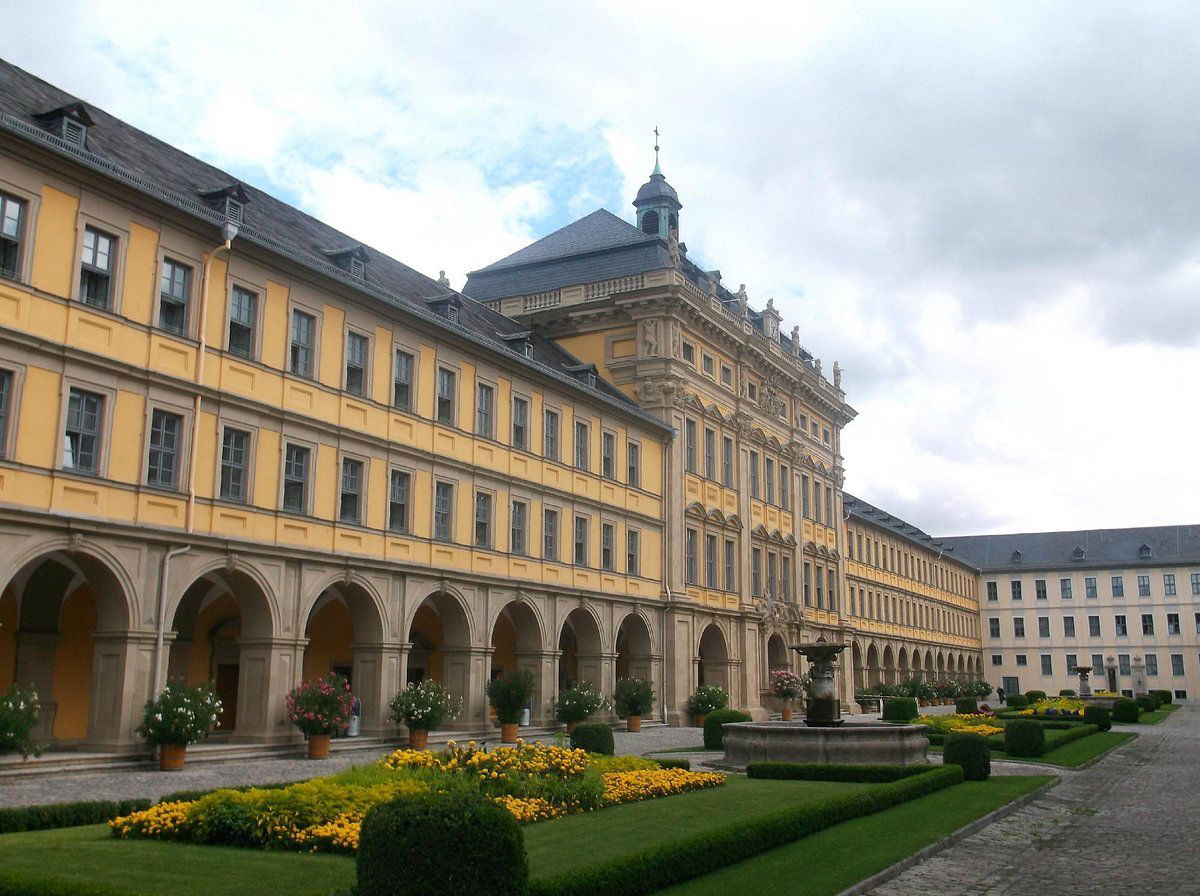
The estate's address , Klinikstraße 1, at the heart of the old city , is itself a statement. Most of Germany's prestigious wine operations are located in villages along river valleys, surrounded by their own vineyards. Juliusspital sits in an urban baroque complex, its cellars running beneath a hospital courtyard that was designed as an architectural ensemble, not merely a functional building. That urban embeddedness shapes the visitor experience in ways that differ from rural estate visits. You arrive through the city, not through vineyard roads, and the cellar entrance places you immediately inside the institution's history rather than its agricultural geography.
The baroque architecture signals a particular moment in Franconian wine history: the late sixteenth and seventeenth centuries, when ecclesiastical and aristocratic patrons were the primary drivers of viticultural investment in the region. Estates like Kloster Eberbach in Eltville represent the same impulse in the Rheingau , monastic foundations that accumulated prime vineyard land over centuries and whose physical infrastructure still organises the wine operation today. At Juliusspital, the continuity between the original institutional mission and current production is direct and unbroken, which is comparatively rare in European wine.
Franconian Silvaner and the Regional Argument
Franconia's wine identity is built around Silvaner in a way that no other German region can claim. While Riesling dominates the Mosel, Rheingau, and Nahe , estates like Weingut Clemens Busch in Pünderich and Schlossgut Diel in Rümmelsheim working Riesling at serious levels , Franconia's distinct contribution to German wine culture has always been its argument that Silvaner, given the right soils and serious winemaking attention, produces wines of equivalent complexity and age-worthiness.
That argument is easiest to make from the region's three classified sites: Würzburger Stein, Würzburger Innere Leiste, and Randersackerer Pfülben, among others. Juliusspital holds significant parcels in several of these sites, which places it in the conversation about Franconia's top-tier Silvaner and Riesling expressions. The Würzburger Stein is one of Germany's most historically documented single vineyard sites, cited in wine literature going back centuries, and the estates that hold substantial Stein parcels operate in a different register from those working less prestigious ground.
Silvaner's appeal to wine professionals and serious collectors has grown measurably over the past decade, partly as a corrective to Riesling's dominance in German fine wine discourse, and partly because Silvaner's texture , less overtly aromatic, more mineral and saline on the palate , fits the broader shift in professional taste toward restraint-forward whites. Franconia benefits from that shift, and estates like Juliusspital, which have treated Silvaner seriously for generations when it was commercially unfashionable, are well positioned within it. The same structural trend benefits producers in other regions who have worked less commercially obvious grape varieties at high levels, from Weingut Battenfeld-Spanier in Hohen-Sülzen to Weingut A. Christmann in Neustadt an der Weinstraße.
Recognition and Where Juliusspital Sits in Its Peer Group
Juliusspital holds a Pearl 3 Star Prestige rating from EP Club in 2025, which places it in the upper tier of German estate recognition on this platform. Within Würzburg specifically, that rating positions it alongside Bürgerspital as one of the two institutional estates that define the city's wine identity. Internationally, the estate's peer group includes other historically grounded German houses with strong site holdings and a long track record of serious Silvaner and Riesling production.
The institutional model , where winemaking accountability sits within a foundation structure rather than a family succession , has both advantages and constraints. It tends to produce a conservative house style and long-term site stewardship, since there is no generational turnover forcing reinvention. The wines reflect accumulated knowledge of specific parcels rather than a winemaker's personal pivot. For collectors and visitors who prefer that kind of continuity, Juliusspital represents a specific type of quality assurance that family estates, however talented, cannot replicate in quite the same way. For comparable estates operating outside Germany's wine regions, the institutional continuity at Abadía Retuerta in Sardón de Duero offers a useful parallel, even across very different wine cultures.
Planning Your Visit to Würzburg's Wine Quarter
Weingut Juliusspital is located at Klinikstraße 1 in central Würzburg, within the historic hospital complex. The estate is accessible on foot from Würzburg's main station and from the Altstadt. As with most German estate visits, advance contact to confirm tasting formats and current cellar access is advisable; the institutional structure means that operations are run differently from a family winery's direct-sales model. Würzburg's broader wine offering makes it worth spending at least two days in the city: the combination of Juliusspital, Bürgerspital, and the city's wider restaurant and bar scene creates a coherent itinerary for anyone serious about Franconian wine. Our full Würzburg wineries guide covers the complete picture. For dining around your visit, see our full Würzburg restaurants guide, and for where to stay, our full Würzburg hotels guide. The Würzburg bars guide and experiences guide round out the planning picture for a longer stay.
Frequently Asked Questions
What should I taste at Weingut Juliusspital?
The starting point for any serious tasting at Juliusspital is Silvaner from the estate's classified Franconian sites, particularly from parcels in Würzburger Stein, which is among Germany's most historically documented single vineyard sites. The estate's Riesling from premier parcels is a secondary focus worth attention. Both varieties benefit from the Keuper and shell limestone soils that define Franconia's leading sites, and both carry the mineral, restrained character that the region's leading wines share. The Pearl 3 Star Prestige rating (2025) reflects consistent performance at the upper end of Franconian production, which gives the site-specific bottlings particular credibility.
What makes Weingut Juliusspital worth visiting?
The combination of historical depth, site quality, and institutional continuity places Juliusspital in a category that few European wine estates occupy. Founded in 1576, housed in a baroque complex at the centre of Würzburg, and holding parcels in Franconia's most respected classified sites, it offers a visit that is simultaneously about wine quality and about understanding how German wine culture was built. The Pearl 3 Star Prestige recognition (2025) confirms its current standing within that tradition. For visitors arriving from outside Germany, Würzburg is reachable from Frankfurt in under two hours by train, which makes Juliusspital a realistic day trip or short-stay destination from a major hub. The estate operates within a city that, as Aberlour in Aberlour represents for Speyside whisky, functions as both a production centre and an accessible entry point for serious engagement with a regional tradition.
Cuisine and Credentials
A small set of peers for context, based on recorded venue fields.
| Venue | Classification | Awards | First Vintage | Notes |
|---|---|---|---|---|
| Weingut Juliusspital | 1 awards | This venue | ||
| Jacquart | 1 awards | 1962 | ||
| Lingua Franca | 1 awards | 2015 | ||
| Schloss Vollrads | World's 50 Best | |||
| Weingut Bürgerspital zum Heiligen Geist | 1 awards | |||
| Kloster Eberbach | 1 awards |
Access the Cellar?
Our members enjoy exclusive access to private tastings and priority allocations from the world's most sought-after producers.
Access the Concierge