
One of Franconia's most historically rooted wine estates, Weingut Bürgerspital zum Heiligen Geist has operated from its Theaterstraße address in central Würzburg for centuries, with its holdings spanning the region's celebrated Silvaner and Riesling vineyards. Recognised with a Pearl 3 Star Prestige award in 2025, the estate represents the institutional tier of German viticulture, where charitable foundation ownership and deep terroir continuity shape the wines as much as any individual winemaker.
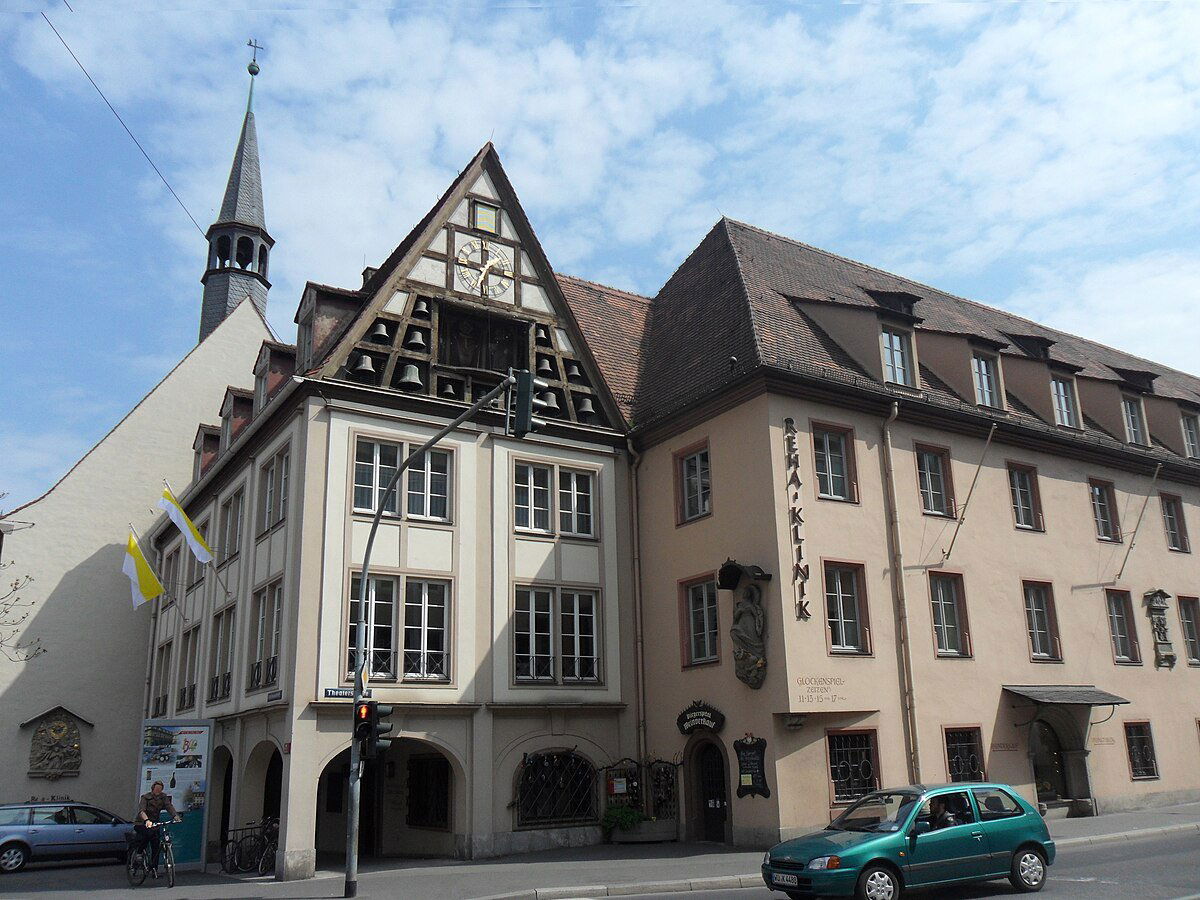
Würzburg's Charitable Wine Tradition and the Estate at Theaterstraße
Approaching Bürgerspital's premises on Theaterstraße in central Würzburg, you encounter an architectural register that German wine country rarely matches. The estate's stone-faced buildings carry the weight of an institution built not around a family's ambitions but around a hospital foundation dating to the medieval period. That civic and charitable origin distinguishes Bürgerspital from virtually every other significant German winery: its vineyards exist to fund welfare, and that founding logic has shaped the estate's continuity across upheavals that dismantled peer institutions. In Franconia, where wine and civic life have been intertwined since the Bishops of Würzburg controlled the region's most productive slopes, Bürgerspital represents a particular expression of that relationship, one where the land's stewardship was never purely commercial.
For context on the broader institutional tier of German wine estates, Kloster Eberbach in Eltville and Schloss Vollrads in Oestrich-Winkel occupy similar positions in the Rheingau, where long-tenure stewardship of historic sites shapes the wines' identity as much as annual vintage decisions. Bürgerspital's Franconian equivalent carries the added dimension of the Bocksbeutel, the flat-bellied bottle that functions almost as a regional mark of origin and signals a wine culture that has resisted external aesthetic pressures for centuries.
Terroir at the Core: What Franconia's Soils Produce
The editorial angle on any serious Franconian estate starts with geology. Würzburg and its surrounding slopes sit on three distinct soil formations: Muschelkalk (Triassic limestone), Keuper (a layered mix of clay, marl, and sandstone), and Buntsandstein (coloured sandstone). Each produces wines with a different structural signature, and Bürgerspital's holdings, spread across several of Franconia's classified vineyard sites, bring all three expressions into the estate's range. Muschelkalk soils are the most celebrated in the region for Silvaner, producing wines with a mineral tension and saline dryness that bears little resemblance to Silvaner from the warmer, richer soils of Baden or Alsace. The grape itself, long considered workaday elsewhere, here becomes a vehicle for one of German wine's most precise terroir arguments.
Silvaner's rehabilitation as a serious variety tracks closely with Franconia's insistence on its primacy. While Riesling dominates export conversations about German wine quality, Franconian estates have consistently made the case that Silvaner on Muschelkalk is among Germany's most site-specific expressions, and that its low aromatic profile is a feature rather than a deficiency, allowing the soil's mineral character to project without interference. Bürgerspital's estate-scale holdings in classified sites give it the range to demonstrate these differences vineyard by vineyard, a comparative exercise that suits the 2025 Pearl 3 Star Prestige recognition, awarded in a competitive tier that demands both consistency and site specificity.
For those tracking how the Pfalz handles comparable terroir arguments with different varieties, Weingut Bassermann-Jordan in Deidesheim and Weingut A. Christmann in Neustadt an der Weinstraße represent the Riesling-forward counterpart to Franconia's Silvaner case. The Mosel's terroir logic runs in a different direction again, with Weingut Clemens Busch in Pünderich working Devonian slate in ways that underline just how soil-dependent German wine identity remains across its regions.
Scale, Holdings, and What Institutional Ownership Changes
German wine estates with charitable or institutional ownership structures function differently from family-owned peers at a fundamental level. The absence of succession pressure removes one of the most common sources of stylistic discontinuity: the generational pivot. Bürgerspital has been able to maintain long-term vine age in key parcels and resist replanting cycles driven by commercial urgency rather than terroir logic. Old Silvaner vines on Muschelkalk produce smaller yields with more concentrated mineral character, and estates with institutional patience are better positioned to protect that material than those facing inheritance events or financial restructuring.
The charitable foundation model also affects pricing posture. Bürgerspital is not a prestige boutique producing fifty cases for allocation lists. Its scale means the wines circulate in the market at prices that reflect Franconian rather than international collector positioning, which is why the estate sits in a different competitive conversation from single-vineyard micro-producers like Weingut Battenfeld-Spanier in Hohen-Sülzen or Schlossgut Diel in Rümmelsheim, both of which operate at smaller scale with collector-market pricing. The estate's closest institutional peer in Würzburg is Weingut Juliusspital, which shares the charitable foundation model and similarly large holdings across Franconia's classified sites. Together, the two estates define an institutional tier within Würzburg's wine identity that has no direct parallel in any other German wine city.
Visiting and Planning in Context
Bürgerspital's address at Theaterstraße 19 in central Würzburg places it within walking distance of the city's main cultural and hospitality quarter. Würzburg is a compact wine city and operates comfortably as a two-to-three day base for Franconian wine exploration: the Marienberg Fortress across the Main river, the Residenz palace complex, and the riverside wine taverns along the Kranenkai all fall within a short radius. The estate's own Weinstuben (wine tavern) has historically been one of the most direct ways to access the wines in context, though visitors should confirm current opening arrangements directly before planning around it.
Franconia's wine season runs strongest between late spring and early autumn, with harvest period in September and October bringing the most activity across estates. Würzburg in winter is considerably quieter, though the Advent market season shifts that briefly. For regional accommodation and dining context before or after visiting, our full Würzburg hotels guide and our full Würzburg restaurants guide cover the city's hospitality range. Those exploring beyond wine will find the city's bar and experience programming in our full Würzburg bars guide and our full Würzburg experiences guide. For the full scope of estate wineries operating in the region, our full Würzburg wineries guide maps the city's broader production landscape. Comparative reference points further afield include Abadía Retuerta in Sardón de Duero, where monastic-origin estate viticulture takes a very different direction in Castilla y León, and Aberlour in Aberlour, which represents a parallel long-tenure institutional model in Scottish whisky production.
Frequently Asked Questions
- What's the vibe at Weingut Bürgerspital zum Heiligen Geist?
- The atmosphere is institutional in the leading sense: historic stone architecture, a charitable foundation origin that pre-dates most of Europe's celebrated wine estates, and a wine identity rooted in Würzburg's civic culture rather than in personal branding. It sits firmly in the prestige tier of Franconian wine, confirmed by the 2025 Pearl 3 Star Prestige award, and operates at a scale that distinguishes it from boutique producers. Visitors come for the direct encounter with one of Germany's most continuous wine traditions, not for novelty or spectacle.
- What wines is Weingut Bürgerspital zum Heiligen Geist known for?
- Franconia's wine identity is built on Silvaner, and Bürgerspital's holdings across the region's Muschelkalk, Keuper, and Buntsandstein soil formations give the estate the range to demonstrate why. Silvaner on Triassic limestone produces some of Germany's most mineral and structurally dry white wines, a regional argument the estate has sustained across centuries of continuous production. Riesling from the same classified sites rounds out the range, and both varieties arrive in the traditional Bocksbeutel bottle that functions as Franconia's regional signature. The 2025 Pearl 3 Star Prestige recognition places the estate among Germany's most consistently rated producers in its category.
Credentials Lens
A quick snapshot of similar venues for side-by-side context.
| Venue | Classification | Awards | First Vintage | Notes |
|---|---|---|---|---|
| Weingut Bürgerspital zum Heiligen Geist | 1 awards | This venue | ||
| Jacquart | 1 awards | 1962 | ||
| Lingua Franca | 1 awards | 2015 | ||
| Schloss Vollrads | World's 50 Best | |||
| Weingut Juliusspital | 1 awards | |||
| Kloster Eberbach | 1 awards |
Access the Cellar?
Our members enjoy exclusive access to private tastings and priority allocations from the world's most sought-after producers.
Access the Concierge