Schlossgut Diel

Schlossgut Diel sits in the Nahe wine country outside Rümmelsheim, where slate and sandstone soils have long shaped some of Germany's most precise Rieslings. Recognised with a Pearl 3 Star Prestige award in 2025, the estate occupies a position among the region's leading producers, drawing visitors who want direct engagement with terroir-driven German white wine at a serious level.
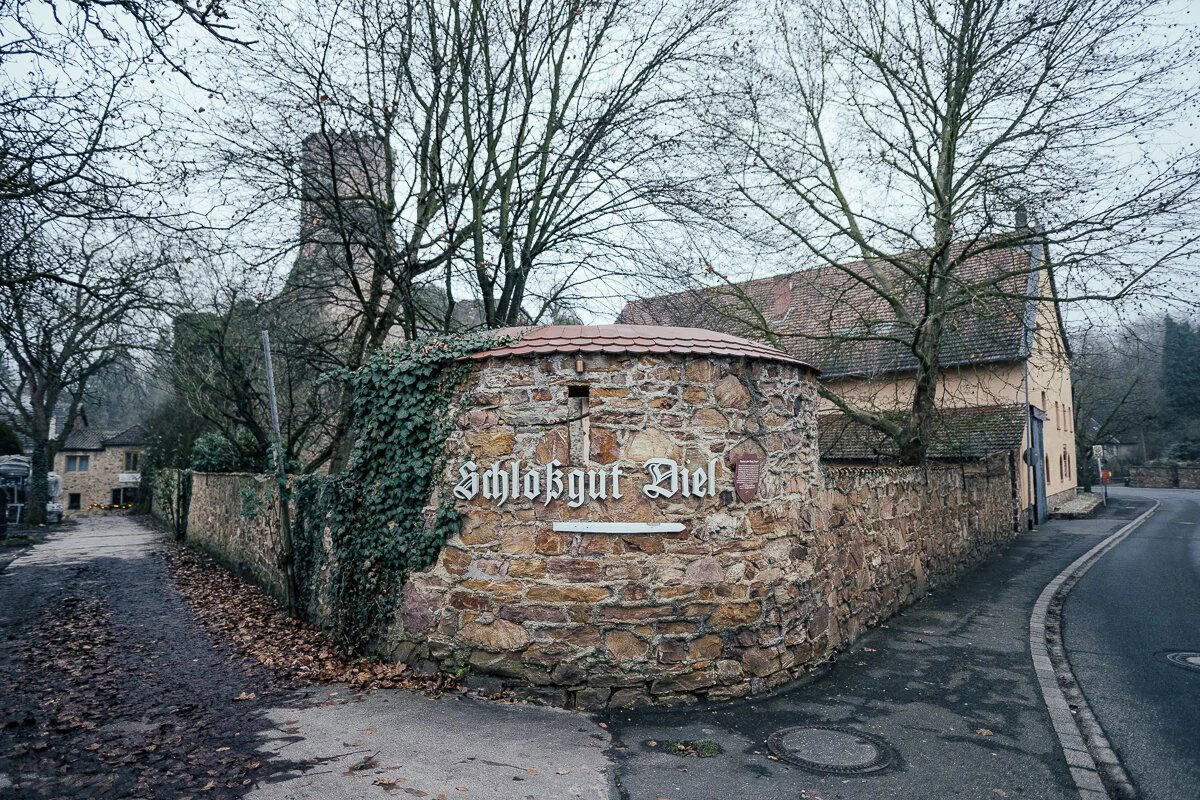
Where the Nahe Writes Its Own Rules
The Nahe Valley sits between the Mosel and the Rhine in a way that resists easy categorisation. Its soils shift from blue slate to volcanic porphyry to red sandstone within kilometres, and that geological restlessness produces wines that neither region can replicate. Rümmelsheim, a village of modest scale on the Nahe's middle reaches, is not a destination that announces itself. The road in from Bad Kreuznach follows the river through a corridor of vines, and Schlossgut Diel, at Burg-Layen 16, arrives as a working estate rather than a tourist attraction: stone buildings, a courtyard, the quiet authority of a property that has been making wine for generations.
That quiet authority is the point. In a country where wine estates are increasingly competing on experience design and visitor infrastructure, the Nahe's leading producers have largely held to a different model. The wine is the experience. Schlossgut Diel's 2025 Pearl 3 Star Prestige recognition reflects where the estate sits in that peer group: at the upper tier of German wine production, measured against producers whose reputations rest on what is in the bottle rather than what surrounds it. For the full picture of what Rümmelsheim and its surroundings offer beyond the cellar door, our full Rümmelsheim wineries guide maps the region's broader production landscape.
Terroir as Argument
The Nahe's soil complexity is not incidental to what Schlossgut Diel produces; it is the argument. The estate draws from sites where geology changes block by block, and in German wine, site specificity carries legal and reputational weight. The Einzellage system means that Goldloch, Burgberg, and Pittermännchen, three of the Nahe's most discussed vineyard sites, each carry a distinct identity on paper and in the glass. Estates that hold parcels in these sites are, in effect, making claims about the earth itself, not simply about winemaking technique.
This is the frame through which Schlossgut Diel's position makes most sense. The Nahe sits outside the international marketing power of the Mosel or Rheingau, but that relative obscurity has a consequence: the wines tend to reflect site before style. Compared to estates like Kloster Eberbach in Eltville or Schloss Vollrads in Oestrich-Winkel, which carry the full institutional weight of the Rheingau and its centuries of documented prestige, the Nahe operates with less received authority and more earned specificity. That distinction matters to the kind of drinker drawn to Schlossgut Diel.
Germany's serious Riesling producers have spent the last two decades in a conversation about how much intervention the grape requires, and the answer, at the premium end, has moved decisively toward restraint. The minerals in the glass should come from the ground, not the winery. This positions the Nahe's leading estates alongside a broader movement in German wine that includes producers such as Weingut A. Christmann in Neustadt an der Weinstraße and Weingut Battenfeld-Spanier in Hohen-Sülzen, both operating within the VDP's framework of classified site hierarchy.
The Estate and Its Peer Set
Schlossgut Diel's Pearl 3 Star Prestige award in 2025 places it in a specific stratum of German wine recognition. Within the country's premium tier, the competitive set includes estates from the Mosel, the Pfalz, and Franken, all working the same fundamental variety under different climatic and geological conditions. Weingut Bassermann-Jordan in Deidesheim operates in Pfalz's warmer, richer register; Weingut Clemens Busch in Pünderich works the Mosel's steep slate terraces; Weingut Bürgerspital zum Heiligen Geist in Würzburg brings Franken's continental weight. Each of these represents a different answer to what German Riesling can be, and Schlossgut Diel's answer is distinctly Nahe in character: cooler than the Pfalz, less dramatically steep than the Mosel, mineralogically diverse in ways that allow for variation across a single estate's range.
For drinkers navigating the upper tier of German wine, the Nahe's value proposition relative to more famous appellations has become increasingly well understood. Production volumes are smaller, secondary market prices are lower than the Mosel's celebrity sites, yet the quality ceiling is comparable. Schlossgut Diel sits near that ceiling on the Nahe.
Coming to Rümmelsheim
Visiting wine estates in this part of Germany requires a different rhythm than a city restaurant or urban tasting bar. Rümmelsheim is reachable by car from Frankfurt in under two hours, and Bad Kreuznach, the Nahe's main town, sits close enough to serve as a base. The estate itself is a working property, and visits typically require advance arrangement; contact through the estate directly is advisable before arrival. There is no walk-in counter culture here. The expectation on both sides is engagement: a visitor who has done the reading, knows the sites by name, and wants to understand the vintage in the glass.
Given the estate's positioning, it makes sense to frame a visit within a wider Nahe circuit. The region has enough premium producers to fill two or three days without repetition, and the valley's terrain, particularly as it tightens toward Monzingen in the south, rewards time spent simply looking at the vineyards that produce the wines. Our full Rümmelsheim experiences guide covers how to structure a visit to the region beyond the cellar door, and our full Rümmelsheim hotels guide covers accommodation across the area. For dining around any estate visit, the full Rümmelsheim restaurants guide and full Rümmelsheim bars guide offer relevant options at different price points.
Internationally, the reference frame for estate visits of this kind extends well beyond Germany. Abadía Retuerta in Sardón de Duero offers a different model of winery hospitality, one with a hotel and restaurant integrated into the estate. Weingut Dr. Bürklin-Wolf in Wachenheim an der Weinstraße represents the Pfalz's version of this same serious-estate register. Each offers a comparison point for what premium German wine hospitality looks like across different regional contexts.
Planning Your Visit
Schlossgut Diel is at Burg-Layen 16, 55452 Rümmelsheim. The estate's 2025 Pearl 3 Star Prestige recognition places it among the Nahe's most formally acknowledged producers, and visits are leading treated as appointments rather than drop-ins. Harvest months, typically September and October on the Nahe, represent the most active period on the estate, and spring, when wines from the previous vintage are being opened and assessed, offers its own logic for a visit. Summer provides the most direct access to the region's landscape alongside the cellar.
Frequently Asked Questions
What kind of setting is Schlossgut Diel?
Schlossgut Diel is a working wine estate in Rümmelsheim, in Germany's Nahe Valley. The address, Burg-Layen 16, places it in agricultural countryside rather than a visitor-oriented wine town. The setting is consistent with how the estate presents its wines: substance over performance. Its 2025 Pearl 3 Star Prestige recognition confirms it as one of the region's upper-tier producers.
What do visitors recommend trying at Schlossgut Diel?
The Nahe's signature is Riesling expressed through a range of geological site types, and Schlossgut Diel's reputation, underlined by its Pearl 3 Star Prestige award, centres on that site-specific expression. Visitors focused on understanding the region tend to work through the estate's classified site wines, which reflect the Nahe's volcanic and slate soils most directly. No specific menu or tasting programme details are available through EP Club's current data.
What is Schlossgut Diel known for?
The estate is known as one of the Nahe's reference producers for serious, site-expressive Riesling. Its 2025 Pearl 3 Star Prestige recognition places it in a tier of German wine estates evaluated against the country's highest production standards. Within the Nahe specifically, it represents the argument that the valley's geological diversity translates into wines with clear individuality across different parcels.
Is Schlossgut Diel reservation-only?
No walk-in details are available through EP Club's current data, but working estates of this category in Germany typically receive visitors by appointment. If you are planning a visit and the estate's award profile and Nahe positioning matter to the decision, contacting the property directly before travel is the standard approach. The estate's website and phone contact are not currently listed in EP Club's database; direct research to the address at Burg-Layen 16, Rümmelsheim is the recommended first step.
Pricing, Compared
A short peer set to help you calibrate price, style, and recognition.
| Venue | Classification | Awards | First Vintage | Notes |
|---|---|---|---|---|
| Schlossgut Diel | 1 awards | This venue | ||
| Jacquart | 1 awards | 1962 | ||
| Lingua Franca | 1 awards | 2015 | ||
| Schloss Vollrads | World's 50 Best | |||
| Kloster Eberbach | 1 awards | |||
| Weingut A. Christmann | 1 awards |
Access the Cellar?
Our members enjoy exclusive access to private tastings and priority allocations from the world's most sought-after producers.
Access the Concierge