
Weingut Clemens Busch operates from the steep slate vineyards above Pünderich on the Moselle, producing Rieslings that carry the mineral imprint of their sites with unusual precision. The estate holds a Pearl 3 Star Prestige rating for 2025, placing it among Germany's most recognised producers. Visiting here means engaging directly with one of the Moselle's most geologically expressive growing zones.
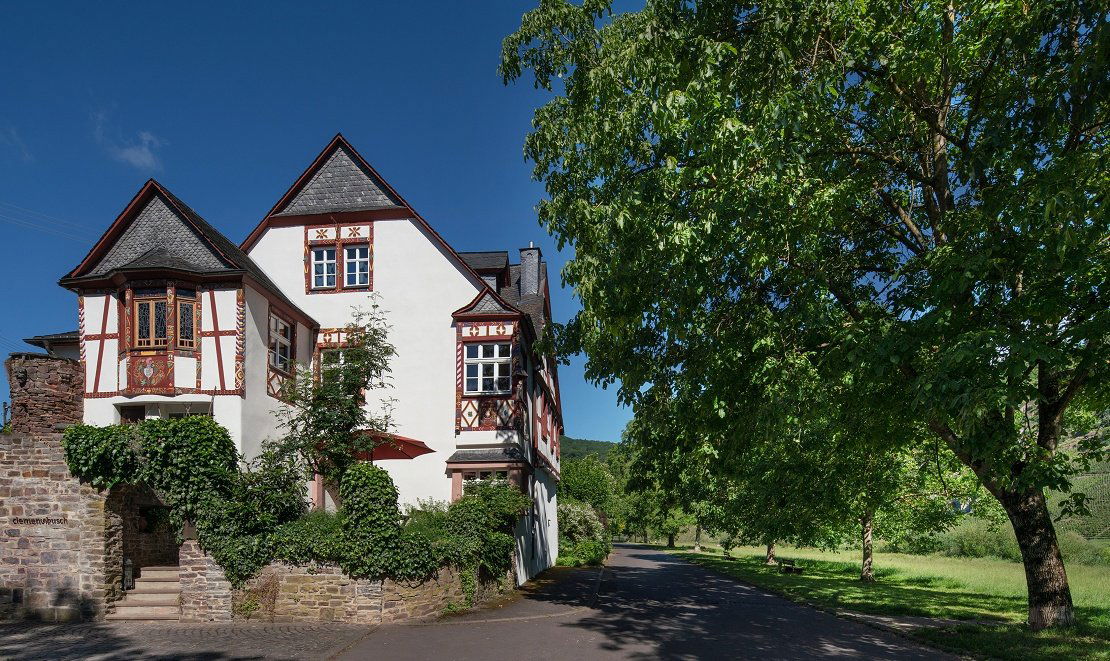
Slate, River Bend, and the Moselle's Mineral Grammar
The lower Moselle between Cochem and Zell does not announce itself the way the middle Moselle does. There are no postcard towns crowded with summer visitors, no single vineyard name that registers immediately with the wine-buying world at large. What this stretch offers instead is geology: a continuous exposition of Devonian blue slate that runs through the hillsides in thick, crumbling layers, absorbing heat during the day and radiating it back at night, draining water with unusual efficiency, and transmitting a particular mineral character into every vine that roots through it. Pünderich sits inside this corridor, and Weingut Clemens Busch, at Kirchstraße 37, works within its terms rather than against them.
The village itself is small enough that arriving by car along the river road feels more like a discovery than a destination. The Moselle curves sharply here, and the vineyards rise at gradients that make mechanisation impossible — the defining condition of this part of the valley. Steep-slope viticulture on the lower Moselle is not a branding decision; it is the physical reality that has shaped every production choice estates like Clemens Busch make, from harvest timing to cellar practice. For context on how that compares across German wine regions, see our full Pünderich wineries guide.
What a Pearl 3 Star Prestige Rating Means in Context
Weingut Clemens Busch carries a Pearl 3 Star Prestige rating for 2025. Within the Pearl classification framework, the Prestige tier at three stars places the estate in a small cohort of producers whose work is assessed not just as consistent but as category-defining at a national level. The Moselle has a number of estates that hold serious critical standing — Kloster Eberbach in Eltville and Schloss Vollrads in Oestrich-Winkel represent the kind of historical institutional weight that anchors German wine's upper tier , but the distinction for an estate like Clemens Busch is that its recognition derives from site fidelity rather than historical prestige or scale.
Compared with Nahe producers such as Schlossgut Diel in Rümmelsheim, or Pfalz estates including Weingut A. Christmann in Neustadt an der Weinstraße and Weingut Bassermann-Jordan in Deidesheim, Clemens Busch operates in a fundamentally different geological register. Those regions work with sandstone, loess, and limestone soils that tend toward broader, more generously textured Rieslings. The blue and red slate of the lower Moselle pulls wine toward tension and mineral definition. The award, in that light, reflects recognition of a particular kind of precision rather than a general quality benchmark applied uniformly across German production.
Terroir as the Argument
The central editorial fact about Clemens Busch is that its reputation rests on site differentiation at a granular level. The lower Moselle's Marienburg vineyard, which encompasses several parcels of varying slate composition, has been the vehicle through which the estate has made its case to the international market. In serious Riesling circles, the distinction between blue slate and red slate parcels within a single vineyard is treated not as marketing nuance but as a measurable difference in wine character: blue slate tends to yield wines with a cooler, more austere mineral line; red slate produces something rounder, with a darker-fruited quality.
This kind of within-site differentiation mirrors what Burgundy's premier and grand cru system formalises, but on the Moselle it operates outside a codified classification hierarchy. The VDP classification system (Verband Deutscher Prädikatsweingüter) provides some scaffolding through its Grosse Lage designation, which identifies sites of documented historic quality. The fact that Clemens Busch works within this framework while also distinguishing between geological sub-parcels reflects the ambition that separates upper-tier Moselle estates from simply competent producers.
Estates in other German regions pursuing a similarly site-specific argument include Weingut Battenfeld-Spanier in Hohen-Sülzen and Weingut Dr. Bürklin-Wolf in Wachenheim an der Weinstraße, both of which have used their VDP membership and single-vineyard focus to build international credibility. The methods differ , Rheinhessen and Pfalz soils demand different farming approaches , but the underlying logic of terroir articulation connects them.
For reference on how institutional-scale German wine production handles the same question of site expression differently, Weingut Bürgerspital zum Heiligen Geist in Würzburg manages a vast Franconian portfolio across multiple sites, where consistency across a large range takes precedence over maximum expression from any single parcel. Clemens Busch represents the opposite end of that spectrum.
Planning a Visit to Pünderich
Pünderich is a working village, not a wine tourism hub, and approaching a visit to Weingut Clemens Busch with that understanding sets appropriate expectations. The estate is at Kirchstraße 37 , a short walk from the river road that runs through the village. Reaching Pünderich by road from Cochem takes under 30 minutes; from Trier, the drive follows the Moselle upstream for roughly an hour. The nearest train station with regular regional connections is Bullay, a few kilometres away, where a small car ferry also crosses the river.
Given that no current booking details or visitor hours are available through EP Club's verified data, contacting the estate directly before making the journey is the practical approach. Estate visits in this part of the Moselle tend to be by appointment, particularly for producers working at this level of critical recognition , demand for cellar tastings typically exceeds casual walk-in capacity, especially during harvest and the spring tasting season (April through June).
If you are planning a broader Moselle itinerary, Pünderich works well as a quieter complement to more visited towns like Bernkastel-Kues or Traben-Trarbach. For eating, drinking, and staying in the area, see our full Pünderich restaurants guide, our full Pünderich hotels guide, our full Pünderich bars guide, and our full Pünderich experiences guide. For wine-focused travel beyond Germany, Abadía Retuerta in Sardón de Duero and Aberlour in Aberlour represent two quite different expressions of estate-level production worth comparing against the German slate tradition.
Frequently Asked Questions
- How would you describe the overall feel of Weingut Clemens Busch?
- Clemens Busch operates in the register of a serious, site-focused estate rather than a visitor attraction. Pünderich is a small lower Moselle village with a working agricultural character, and the estate reflects that. The Pearl 3 Star Prestige rating for 2025 confirms its position at the leading of German Riesling's critical hierarchy, which means the experience of visiting , when appointments are available , is oriented toward understanding the wines and their vineyard origins rather than hospitality theatre. Pricing sits within the premium Moselle tier, consistent with that level of recognition.
- What do visitors recommend trying at Weingut Clemens Busch?
- The estate's standing in the Moselle derives from its work with the Marienburg vineyard's slate parcels, particularly the differentiation between geological sub-sites that the winery has pursued over multiple vintages. Any tasting focused on these single-vineyard Rieslings , especially those that show the contrast between blue and red slate expression , engages with the core argument the estate has been making to international critics. The Pearl 3 Star Prestige award in 2025 reflects that this argument has been received at the highest level of German wine recognition.
How It Stacks Up
A quick context table based on similar venues in our dataset.
| Venue | Classification | Awards | First Vintage | Notes |
|---|---|---|---|---|
| Weingut Clemens Busch | 1 awards | This venue | ||
| Jacquart | 1 awards | 1962 | ||
| Lingua Franca | 1 awards | 2015 | ||
| Schloss Vollrads | World's 50 Best | |||
| Kloster Eberbach | 1 awards | |||
| Schlossgut Diel | 1 awards |
Access the Cellar?
Our members enjoy exclusive access to private tastings and priority allocations from the world's most sought-after producers.
Access the Concierge