Schloss Vollrads


One of the Rheingau's most historically grounded addresses, Schloss Vollrads has documented vinous activity stretching back to 1211, making it one of the oldest recorded wine estates in Germany. Today it holds a Pearl 3 Star Prestige rating for 2025 and remains focused on Riesling grown from its own Oestrich-Winkel terroir. The estate wears its eight centuries lightly, directing attention to the wines rather than the archive.
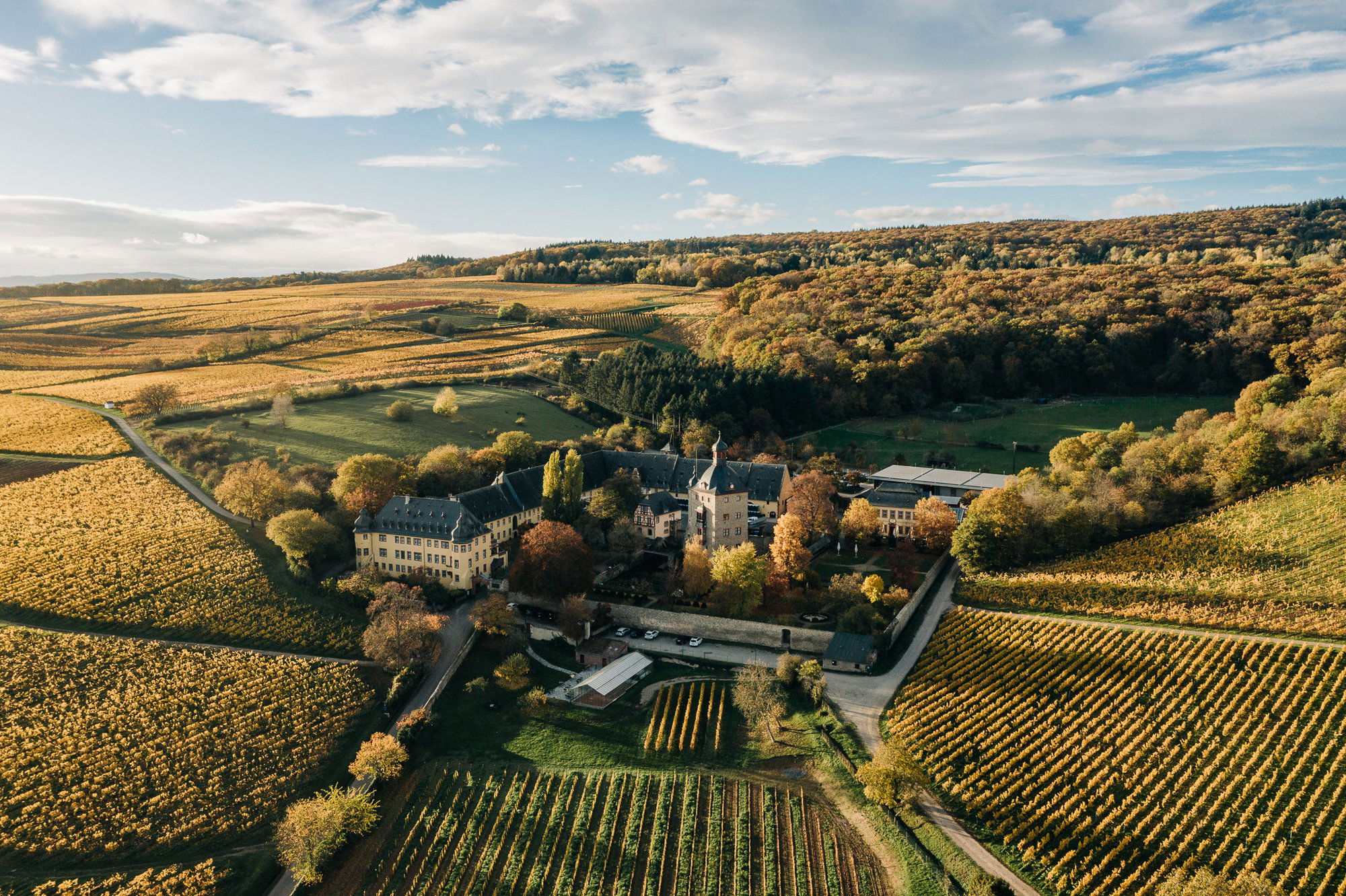
Eight Centuries on the Rheingau Slope
There is a particular kind of authority that comes not from reputation management but from duration. Schloss Vollrads, situated in Oestrich-Winkel in the Rheingau, belongs to that category. The estate's records of vinous activity trace back to 1211, a date that places winemaking here before much of what we now consider classical European viticulture had taken shape. Approaching the property, the tower that anchors the estate's silhouette has looked out over the same Rhine-facing slopes for centuries, and the effect is less monumental than quietly grounding. This is a place that has outlasted trends, wars, and entire economic epochs while returning, each vintage, to the same fundamental question: what does this particular ground grow leading?
The answer, consistently, has been Riesling. The Rheingau's claim to Riesling excellence is well-established across a narrow band of south-facing hillside that catches both sun and the moderating humidity rising off the Rhine. Within that band, Schloss Vollrads occupies its own distinct parcel, with the estate's elevation and specific soil composition shaping wines that read differently from valley-floor or steep-slope neighbours. In 2025, the estate holds a Pearl 3 Star Prestige rating, a credential that places it firmly in the upper tier of the Rheingau's assessed producers.
What the Ground Is Actually Saying
Riesling's particular genius as a variety is its capacity to translate site into wine with minimal interference. Nowhere does this matter more than on the Rheingau's slate and loess soils, where drainage, mineral uptake, and diurnal temperature variation combine to produce wines with a structural specificity that warmer or wetter sites cannot replicate. Schloss Vollrads works from estate fruit, which means the wines in the glass are a direct argument for a particular piece of geography rather than a blended statement about the region at large.
The Rheingau occupies roughly fifty kilometres of Rhine riverbank between Wiesbaden and Rüdesheim, and the stylistic range across that corridor is wider than its compact geography suggests. Producers like Weingut Peter Jakob Kühn and Weingut Josef Spreitzer, both also based in Oestrich-Winkel, represent the argument for precise, site-driven single-vineyard expression at smaller scale. Weingüter Wegeler and Weingut Allendorf, likewise in the same commune, round out a concentration of Riesling production in Oestrich-Winkel that is unusual even within the Rheingau's already dense producer map. Against these peers, Schloss Vollrads operates at a scale and with a historical depth that distinguishes it without removing it from the conversation. The 3 Star Prestige recognition places it in the same upper bracket as the Rheingau's most closely watched estates.
The Prädikat system, Germany's legally defined quality ladder that runs from Kabinett through Spätlese, Auslese, and beyond into the rarified Beerenauslese and Trockenbeerenauslese categories, gives Riesling estates like Vollrads a vocabulary for expressing not just terroir but harvest timing and botrytis selection. Visiting during late September or October, when harvest decisions are being made across the Rheingau, gives a different understanding of why those designations carry weight: the grape itself, picked days or even hours apart, produces fundamentally different wines.
Experiencing the Estate
Estate's approach reflects a deliberate preference for experience alongside the bottle. This is not unusual among historically significant Rheingau producers, where the physical estate is itself part of the offer, but Schloss Vollrads manages the balance between heritage and accessibility with some care. The tower, the courtyard, and the surrounding vineyard parcels create a physical itinerary that most urban tasting rooms cannot replicate. For visitors travelling from Frankfurt, the Rheingau is approximately forty-five minutes by road or regional rail to Oestrich-Winkel, making it a viable day visit from one of Germany's major business and financial centres. Those coming specifically for the estate and the wider region's producers would do well to consult our full Oestrich-Winkel wineries guide before mapping a route, given the density of quality addresses within a short radius.
Beyond wine production, the Rheingau's visitor infrastructure has developed significantly over the past two decades. For accommodation, our full Oestrich-Winkel hotels guide covers options from riverside guesthouses to the more formal hotel properties that suit multi-day itineraries. The restaurant scene, covered in our full Oestrich-Winkel restaurants guide, ranges from wine-focused regional cooking to more casual vineyard-adjacent dining. Those looking for evening programmes would find our full Oestrich-Winkel bars guide and our full Oestrich-Winkel experiences guide useful supplements to the wine itinerary itself.
The Rheingau in a Wider German Context
Germany's Riesling production spans the Mosel, Rheingau, Nahe, Pfalz, and several smaller appellations, each making a distinct argument for the variety's range. The Rheingau's particular position, historically the region that shaped the world's understanding of German Riesling during the eighteenth and nineteenth centuries, gives estates like Schloss Vollrads a comparative frame that extends well beyond regional competition. Kloster Eberbach in Eltville, the Cistercian estate whose own documented history rivals Vollrads' in depth, represents the same tradition of institution-scale winemaking on the Rheingau slope. On the Nahe, Schlossgut Diel in Rümmelsheim operates from a similar estate-with-history model, while in the Pfalz, Weingut Bassermann-Jordan in Deidesheim and Weingut A. Christmann in Neustadt an der Weinstraße anchor the premium end of a warmer-climate Riesling and Pinot Noir argument. These comparisons are useful for visitors calibrating expectations: what Vollrads does with Riesling on its specific Rheingau slope is a product of a particular geological and climatic brief that does not transfer directly to any of these other addresses, however distinguished.
For context outside Germany, the model of an estate with deep documentary history focusing on single-variety terroir expression appears across European winemaking. Abadía Retuerta in Sardón de Duero draws on monastic heritage in a comparable way, though its variety set and climate are entirely different. The comparison is structural rather than stylistic: both estates treat their physical and historical context as part of what gives the wines meaning, rather than incidental background.
Planning Your Visit
Given the estate's position as one of the Rheingau's most historically documented addresses and its current 3 Star Prestige standing, advance planning is worth the effort. The Rheingau's peak visitor period runs from late spring through the harvest months of September and October, when the combination of warm weather and active vineyard work gives visits a context that off-season cannot provide. For those with a broader European itinerary that includes single-malt distilleries alongside wine estates, Aberlour in Aberlour in Scotland's Speyside represents a different but comparable tradition of place-specific production with significant institutional age.
The estate address is Schloss Vollrads 1, 65375 Oestrich-Winkel. Contact and booking details are leading confirmed directly through the estate's current channels, as operating hours, tasting formats, and group visit policies vary seasonally and are subject to change.
Frequently Asked Questions
What wines should I try at Schloss Vollrads?
Focus on the estate's Riesling range across Prädikat levels. The Rheingau's south-facing slate and loess soils favour wines with pronounced acidity and mineral structure at Kabinett and Spätlese levels, while the estate's Auslese and above productions, made in years with suitable botrytis conditions, represent a different register of the same terroir. The 3 Star Prestige rating for 2025 indicates consistent quality across the range rather than a single standout category. Comparing across Prädikat levels during a single visit gives the clearest picture of how harvest timing and selection decisions express themselves through the same ground.
Why do people go to Schloss Vollrads?
The primary draw is the combination of historical depth and current quality. Documented vinous activity from 1211 is not a marketing claim but a matter of archival record, and visiting an estate with that continuity gives the wines a context that newer addresses cannot offer. Oestrich-Winkel itself is one of the Rheingau's denser producer communes, so Vollrads fits into a broader day or multi-day itinerary naturally. The 2025 Pearl 3 Star Prestige recognition confirms that the historical reputation is substantiated by current production standards rather than carried by name alone.
How far ahead should I plan for Schloss Vollrads?
The estate's standing and the Rheingau's popularity as a wine destination mean that harvest-period visits, particularly September and October weekends, benefit from planning several weeks in advance. Specific tasting formats, guided visits, or group bookings may require longer lead times. Checking directly with the estate for current availability is advisable, as seasonal programming details change year to year. Midweek visits outside the harvest period typically allow more flexibility, and the drive or rail connection from Frankfurt makes spontaneous weekday visits more practical than they would be from a greater distance.
A Credentials Check
A small peer set for context; details vary by what’s recorded in our database.
| Venue | Classification | Awards | First Vintage | Notes |
|---|---|---|---|---|
| Schloss Vollrads | World's 50 Best | This venue | ||
| Weingut Allendorf | 1 awards | |||
| Weingut Josef Spreitzer | 1 awards | |||
| Weingut Peter Jakob Kühn | 1 awards | |||
| Weingüter Wegeler | 1 awards |
Access the Cellar?
Our members enjoy exclusive access to private tastings and priority allocations from the world's most sought-after producers.
Access the Concierge