
A Cistercian monastery founded in 1136, Kloster Eberbach sits in the Rheingau hills above Eltville and operates as one of Germany's most historically significant wine estates. Its 900-year relationship with Riesling viticulture, combined with a Pearl 3 Star Prestige rating in 2025, places it in a small tier of German estates where history and contemporary quality converge. Few wine destinations in Europe carry this density of accumulated context.
Stone, Vine, and Eight Centuries of Riesling in the Rheingau
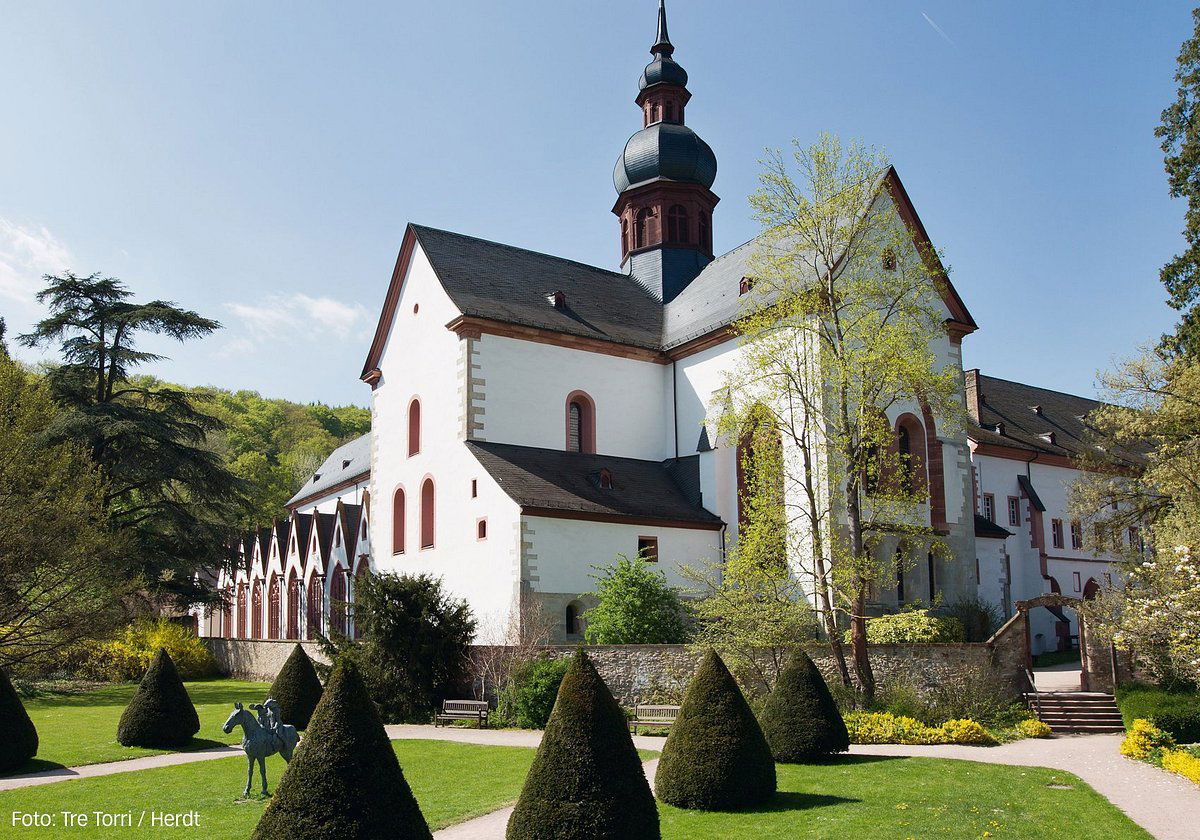
Approaching Kloster Eberbach through the forested valley above Eltville, the monastery appears before any vineyard does. The Romanesque basilica and intact cloister date to the twelfth century, and the scale of the complex — dormitories, cellars, chapter house, all in grey sandstone — communicates something that most wine estates cannot manufacture: the physical weight of an institution that has been doing this, continuously, since 1136. The Cistercian monks who founded the estate understood that the south-facing slopes of the Rheingau were among the most capable soils in Central Europe for growing white wine grapes, and the intervening nine centuries have not substantially changed that assessment.
The Rheingau holds a particular position in German wine. While the Mosel draws the most international attention for its steep-slate Rieslings and the Pfalz has expanded its reputation for breadth and warmth, the Rheingau operates as the historical heartland of German viticulture , the region where Riesling's capacity for minerality and structured acidity was first codified at institutional scale. Kloster Eberbach sits at the centre of that story, not as a footnote but as one of its primary authors.
What the Land Actually Does Here
Terroir in the Rheingau is not a uniform proposition. The region runs roughly east-west along the north bank of the Rhine between Wiesbaden and Rüdesheim, with the Taunus hills providing a northern windbreak and the river moderating temperatures through reflected heat and humidity. Within that band, soil composition shifts considerably: there are quartzite and phyllite slopes, loess and loam flats, and pockets of deep clay that produce markedly different wine profiles from neighbouring parcels.
The vineyards associated with Kloster Eberbach include the Steinberg, a fully walled monopole site directly above the monastery , one of the very few walled single-vineyard estates in Germany and a direct conceptual parallel to the Burgundian clos tradition. The Cistercians built the wall in the thirteenth century to demarcate and protect a site they had already identified as exceptional. The Steinberg's combination of loam over quartzite subsoil, its elevation, and its aspect toward the south-southwest produces Rieslings with a tighter, more mineral frame than many lower-lying Rheingau sites, which tend toward richer, rounder profiles. This is the kind of site-specific distinction that takes centuries to document reliably, and Kloster Eberbach has those centuries.
For travellers already familiar with the Rheingau's peer estates, the comparison set is instructive. Schloss Vollrads in Oestrich-Winkel operates from a similarly historic base, while estates like Weingut Balthasar Ress in Eltville represent the smaller, family-scale operations that define much of the region's day-to-day production. Kloster Eberbach occupies a different tier: its scale, its institutional continuity, and its recognition place it in a narrower category where the estate itself functions as a reference point for the region.
Recognition and Where It Sits Among Peers
Kloster Eberbach holds a Pearl 3 Star Prestige rating from EP Club in 2025, a designation that places it among a small group of wine estates where quality signals, historical depth, and experiential value are all operating at the same level simultaneously. This matters because in German wine, those three elements do not always align: there are historically significant estates producing wine that no longer justifies the reputation, and there are newer producers with excellent wine and minimal infrastructure for visitors. The 3 Star Prestige rating indicates that Kloster Eberbach clears all three bars.
For context on how this tier functions across German-speaking wine regions, properties like Schlossgut Diel in Rümmelsheim and Weingut A. Christmann in Neustadt an der Weinstraße sit within the broader German fine wine conversation, as do Pfalz estates such as Weingut Bassermann-Jordan in Deidesheim and Weingut Battenfeld-Spanier in Hohen-Sülzen. The Rheingau's claim, and Kloster Eberbach's in particular, rests on a different kind of authority: not just the wine in the bottle but the accumulated argument for why this specific ground matters.
Further afield, estates with comparable combinations of heritage and viticultural ambition include Abadía Retuerta in Sardón de Duero, another former monastic estate that has converted long historical continuity into a contemporary wine program. The comparison underlines how rare it is for monastery-origin estates to remain primary producers rather than becoming museums or event venues with wine as a secondary activity.
The Visitor Experience and How to Approach It
The monastery complex is open to visitors, and the combination of the Romanesque architecture, the medieval wine cellars, and the surrounding vineyard landscape makes it one of the more complete wine estate visits available anywhere in the Rhine region. The cellars , used for aging wine since the twelfth century , are among the most intact medieval wine infrastructure in Europe, which means the physical experience of the estate maps directly onto the historical argument for the wine.
Eltville itself, the nearest town and postal address for the estate, sits on the Rhine riverfront approximately 15 kilometres west of Wiesbaden. The town is accessible by regional rail from Frankfurt (roughly 40 minutes on the RB10 line) or by car along the B42 river road. Kloster Eberbach lies in the hills above Eltville, reachable by road through the forest; the drive from the town centre takes under ten minutes. For a broader orientation to the area, our full Eltville wineries guide maps the wider estate scene, while our full Eltville restaurants guide, our full Eltville hotels guide, our full Eltville bars guide, and our full Eltville experiences guide cover the broader travel picture.
Wine tourism in the Rheingau runs most actively from late spring through the harvest period in October, when the Riesling grapes reach maturity and the valley is at its most visually legible as a wine-producing landscape. The estate's scale means it absorbs visitors without the crowding that affects smaller Rheingau properties on high-traffic weekends, but the most considered visit is one planned outside the peak August tourist window.
For comparison points elsewhere in German viticulture, Weingut Bürgerspital zum Heiligen Geist in Würzburg represents a similar model of institutional continuity in Franconian wine, while Weingut Clemens Busch in Pünderich offers the Mosel's contrasting approach to terroir expression through slate-driven minerality. The range of reference points matters here because Kloster Eberbach's argument is ultimately a Rheingau argument, specific in its soil, its microclimate, and its historical logic. Estates in Würzburg or the Mosel make different claims from different ground, and understanding the distinctions helps calibrate what the Steinberg monopole actually represents.
For malt whisky travellers who cross categories, Aberlour in Aberlour offers an interesting structural parallel: a production site where location and process are inseparable from the product's identity, and where the physical visit deepens the appreciation of what is in the bottle.
Frequently Asked Questions
- What wines is Kloster Eberbach known for?
- Kloster Eberbach is primarily associated with Riesling from the Rheingau, particularly from the Steinberg, a fully walled monopole vineyard above the monastery that the Cistercian monks established in the thirteenth century. The Steinberg's loam-over-quartzite soils and refined south-southwest aspect produce structured, mineral-driven Rieslings that sit at the tighter end of the Rheingau style spectrum. The estate's EP Club Pearl 3 Star Prestige recognition in 2025 reflects both the quality of the wine and the depth of the site's historical documentation.
- What is the standout thing about Kloster Eberbach?
- The combination of intact twelfth-century Cistercian architecture, medieval wine cellars in continuous use, and a walled monopole vineyard makes Kloster Eberbach one of the most coherent wine estate experiences in Germany. Unlike many historic properties that have separated their heritage presentation from their wine production, Kloster Eberbach holds both together at a level that the 2025 Pearl 3 Star Prestige rating reflects. For visitors based in or near Eltville, this is not a secondary attraction in the Rheingau wine circuit , it is the primary reference point.
- How hard is it to get into Kloster Eberbach?
- The monastery complex is generally open to visitors without the kind of restricted-access booking requirements that affect smaller, appointment-only estates. Because Kloster Eberbach operates at institutional scale, it can accommodate visitor volume that would overwhelm a family-run Rheingau producer. That said, specific cellar tours, tastings, and events within the estate do require advance booking, particularly during the October harvest season. For the most current availability and event programming, checking the estate's official website directly is the practical starting point , contact details and hours were not available in our data at time of publication.
- Is Kloster Eberbach worth visiting if you are staying in Frankfurt?
- Yes, and the logistics support a day trip without difficulty. Eltville is approximately 40 minutes from Frankfurt by regional rail, and the estate sits a short drive above the town. The combination of the Romanesque architecture, the historic cellars, and the Steinberg vineyard gives the visit a density of content , architectural, historical, and viticultural , that justifies the travel time from the city. The estate's 2025 Pearl 3 Star Prestige recognition places it in the category of destinations where the experience matches or exceeds the advance reputation.
Cost Snapshot
A quick peer snapshot; use it as orientation, not a full ranking.
| Venue | Classification | Awards | First Vintage | Notes |
|---|---|---|---|---|
| Kloster Eberbach | 1 awards | This venue | ||
| Jacquart | 1 awards | 1962 | ||
| Lingua Franca | 1 awards | 2015 | ||
| Schloss Vollrads | World's 50 Best | |||
| Schlossgut Diel | 1 awards | |||
| Weingut A. Christmann | 1 awards |
Access the Cellar?
Our members enjoy exclusive access to private tastings and priority allocations from the world's most sought-after producers.
Access the Concierge