Weingut Dr. Loosen


Weingut Dr. Loosen occupies a historic estate on the B53 in Bernkastel-Kues, at the heart of the Mosel's steepest slate-terraced vineyards. Holding a Pearl 4 Star Prestige rating in 2025, the estate is among Germany's most internationally recognised Riesling producers, with Dr. Ernie Loosen credited as one of the grape's most effective global advocates. It is a reference address for anyone serious about understanding what old-vine Riesling from blue-grey Devonian slate actually tastes like.
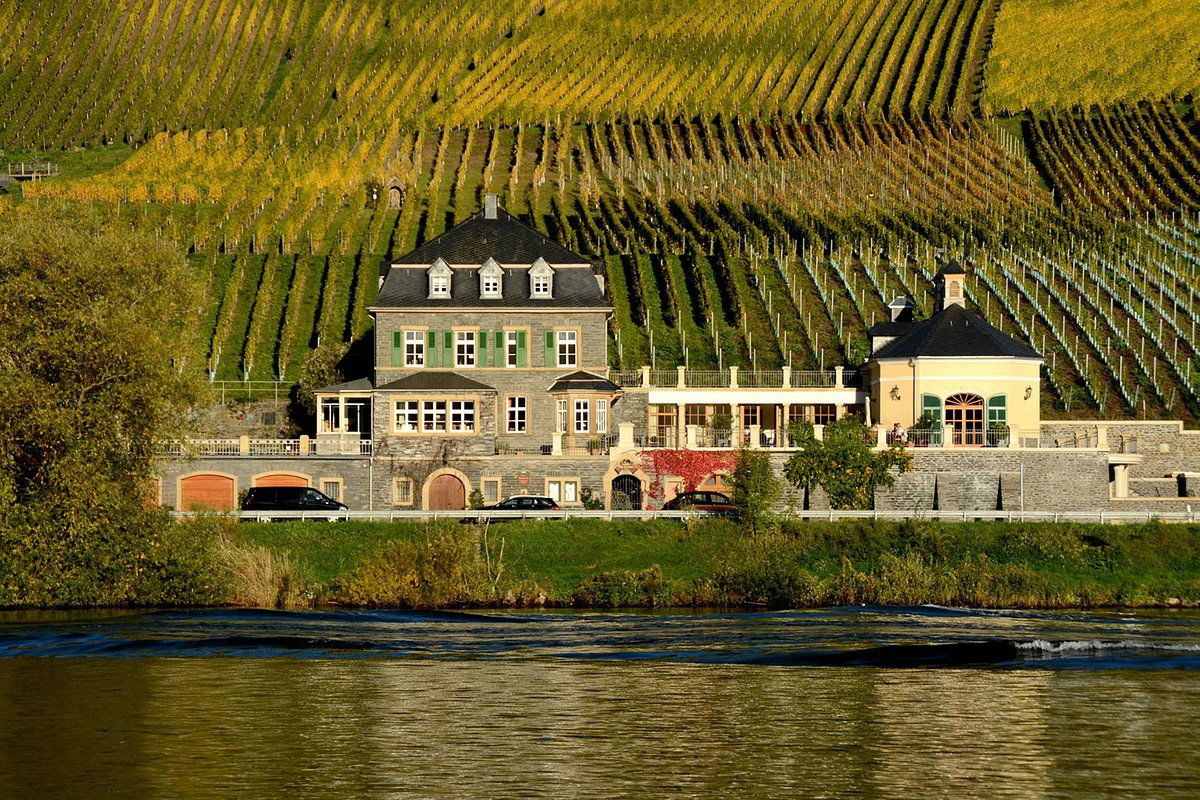
Slate, Slope, and the Mosel's Case for Riesling
The B53 road that threads along the Mosel between Bernkastel-Kues and Traben-Trarbach is one of the most concentrated wine corridors in Europe. On either side, vineyards tilt at angles that make mechanised farming impossible — some slopes exceed 60 degrees — and the blue-grey Devonian slate that defines the geology here absorbs heat during the day and radiates it back through cool Mosel nights. This thermal dynamic, combined with the river's moderating humidity and the region's marginal northern latitude, produces a growing season long enough to develop aromatic complexity without sacrificing the acidity that makes Mosel Riesling age as reliably as it does. Weingut Dr. Loosen's address at St. Johannishof on the B53 in Bernkastel-Kues places it squarely within this tradition, working some of the valley's oldest ungrafted vines on those same precipitous, slate-rich slopes.
Understanding Dr. Loosen means understanding what old vines on poor soil actually produce. Vines that have spent decades pushing roots through fractured slate develop a root system that reaches considerably deeper than those on more fertile ground. Water stress, controlled by slate's drainage properties, concentrates flavour. Yield per vine drops. The resulting wines carry a mineral tension , sometimes described as a cool, almost electrical quality , that reflects the physical conditions of the site more directly than almost any other winemaking region in Germany. For the wine traveller arriving in Bernkastel-Kues, the estate is less a destination in isolation and more a working demonstration of why the Mosel's steepest parcels command the attention they do among collectors and critics internationally.
The Estate in Context: Mosel Riesling's Broader Peer Set
Germany's Riesling estates operate across a wide spectrum of style and ambition. At one end sit co-operatives and volume producers whose wines reach supermarket shelves across Europe. At the other end, a smaller group of estates , working classified or historically significant vineyards, farming with precision, and ageing wines before release , form the reference tier against which the region's reputation is ultimately judged. Dr. Loosen sits in that upper tier, holding a Pearl 4 Star Prestige rating for 2025, a designation that positions it within Germany's premium winery peer set alongside estates such as Schlossgut Diel in Rümmelsheim, Weingut Clemens Busch in Pünderich, and Weingut A. Christmann in Neustadt an der Weinstraße. Each represents a distinct regional expression of German viticulture, but the Mosel's combination of slate and steep-slope farming gives Dr. Loosen a terroir argument that is difficult to replicate in the Pfalz or Nahe.
The international dimension matters here. While estates such as Kloster Eberbach in Eltville or Schloss Vollrads in Oestrich-Winkel carry deep historical significance within the Rheingau, Dr. Loosen's profile extends with particular force into export markets , the United States especially , where Dr. Ernie Loosen has spent decades arguing for Riesling's place at the serious wine table. That advocacy work, conducted through trade relationships and collaborative projects rather than advertising, has shaped how a generation of sommeliers and collectors in North America and Asia think about the Mosel. The estate's wines function partly as ambassadors for an entire appellation.
Approaching the Estate: What to Expect on Arrival
St. Johannishof sits on the B53, the main road running along the Mosel's south-facing left bank. The surrounding landscape delivers the first impression before the estate itself comes into view: the river curves through its steep-walled valley, the slate cliffs rise behind it, and the vine rows trace the contours of slopes that have been cultivated in this form for well over a thousand years. The visual effect is less picturesque postcard and more geological argument , the landscape explains the wine before you have tasted it.
Visitors to the Mosel typically use Bernkastel-Kues as a base, and the town's medieval market square and half-timbered architecture draw considerable tourist traffic through summer and the autumn harvest season. For wine-focused travellers, the estate visit works leading when planned alongside exploration of the broader region. Our full Bernkastel-Kues wineries guide covers the range of producers operating in and around the town. For those staying overnight, our full Bernkastel-Kues hotels guide outlines accommodation options across the area, and our full Bernkastel-Kues restaurants guide maps the dining scene for evenings spent in town after a day on the wine road.
Riesling's Style Range: From Kabinett to Auslese
Mosel Riesling's classification system , Kabinett, Spätlese, Auslese, Beerenauslese, Trockenbeerenauslese, Eiswein , is among the most granular in the wine world, and understanding it matters when approaching an estate at this level. The classifications reflect must weight at harvest, which broadly correlates with residual sugar in the finished wine, though the relationship is more nuanced than a simple sweetness scale. A Spätlese from a cool year can carry considerable tension and restraint, while a warmer Kabinett might feel rounder than its category implies.
What the slate of the Mosel's central section does across all these styles is maintain acidity as a structural backbone. The same mineral sharpness that collectors associate with aged Mosel Riesling is already present in the wine's youth, and it is that quality , the balance between fruit, sweetness where present, and acid , that makes the wines as food-compatible as they are cellar-worthy. Among Germany's Riesling regions, the Mosel argues its case through finesse rather than weight, a different aesthetic from the Pfalz expressions found at producers like Weingut Bassermann-Jordan in Deidesheim or Weingut Battenfeld-Spanier in Hohen-Sülzen. Both traditions are serious; they simply speak a different dialect of the same grape.
For those approaching German Riesling from a different reference frame entirely, comparisons with Weingut Bürgerspital zum Heiligen Geist in Würzburg , a Franken estate working sandstone and shell-limestone soils rather than slate , illustrate how dramatically terroir shifts the wine's character even within a single country and grape variety.
Planning a Visit
Weingut Dr. Loosen is located at St. Johannishof, B53, 54470 Bernkastel-Kues. The estate is reachable by car along the B53 river road, and the Mosel valley's rail connections link Bernkastel-Kues to Trier and Koblenz for those arriving without a vehicle. The harvest period from late September through October brings the highest visitor concentration to the region, and tasting room availability at premium estates tightens considerably during this window; contacting the estate directly to arrange a visit ahead of the autumn rush is the practical approach. Spring and early summer offer quieter access to both the vineyards and the estate facilities. For those building a broader itinerary around the Mosel and Germany's wine regions, our full Bernkastel-Kues experiences guide and our full Bernkastel-Kues bars guide cover the full range of what the town and its surroundings offer beyond the cellar door.
Frequently Asked Questions
- How would you describe the overall feel of Weingut Dr. Loosen?
- The estate operates as a working winery on the B53 in Bernkastel-Kues, at the centre of the Mosel's premium wine corridor. The feel is defined by the surrounding landscape , steep slate vineyards, the river below , rather than by hospitality theatrics. It holds a Pearl 4 Star Prestige rating for 2025, which places it in a peer group where serious wine engagement, not casual tourism, is the baseline expectation.
- What wines should I try at Weingut Dr. Loosen?
- The estate's reputation is built on old-vine Riesling from the Mosel's steepest slate-terraced parcels. Across the Prädikat range , from Kabinett through Auslese , the wines carry the acidity and mineral tension that Devonian slate and a long northern growing season produce. The 2025 Pearl 4 Star Prestige recognition reflects consistent quality across the range rather than a single standout bottling.
- What makes Weingut Dr. Loosen worth visiting?
- The estate provides direct access to the argument that Mosel Riesling makes on its own terms: old vines, extreme slate slopes, and wines shaped by conditions that are difficult to reproduce elsewhere in Germany. The Pearl 4 Star Prestige rating for 2025 and the estate's international profile as a reference producer for the grape make it a logical stop for anyone building a serious understanding of German white wine. Bernkastel-Kues is a practical base for the visit, with hotels, restaurants, and further wineries all within range.
- Do I need a reservation for Weingut Dr. Loosen?
- Given the estate's international profile and the Mosel's concentrated autumn harvest season, contacting Dr. Loosen in advance of any planned visit is the sensible approach, particularly from late September through October. The estate is located at St. Johannishof, B53, Bernkastel-Kues. Specific booking policies and current opening hours are leading confirmed directly with the estate, as these details are subject to seasonal variation.
- How does Weingut Dr. Loosen's approach to single-vineyard Riesling compare to other Mosel producers?
- The estate's focus on ungrafted old vines in classified Mosel sites , including historically significant vineyards such as Wehlener Sonnenuhr, Erdener Treppchen, and Ürziger Würzgarten , places it within a small group of producers who treat individual vineyard character as the primary argument in the wine rather than a stylistic overlay. This site-specific discipline, combined with the Pearl 4 Star Prestige recognition for 2025 and Dr. Ernie Loosen's sustained international advocacy for the grape, gives the estate a reference position in Mosel Riesling that extends well beyond the Bernkastel-Kues postal address. Collectors and sommeliers looking to compare single-vineyard Mosel expressions against other German regions might also consider visits to Abadía Retuerta in Sardón de Duero or Aberlour in Aberlour to situate terroir-driven production within a broader international frame.
Reputation First
A quick peer snapshot; use it as orientation, not a full ranking.
| Venue | Classification | Awards | First Vintage | Notes |
|---|---|---|---|---|
| Weingut Dr. Loosen | World's 50 Best | This venue | ||
| Jacquart | 1 awards | 1962 | ||
| Lingua Franca | 1 awards | 2015 | ||
| Schloss Vollrads | World's 50 Best | |||
| Kloster Eberbach | 1 awards | |||
| Schlossgut Diel | 1 awards |
Access the Cellar?
Our members enjoy exclusive access to private tastings and priority allocations from the world's most sought-after producers.
Access the Concierge