Weingut Dr. Bürklin-Wolf

One of the Pfalz's most historically grounded estates, Weingut Dr. Bürklin-Wolf holds a Pearl 3 Star Prestige rating (2025) and operates from Ringstraße 4 in Wachenheim an der Weinstraße. The estate is positioned among the region's upper tier of Riesling producers, with vineyard holdings that span the Mittelhaardt's most debated grand cru parcels — a reference point for anyone serious about German wine.
Wachenheim's Place in the Pfalz Hierarchy
The Mittelhaardt sits at the centre of a long argument about where Germany's finest Riesling actually grows. For most of the twentieth century, the Mosel held the critical consensus; in recent decades, the Pfalz has reasserted its case with a conviction that is harder to dismiss. Wachenheim an der Weinstraße occupies a specific position in that argument — a village with vineyard sites of genuine complexity, sheltered by the Haardt mountains to the west and warmed by one of Germany's sunniest mesoclimates. The soils here shift from sandstone to basalt to limestone within short distances, and that variability is precisely what separates the Mittelhaardt's leading parcels from more uniform growing areas elsewhere in the country. Weingut Dr. Bürklin-Wolf, at Ringstraße 4, is among the estates most closely associated with this terrain and with the effort to articulate what it produces.
The Pfalz's upper tier of Riesling houses tends to be assessed against a small peer set. Estates like Weingut A. Christmann in Neustadt an der Weinstraße and Weingut Bassermann-Jordan in Deidesheim compete for the same critical attention and, in some cases, share overlapping vineyard geography. Further afield, German wine estates with comparable historical depth — including Kloster Eberbach in Eltville and Schloss Vollrads in Oestrich-Winkel in the Rheingau , represent the same tradition of estate-driven, site-expressive winemaking that defines how Germany presents itself at the serious end of the international wine market. Dr. Bürklin-Wolf holds a Pearl 3 Star Prestige rating for 2025, a trust signal that places it consistently inside this upper bracket rather than adjacent to it.
What the Land Produces Here
Terroir expression in the Mittelhaardt is not a simple story. Unlike regions where a single soil type dominates and the winemaker's task is to translate one geological voice, Wachenheim and its neighbouring villages , Forst, Deidesheim, Ruppertsberg , present producers with a mosaic. The Pechstein vineyard in Forst, famous for its dark basalt inclusions that absorb heat during the day and release it at night, is among the most discussed individual parcels in German viticulture. Kirchenstück, Ungeheuer, Jesuitengarten: these are not marketing names but geological addresses, each with documented soil profiles that produce measurably different Riesling character even when grown by the same producer in the same vintage.
Riesling from the Mittelhaardt tends to run warmer and broader than its Mosel counterpart. Where Mosel Riesling is often defined by high-wire tension , razor acidity balanced against residual sweetness at low alcohol , Pfalz Riesling at the Mittelhaardt's leading addresses shows more weight and textural presence, with alcohol levels that can support full fermentation to dry or near-dry styles without losing complexity. This is the category in which the VDP classification system , Germany's producer-led pyramid of vineyard quality, modelled loosely on Burgundy's cru system , has had its most visible effect on how estates communicate quality. The Grosse Lage designation (equivalent to Burgundy's grand cru) and the corresponding Grosses Gewächs dry wine category have both sharpened the way estates like Dr. Bürklin-Wolf position their leading parcels to an international audience that does not necessarily read German wine law fluently.
Estates elsewhere in Germany working from comparably defined terroir , Schlossgut Diel in Rümmelsheim on the Nahe, or Weingut Battenfeld-Spanier in Hohen-Sülzen in the Rheinhessen , face a structurally similar challenge: how to convey site specificity to buyers accustomed to varietal or regional labelling rather than German vineyard designation. The VDP classification has helped, but the underlying argument is still made first in the glass.
Approaching the Estate
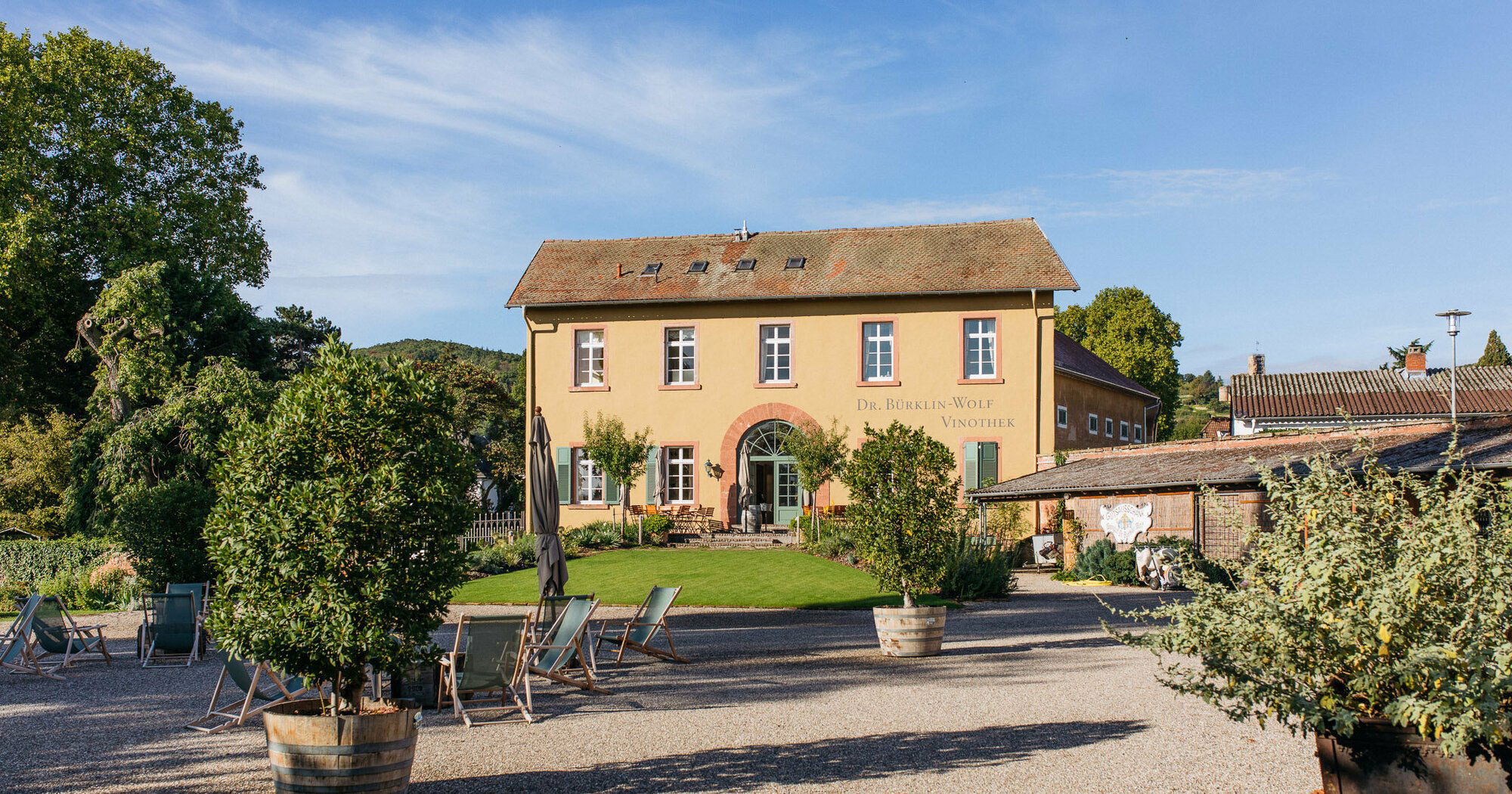
Wachenheim is a compact village, quiet by the standards of the wine route towns to its south. The Deutsche Weinstraße runs directly through, connecting travellers moving between the more trafficked stops of Neustadt and Bad Dürkheim, but Wachenheim itself does not push for attention. Ringstraße sits close to the village centre, and an estate of Dr. Bürklin-Wolf's scale and history integrates into the town's built fabric in the way that characterises the Mittelhaardt's most established producers: old stone, functional winery architecture, a working estate rather than a wine tourism set-piece.
Visitors to the Pfalz in general should plan around the harvest season, roughly September through October, when the vineyards are active and the wine route's restaurants and Strausswirtschaft seasonal wine taverns operate at full capacity. The shoulder months of May and June offer access without the autumn crowds; Riesling from the previous vintage is typically available for tasting during spring open-cellar events, which the Pfalz's major estates run collectively on designated weekends. For logistics beyond the winery itself, our full Wachenheim an der Weinstraße hotels guide covers accommodation options within the village and in nearby Deidesheim and Bad Dürkheim, both of which offer more extensive choices. Travellers looking to combine the visit with dining should consult our full Wachenheim an der Weinstraße restaurants guide, and those interested in the broader bar and cellar-door circuit can use our full Wachenheim an der Weinstraße bars guide alongside our full Wachenheim an der Weinstraße wineries guide.
Where This Estate Fits in a Broader German Wine Itinerary
A serious engagement with German wine estates does not naturally follow a single region. Producers like Weingut Clemens Busch in Pünderich on the Mosel work from slate soils and a cooler climate that produce a stylistically different Riesling to anything from the Mittelhaardt, and the contrast between those two terroir types is more instructive than either estate in isolation. Similarly, Weingut Bürgerspital zum Heiligen Geist in Würzburg demonstrates how Franconian viticulture , Silvaner rather than Riesling as the anchor variety, Muschelkalk limestone soils , operates on a different axis entirely. For those building a wider European wine itinerary, the structural parallels between how Pfalz estates articulate site specificity and how producers elsewhere in continental Europe approach the same question are worth considering: Abadía Retuerta in Sardón de Duero offers a useful Spanish counterpoint, while Aberlour in Aberlour raises the question of what terroir expression means in a distilled spirit context. For the full scope of what the region offers beyond the cellar door, our full Wachenheim an der Weinstraße experiences guide maps the village and its surrounds.
Frequently Asked Questions
- How would you describe the overall feel of Weingut Dr. Bürklin-Wolf?
- It is a working estate with genuine historical depth, set in the compact village of Wachenheim an der Weinstraße on the Mittelhaardt. The Pearl 3 Star Prestige rating (2025) reflects its position among the Pfalz's serious upper tier rather than its wine tourism infrastructure. Expect a functional, production-focused environment rather than a designed visitor experience , the emphasis is on the wine and the vineyards, not the reception.
- What wines should I try at Weingut Dr. Bürklin-Wolf?
- The estate's reputation is built on site-specific Riesling from Mittelhaardt grand cru parcels, where volcanic basalt and varied limestone soils produce wines with textural weight and site clarity. Within the VDP classification, Grosses Gewächs (GG) dry Rieslings from named Grosse Lage vineyards are the category that the estate's Pearl 3 Star Prestige (2025) credential most directly supports. Peers for comparison include Weingut Bassermann-Jordan in Deidesheim and Weingut A. Christmann in Neustadt an der Weinstraße.
- What should I know about Weingut Dr. Bürklin-Wolf before I go?
- The estate is at Ringstraße 4, Wachenheim an der Weinstraße, on the Deutsche Weinstraße in the Pfalz. Contact and booking details are not publicly listed in this record, so confirm visit arrangements directly before travelling. Wachenheim itself is a small village; plan for accommodation in nearby Bad Dürkheim or Deidesheim if staying overnight, and use our full Wachenheim an der Weinstraße wineries guide to build a full itinerary around the estate.
Recognition Snapshot
A small comparison set for context, based on the venues we track.
| Venue | Classification | Awards | First Vintage | Notes |
|---|---|---|---|---|
| Weingut Dr. Bürklin-Wolf | 1 awards | This venue | ||
| Jacquart | 1 awards | 1962 | ||
| Lingua Franca | 1 awards | 2015 | ||
| Schloss Vollrads | World's 50 Best | |||
| Kloster Eberbach | 1 awards | |||
| Schlossgut Diel | 1 awards |
Access the Cellar?
Our members enjoy exclusive access to private tastings and priority allocations from the world's most sought-after producers.
Access the Concierge