Schloss Johannisberg


A Neoclassical palace above the Rhine, Schloss Johannisberg holds a documented place in German wine history as the first estate dedicated entirely to Riesling, with vines traced to 817 AD. Awarded Pearl 4 Star Prestige in 2025, it remains the reference point for Rheingau Riesling and a site where centuries of site-specific viticulture are still readable in the glass.
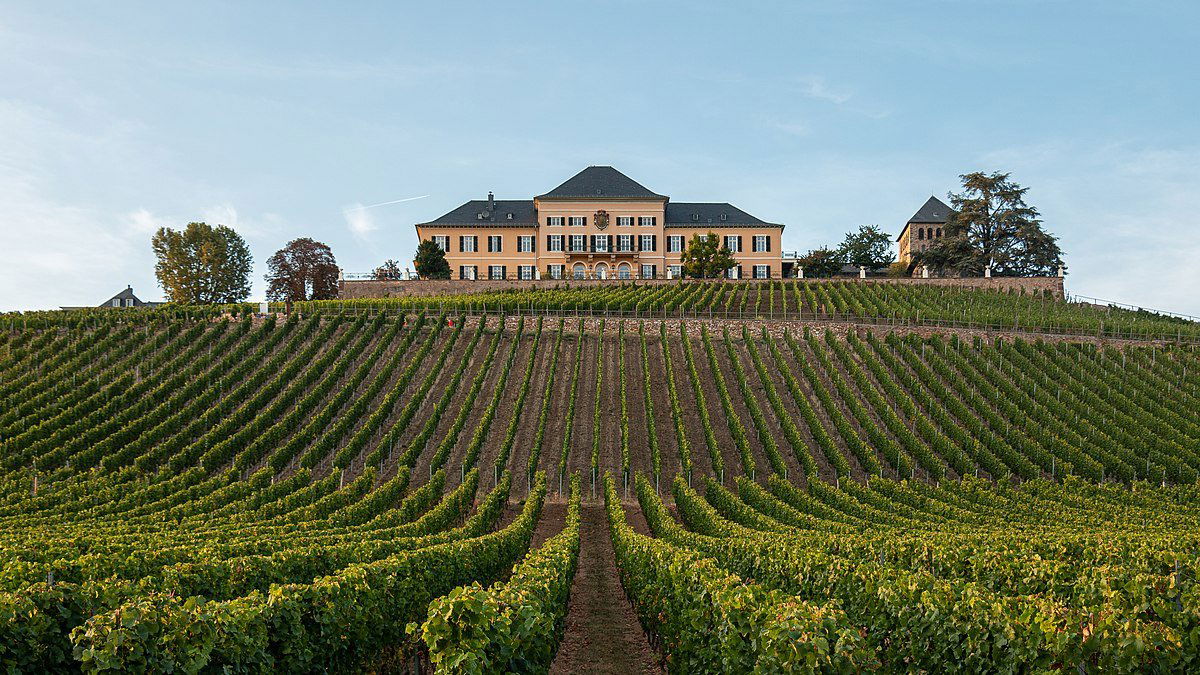
A Hill, a Palace, and Eight Centuries of Riesling
The approach to Schloss Johannisberg does much of the editorial work before a single bottle is opened. The Neoclassical palace sits above the Rhine valley at an elevation that separates it visually and climatically from the flat production estates below. Vineyards slope south toward the river, and the orientation — a near-perfect solar collector for a cool-climate grape — is not accidental. The monks who first planted vines here in 817 AD were working empirically, following slope, sun, and stone. What they established was a logic of site that thirteen subsequent centuries have done little to contradict.
That continuity is what gives Schloss Johannisberg its particular weight in the Rheingau. This is not a winery that built its identity around a philosophy or a winemaker's signature; the identity was encoded in the geography long before it could be articulated as a brand. The hill itself is the argument.
The First Riesling Estate and What That Claim Means
In 1720, Schloss Johannisberg became the world's first estate dedicated exclusively to Riesling , a decision that reads today less like a bold wager and more like a recognition of the inevitable. The Johannisberg site is among the warmest in the Rheingau, a region that already sits at the northern edge of viable viticulture. Riesling, with its late-ripening character and tolerance for cold-climate stress, was the variety most capable of expressing what the hill actually offers: slow accumulation of sugar against a taut acidic spine, the tension between ripeness and restraint that defines the finest German Riesling.
The 1720 conversion to a single-variety estate also has a documentary function. It marks the moment at which the relationship between this specific site and this specific grape became a matter of institutional record rather than agricultural habit. Comparable estates in Germany , Schloss Vollrads in Oestrich-Winkel and Kloster Eberbach in Eltville , share the Rheingau's monastic viticultural heritage, but Johannisberg's documented specialisation predates theirs. That provenance is now a trust signal as much as a historical footnote.
Terroir as Argument: Reading the Johannisberg Site
The Rheingau's defining characteristic is its east-west orientation along the Rhine, which forces south-facing slopes into direct solar exposure while the river moderates temperature extremes. Schloss Johannisberg's vineyard, the Johannisberger Klaus among others, sits on weathered quartzite and phyllite with shallow topsoil , the kind of substrate that stresses vines just enough to concentrate flavour without shutting down ripening. In warm years, the site can push toward full physiological maturity with relative ease. In cooler vintages, the slope's solar advantage becomes decisive.
This combination produces Rieslings with the Rheingau's characteristic weight and spice alongside the site-specific mineral precision that distinguishes Johannisberg from flatter neighbours. The estate's classification system, colour-coded by capsule to indicate sweetness level from trocken through to Trockenbeerenauslese, maps the range of ripeness that a single hill can produce across a single harvest. That range is itself a terroir statement: only a site with genuine complexity in sun exposure and drainage can generate such variation within one growing season.
For visitors comparing across the Rheingau and beyond, the contrast with estates in the Mosel , such as Weingut Clemens Busch in Pünderich , illustrates how dramatically German Riesling shifts in character with geography. Where slate-driven Mosel sites tend toward delicacy and electric acidity, Johannisberg's quartzite and warmer position produce fuller-bodied, more textured expressions of the same variety. Neither is a correction of the other; they are different arguments made by different ground.
Historical Continuity as a Competitive Position
In a category where provenance and documentary history increasingly function as quality proxies, Schloss Johannisberg occupies an unusual position. The Pearl 4 Star Prestige award (2025) places it in the upper tier of current assessment, but the estate's authority in the market was established long before contemporary rating systems existed. Napoleon's troops occupied it. Metternich received it as a gift from the Austrian Emperor after the Congress of Vienna. These are not merely picturesque footnotes; they are evidence of how consistently this site has been treated as a prize worth claiming by people with access to better options.
That historical density places Johannisberg in a different competitive conversation from newer German estates building reputations through organic conversion or interventionist winemaking. Comparators in the Pfalz, such as Weingut A. Christmann in Neustadt an der Weinstraße and Weingut Bassermann-Jordan in Deidesheim, are producing some of Germany's most discussed wines right now, but they are building upward from a different baseline. Johannisberg's challenge is almost the inverse: maintaining relevance and precision in a market that now rewards the new, while the site's history does the trust-building that younger estates have to earn over decades.
Estates like Schlossgut Diel in Rümmelsheim and Weingut Battenfeld-Spanier in Hohen-Sülzen show how German producers outside the classical heartland are staking quality claims, which makes the Rheingau's historic estates increasingly conscious of what their terroir advantage actually delivers in the glass rather than simply on paper. For a broader perspective on how historic European estates balance heritage and contemporary winemaking, the comparison with Abadía Retuerta in Sardón de Duero is instructive , a different country, a different grape, but a similar negotiation between site authority and market positioning.
Planning a Visit to Johannisberg
Schloss Johannisberg sits within the village of Geisenheim-Johannisberg, accessible from Frankfurt in under an hour by road and reachable from Wiesbaden by Rhine ferry in summer months. The estate is open to visitors for wine tasting and cellar tours, with the palace terrace offering views across the Rhine valley that contextualise the site's elevation advantage in a way no tasting note can fully replicate. Visitors planning a wider Rheingau itinerary will find the estate a logical anchor, given its central position between Rüdesheim to the west and Eltville to the east.
For those building a full visit around the region, our full Geisenheim-Johannisberg wineries guide maps the broader estate landscape. The village also supports accommodation and dining options catalogued in our Geisenheim-Johannisberg hotels guide and our restaurants guide. For evening options, our bars guide covers the local scene, and our experiences guide extends beyond the cellar door into the wider Rheingau.
For those with an interest in how monastic viticulture shaped the German wine tradition, a visit to Kloster Eberbach in Eltville pairs naturally with Johannisberg, offering a Cistercian counterpoint to the palace's aristocratic register. And for those whose interest in aged spirits extends beyond wine, the contrast with Aberlour in Aberlour illustrates how different terroir traditions build long-term identity around a single product category, a discipline Johannisberg mastered in Riesling three centuries ago. Similarly, the Weingut Bürgerspital zum Heiligen Geist in Würzburg offers a Franconian comparison for those tracing how charitable institutions preserved Germany's great wine estates across centuries of political disruption.
Frequently Asked Questions
How would you describe the overall feel of Schloss Johannisberg?
The estate reads less like a winery and more like a site of record. The Neoclassical palace above the Rhine carries real historical weight , Metternich's connection alone positions it within European political history , and the vineyard below reinforces that the setting is functional rather than decorative. The 2025 Pearl 4 Star Prestige award confirms it holds its place in the contemporary quality tier, but the atmosphere is shaped more by eight centuries of continuous cultivation than by any recent investment in visitor experience. If you are coming primarily for the wines, the site provides the context that explains why Rheingau Riesling developed the way it did. If you are coming for the setting, the hill delivers that independently of whatever is in the glass.
What is the leading wine to try at Schloss Johannisberg?
The estate's capsule classification system gives a useful framework here. Because specific current offerings are not confirmed in available data, the editorial answer is to look for wines from the Johannisberger Klaus vineyard, where the quartzite-rich soils and south-facing slope produce the most site-specific expression of the estate's terroir. Across the Rheingau, producers with comparable historical standing including Schloss Vollrads tend to offer their most precise terroir expression at the Spätlese and Auslese levels, where ripeness is sufficient for complexity but not so advanced that sweetness obscures the mineral character of the underlying site. At Johannisberg, that same logic applies: the intermediate classifications are where the hill speaks most directly.
Cost Snapshot
A compact peer set to orient you in the local landscape.
| Venue | Classification | Awards | First Vintage | Notes |
|---|---|---|---|---|
| Schloss Johannisberg | World's 50 Best | This venue | ||
| Jacquart | 1 awards | 1962 | ||
| Lingua Franca | 1 awards | 2015 | ||
| Schloss Vollrads | World's 50 Best | |||
| Kloster Eberbach | 1 awards | |||
| Schlossgut Diel | 1 awards |
Access the Cellar?
Our members enjoy exclusive access to private tastings and priority allocations from the world's most sought-after producers.
Access the Concierge