Château Cos d'Estournel


Bordeaux's most architecturally distinctive estate, Château Cos d'Estournel combines exotic pagoda towers with 91 hectares of prime Saint-Estèphe terroir. Under Dominique Arangoïts' direction, this Second Growth produces investment-grade wines that perfectly express the Gironde Estuary's moderating influence.
 Discover on Pearl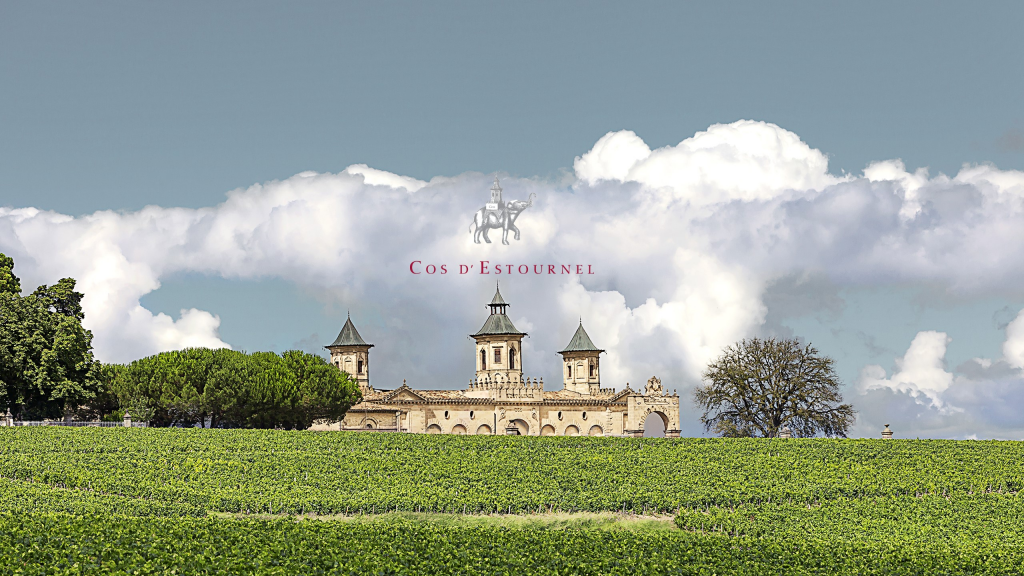
The Architecture of Ambition in Saint-Estèphe
Approaching Cos d'Estournel from the gravel road that separates it from Pauillac to the south, the silhouette arrives before any formal introduction is needed. Pagodas rise above the vine rows. Elephant statues flank the entrance. The estate's visual grammar is a deliberate departure from the austere stone facades that line most of the Médoc, and it has been since the nineteenth century. What the architecture signals is not eccentricity for its own sake but rather the ambitions of a founder who traded with the East and brought that vocabulary home to the Gironde. The estate's first documented vintage dates to 1811, which places Cos d'Estournal among the oldest continuously operating properties in the appellation.
Saint-Estèphe sits at the northern tip of the Médoc's classified commune sequence, separated from Pauillac by the Jalle du Breuil stream. The appellation's character is defined by heavier clay soils that give its wines more tannic structure and slower evolution than their southern neighbours. Within that context, Cos d'Estournal has held second growth classification since 1855, a tier it shares across the Médoc with estates from Margaux to Pauillac, though within Saint-Estèphe itself only Château Montrose shares that standing. That dual identity, architecturally theatrical and institutionally serious, is what makes the estate a reference point when discussing the appellation rather than simply a listing within it.
Viticulture in a Clay-Heavy Appellation
The editorial angle on Cos d'Estournal in 2025 is not simply its classification history but how it fits into Bordeaux's evolving conversation around sustainable viticulture. The Médoc's clay-dominant soils present particular challenges for organic and regenerative approaches: drainage management, fungal pressure, and the region's Atlantic climate create conditions where conventional intervention has historically been the path of least resistance. Estates that have moved toward reduced-input or certified programmes in this environment are operating against more friction than counterparts in drier appellations like Roussillon or Priorat.
Winemaker Dominique Arangoïts oversees the vineyard and cellar programme at Cos d'Estournal, a role that carries responsibility for one of the Médoc's most-watched properties. In the broader context of Bordeaux's classified growths, the direction of vineyard management at second growth estates has become a meaningful signal: buyers who track provenance as closely as they track vintage scores are watching whether estates at this tier make substantive commitments to reduced chemical inputs or whether sustainability language remains primarily communicative. The 2025 Pearl 4 Star Prestige award places Cos d'Estournal in a recognised tier of prestige producers, a trust signal that operates alongside, rather than instead of, the 1855 classification.
For comparison within Saint-Estèphe, Château Haut-Marbuzet and Château Lafon-Rochet represent the cru bourgeois and fourth growth tiers respectively, both operating in the same clay-inflected terroir but with different resource bases and market positioning. Château Calon Ségur, a third growth in the north of the appellation, has pursued certified organic viticulture in recent years, making it a reference point for what commitment to sustainable practice looks like at classified growth level in this specific Médoc context. These estates collectively define what Saint-Estèphe's peer set looks like when assessing both quality tier and viticulture approach.
What the Wines Represent
Cos d'Estournal's position in the global fine wine market rests on consistent production from a grand vin programme that has tracked closely with critical attention since the 1980s. The estate's second label provides earlier accessibility, a structure common among second growths that manage yield and selection pressure. The broader significance for a buyer or visitor is that these wines represent the northern Médoc's ability to produce Cabernet Sauvignon-dominant blends with the structural longevity that justifies en primeur purchase: buying at barrel before bottling, a practice that the estate has participated in for generations and that EP Club's coverage tracks closely.
Beyond the Médoc, estates with similarly long track records of documented production and classified status include Château Batailley in Pauillac and, outside France entirely, Abadía Retuerta in Sardón de Duero, which demonstrates how the estate-wine model with deep vineyard identity has found expression across Europe. The comparison is useful not as equivalence but as illustration of how wine culture at the prestige tier functions internationally. Similarly, the precision agriculture and terroir-expression conversation happening at properties like Albert Boxler in Niedermorschwihr in Alsace reflects a broader European turn toward site-specificity that resonates with what Cos d'Estournal's clay-gravel terroir argument has always made about the Gironde's northern reaches.
Visiting the Estate
Saint-Estèphe is accessible from Bordeaux by car in under an hour via the D2 Route des Châteaux, the road that threads through the Médoc's most concentrated sequence of classified estates. The village of Saint-Estèphe sits at the northern end of that route, and Cos d'Estournal sits at the commune's southern border, making it one of the first estates encountered when entering the appellation from Pauillac. Estate visits in the Médoc typically require advance booking; the high season runs from late spring through harvest in October, when the combination of tourist demand and active vineyard operations compresses availability. Visitors planning around harvest should book several months ahead.
The estate's physical environment, given the architectural programme of pagodas and Eastern detailing that has defined the property since the nineteenth century, offers a visual experience that no other classified growth in the Médoc replicates. Whether that setting enhances a tasting or simply contextualises it depends on the visitor, but it does mean that a visit here operates on a different register than a session at the more austere chateaux that dominate the appellation. For broader planning around a Saint-Estèphe visit, EP Club maintains guides across categories: our full Saint-Estèphe wineries guide, our full Saint-Estèphe restaurants guide, our full Saint-Estèphe hotels guide, our full Saint-Estèphe bars guide, and our full Saint-Estèphe experiences guide.
For visitors with broader regional interests, the model of estate-based wine tourism that Cos d'Estournal exemplifies within the Médoc finds parallels in estates like Château Bastor-Lamontagne in Preignac in the Sauternes appellation, where visitor programmes centre on sweet wine production, or even in non-wine contexts such as Chartreuse in Voiron and Aberlour in Aberlour, where production heritage and architectural identity anchor the visitor experience as firmly as the liquid in the glass.
Frequently Asked Questions
- What should I taste at Cos d'Estournal?
- The grand vin is the primary reference point for understanding what second growth Saint-Estèphe looks like at full expression: Cabernet Sauvignon-dominant with the clay-derived structure that gives northern Médoc wines their particular density and longevity. Winemaker Dominique Arangoïts oversees both the grand vin and second label programmes. The estate holds a 2025 Pearl 4 Star Prestige award, which situates it in the upper tier of prestige producers rather than simply within its 1855 classification.
- What should I know about Cos d'Estournal before I go?
- The estate is located in Saint-Estèphe at the southern edge of the commune, accessible from Bordeaux via the D2 in under an hour. It holds second growth classification from 1855 and a 2025 Pearl 4 Star Prestige award. Visitors should be aware that the estate's architectural character, with its pagodas and Eastern-influenced detailing, makes it visually distinct from other Médoc classified growths, and that visit programmes at this level typically require booking well in advance, particularly during the spring-to-harvest high season.
- How far ahead should I plan for Cos d'Estournal?
- Estate visits at classified Médoc properties during the high season (late spring through October harvest) typically book up weeks to months in advance. For Cos d'Estournal specifically, given its profile as a 2025 Pearl 4 Star Prestige estate with second growth classification, demand during en primeur week in April and during harvest season is particularly concentrated. Visitors arriving in the Médoc without pre-arranged estate appointments often find availability limited at properties in this tier, so planning two to three months ahead during peak periods is a reasonable baseline.
- Why does Cos d'Estournal have pagodas and Eastern architecture — is that unusual for a Bordeaux château?
- Yes, it is unusual within the Médoc classification, and the architectural identity is directly traceable to the estate's founding history in the early nineteenth century, with the first vintage recorded in 1811. The Eastern motifs reflect trade connections that shaped the founder's aesthetic sensibility, making Cos d'Estournal visually distinct from every other second growth in Bordeaux. No other estate in the 1855 classification combines this architectural programme with the same level of critical recognition, which is part of why the estate functions as a reference point in discussions of Médoc identity rather than simply a name on a classification list.
Peer Set Snapshot
These are the closest comparables we have in our database for quick context.
| Venue | Awards | Notes |
|---|---|---|
| Cos d'Estournal | 50 Best Vineyards #97 (2025); Pearl 4 Star Prestige | This venue |
| Château Calon Ségur | Pearl 4 Star Prestige | Vincent Millet, Est. 1779, 20,000 cases, Troixième Crus |
| Château Haut-Marbuzet | Pearl 3 Star Prestige | |
| Château Lafon-Rochet | Pearl 3 Star Prestige | |
| Château Montrose | Pearl 5 Star Prestige | Hervé Berland, Est. 1829, 19,000 cases, Deuxièmes Crus |
| A. Margaine | Pearl 2 Star Prestige |
Access the Cellar?
Our members enjoy exclusive access to private tastings and priority allocations from the world's most sought-after producers.
Get Exclusive Access