
Bodegas Protos sits at the base of Peñafiel's medieval castle, one of the most architecturally distinctive wine addresses in Ribera del Duero. Awarded a Pearl 3 Star Prestige rating in 2025, it operates at the serious end of the region's visitor experience and produces Tempranillo-led wines that speak directly to the limestone and clay soils beneath the Duero valley.
Where the Castle Meets the Cave
Peñafiel's castle does not sit above the town so much as preside over it. The elongated ridge-leading fortress — one of the most recognisable silhouettes in Castile — anchors a landscape that has been producing wine since long before Spain had appellation law. At its base, literally carved into the rock beneath, Bodegas Protos occupies one of the most geologically integrated winery sites in Ribera del Duero. The approach from the road gives you the full picture: sandstone cliff, medieval battlements, and the controlled cool of barrel-ageing caves that required no refrigeration for centuries because the hillside does the work. It is a setting where architecture and terroir are, for once, genuinely inseparable.
That physical context matters because it shapes how Protos fits into the Ribera del Duero conversation. The Duero valley runs east to west at roughly 800 to 900 metres above sea level, which is high enough to create the diurnal temperature swings , warm afternoons, cold nights , that drive aromatic intensity and preserve acidity in Tempranillo. Peñafiel itself sits in the eastern stretch of the DO, on soils with a higher proportion of limestone and chalk than the sandier flats further west. That subsoil character tends to produce wines with a particular freshness and mineral length, which distinguishes the eastern Ribera wines from their rounder, more immediately plush counterparts closer to Valladolid. Protos, drawing from vineyards in and around the town, expresses that geological argument directly in the glass.
Ribera del Duero and the Terroir Question
Ribera del Duero spent much of its modern history competing with Rioja on Rioja's terms , oak, longevity, and prestige bottlings built around the same Tempranillo grape. What has shifted in the past two decades is a growing interest in where, specifically, within the DO a wine comes from. Single-vineyard releases, village-level designations, and altitude-specific bottlings have moved from fringe curiosity to mainstream conversation among serious buyers. The region's geography supports this: the Duero plateau is not a monolith. Alluvial terraces differ from hillside limestone exposures; north-facing slopes retain moisture differently from south-facing ones; altitude variations of even 100 metres can mean meaningfully different ripening windows.
Bodegas Protos holds a significant position in that local geography, with vineyard holdings that include old-vine Tinta del País , the local name for Tempranillo , planted in the calcareous soils immediately around Peñafiel. Old vines on limestone in this part of Castile produce lower yields and more concentrated flavour compounds, the kind of material that serious Spanish winemaking builds reputations on. Among the region's established names, Protos occupies the heritage tier: it is one of the founding producers of the Ribera del Duero DO when the appellation was formalised in 1982, which positions it as a reference point rather than an upstart, and earns it a credibility that newer boutique entrants are still building toward. For context on comparable heritage-tier producers working with similar raw material, Arzuaga Navarro in Quintanilla de Onésimo and Abadía Retuerta in Sardón de Duero represent the immediate competitive peer set in terms of both scale and seriousness.
The Winery as an Architectural Argument
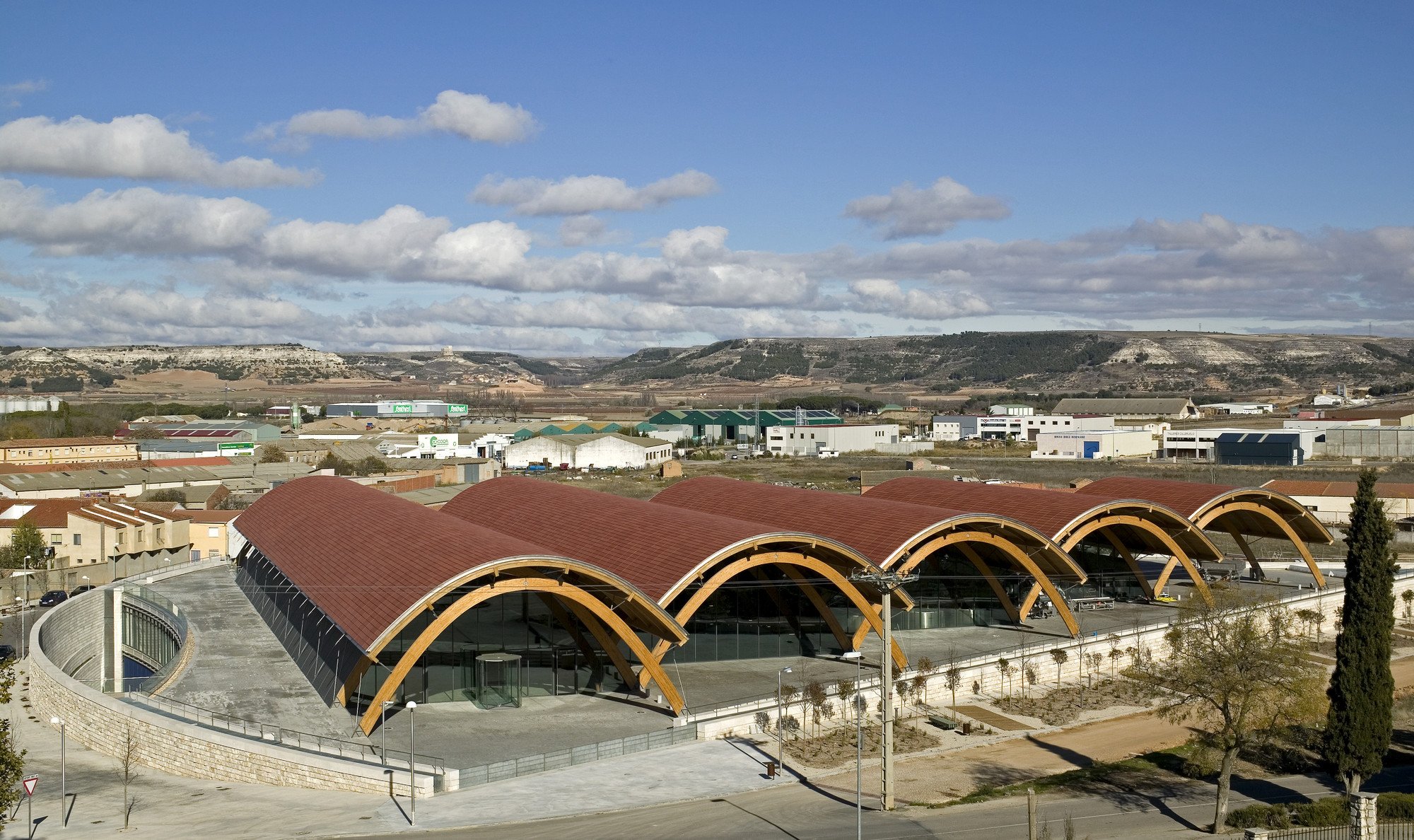
The Protos site involves two distinct architectural registers. The original cave system, tunnelled directly into the hillside beneath the castle, provides the natural constant-temperature environment that made it viable to age wine here long before modern climate control. These caves , some extending deep into the limestone , remain in use and form the emotional core of any visit. Then there is the contemporary winery structure designed by the late Richard Rogers, completed in 2008, which extends from the hillside in a language of arching timber and steel. The contrast is deliberate: ancient geology, modern engineering, and a design that acknowledges both without pretending to resolve the tension between them.
This architectural ambition places Protos in a different category from the utilitarian production facilities that still dominate much of Spain's wine country. It is comparable in design ambition to Bodegas Ysios in Laguardia, whose Santiago Calatrava building turned a Rioja production house into a destination of a different order, or Bodegas Vivanco in Valle de Mena, where museum infrastructure anchors a visitor experience built around wine culture rather than just wine production. For Protos, the experience of walking from Richard Rogers' contemporary structure into centuries-old limestone caves is itself a form of terroir education: the rock that shapes the wine is also the rock you are standing inside.
The 2025 Pearl 3 Star Prestige Rating
EP Club's 2025 Pearl 3 Star Prestige award places Bodegas Protos in the upper tier of rated wine experiences in this region. Within the broader Spanish wine visitor circuit, that credential puts it alongside a small cohort of properties where architecture, production quality, and guided experience converge at a level that warrants the journey specifically. Other awarded Spanish producers in the EP Club network include Codorníu in Sant Sadurní d'Anoia, CVNE in Haro, and Clos Mogador in Gratallops, each sitting within distinct regional traditions. Internationally, the framework extends to properties like Aberlour in Aberlour and Accendo Cellars in St. Helena, though the Ribera del Duero context is its own register entirely.
Closer to home, Pago de Carraovejas represents Peñafiel's other major wine address, producing a different stylistic argument from the same general geography. Visiting both in a single trip gives a sharper picture of what the eastern Ribera terroir can produce across different approaches to viticulture and winemaking. The two properties are close enough to each other that a half-day covers both without logistical difficulty.
Planning Your Visit
Peñafiel sits roughly 55 kilometres east of Valladolid, making it accessible by car from the regional capital in under an hour. The town has limited but characterful accommodation options; for a broader picture of where to stay, our full Peñafiel hotels guide covers the current options across price points. Those building a longer Ribera del Duero itinerary will also want to reference our Peñafiel restaurants guide, our bars guide, and our experiences guide for a complete picture of what the town supports beyond the wineries. For those specifically tracing the Ribera del Duero DO in depth, our full Peñafiel wineries guide maps the broader producer landscape from the same base.
Spring and autumn are the practical peaks for visits: late April through June avoids the plateau heat and coincides with the growing season when the vineyards have visual interest; September and October bring harvest activity and the possibility of watching the winery in operational mode. August is possible but the Castilian plateau in midsummer is an exercise in endurance. Visits to Protos are structured experiences rather than drop-in affairs, which means booking in advance is the operative approach regardless of season.
Frequently Asked Questions
Is Bodegas Protos more low-key or high-energy?
Protos occupies a calm, considered register. The setting , a hillside cave complex beneath a medieval castle , imposes a natural quiet, and the 2025 Pearl 3 Star Prestige rating reflects an experience built around depth rather than spectacle. It is a place for focused attention on wine and geology rather than a high-energy event venue. Those looking for a more animated scene in the Spanish wine world should calibrate expectations accordingly: this is serious, unhurried Ribera del Duero.
What should I taste at Bodegas Protos?
The core of any tasting here should be the Tempranillo-led wines drawn from the calcareous Peñafiel terroir , the limestone and chalk subsoil that distinguishes the eastern Ribera DO from western sections of the appellation. Protos's heritage as one of the founding producers of the 1982 DO makes its Reserva and Gran Reserva-tier bottles the most direct expression of what the winery does over time. Given the 2025 Pearl 3 Star Prestige standing, the structured visit formats are the appropriate way to encounter the full range.
What's the defining thing about Bodegas Protos?
The intersection of site and history. Few wine producers in Spain can claim a cave system carved into a castle hill as their functional ageing infrastructure, and fewer still were present at the founding of their appellation. The 2025 Pearl 3 Star Prestige rating confirms what the address suggests: this is a reference-point winery in Peñafiel, not simply a notable stop on a regional itinerary.
Side-by-Side Snapshot
These are the closest comparables we have in our database for quick context.
| Venue | Cuisine | Price | Awards | Notes |
|---|---|---|---|---|
| Bodegas Protos | Pearl 3 Star Prestige (2025) | This venue | ||
| Pingus | ||||
| Abadía Retuerta | ||||
| Arzuaga Navarro | ||||
| Bodegas Vivanco | ||||
| Bodegas Ysios |
Access the Cellar?
Our members enjoy exclusive access to private tastings and priority allocations from the world's most sought-after producers.
Access the Concierge