Zippy's Kapahulu
Zippy's Kapahulu on Kapahulu Avenue is the flagship location of Hawaii's most recognized local restaurant chain, serving the plate lunch format that defines everyday eating across Oahu. Where fine-dining rooms offer tasting menus, Zippy's offers chili, saimin, and mixed plates at a counter that functions as a social institution. It sits at the working end of Honolulu's dining spectrum, far from the resort corridor.
Pearl is the En Primeur Club membership app — saves, bookings, and concierge access live there. Same editors, same standards.
- Address
- 601 Kapahulu Ave, Honolulu, HI 96815
- Phone
- +1 808 733 3725
- Website
- zippys.com
- Directions
- Get directions
 Saves & bookings on Pearl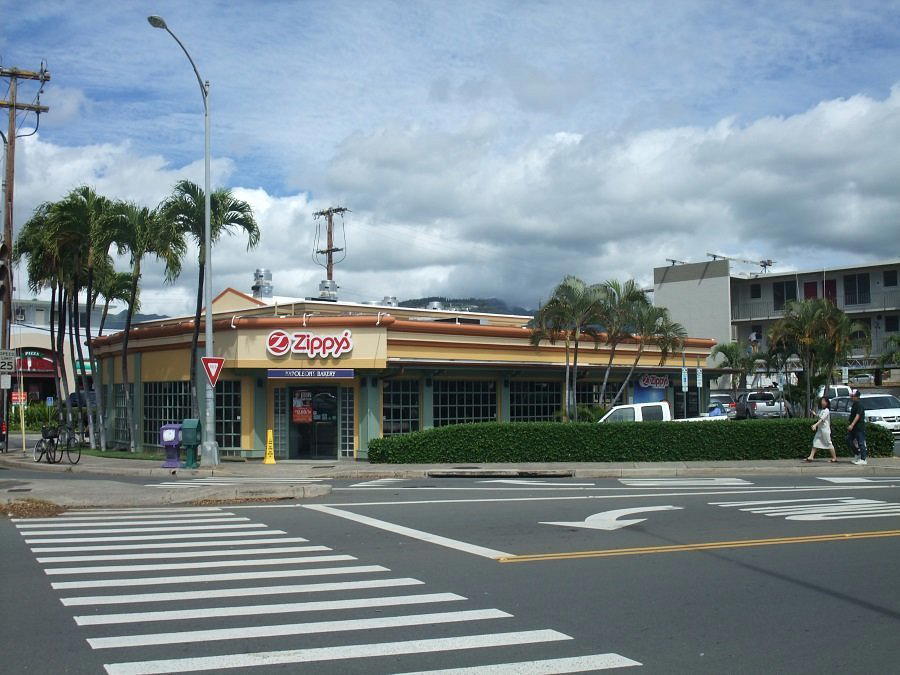
The Counter That Runs the Island
Kapahulu Avenue runs inland from Waikiki, away from the beach hotels and toward the neighborhoods where Honolulu actually lives. The Zippy's at 601 Kapahulu Ave sits along this corridor as a 24-hour anchor, the kind of place where the parking lot is never quite empty at 2 a.m. and the booths fill again before most restaurants open their prep kitchens. Understanding what Zippy's is requires setting aside the vocabulary used to describe the venues that appear in fine-dining conversations. Zippy's does not compete with Alan Wong's Honolulu or Beachhouse at the Moana. It does not compete with the ramen programs at AGU Ramen - Ward Centre. It belongs to a different and arguably more load-bearing part of Honolulu's food culture: the plate lunch tradition.
The Plate Lunch Format and What It Tells You About Hawaii
The plate lunch is Hawaii's most democratic food format. Two scoops of rice, a scoop of macaroni salad, and a protein constitute the standard architecture, a structure that emerged from plantation-era labor camps in the nineteenth century, where workers from Japan, the Philippines, Korea, and Portugal ate from shared kitchens. The format absorbed influences from each wave of migration and arrived in the twentieth century as something distinctly local, neither Asian nor American but the product of a specific Hawaiian working context. Zippy's, founded in 1966, scaled that tradition into a chain that now operates across Oahu and into Maui. The Kapahulu location is one of the company's most-used addresses and functions as a de facto reference point for visitors trying to understand what locals actually eat, as opposed to what hotel dining rooms suggest they eat.
The structure of the menu reflects the logic of working-meal efficiency. Chili is the signature: a mild, slightly sweet preparation that has accumulated a following across generations of Oahu residents. It appears as a standalone dish, as a topping, and as a component in combination plates. Saimin, the local adaptation of Japanese ramen using a dashi-based broth and soft wheat noodles, occupies another core position. The menu extends across fried chicken, beef stew, and a rotating set of daily specials that map to the multi-ethnic character of local home cooking. This is not a menu organized around a chef's concept. It is organized around what people want to eat at 7 a.m. at noon, at midnight, and at the hour before a long drive.
Where Zippy's Sits in Honolulu's Dining Range
Honolulu's restaurant range is wider than most mainland cities its size. At one end, the resort corridor around Waikiki supports a tier of hotel dining rooms and chef-driven concepts that price against global luxury comparisons. 1050 Ala Moana Blvd and Bread & Butter occupy positions in the mid-to-upper tier. At the other end, the plate lunch economy runs through drive-ins, food trucks, and counters that serve a local population for whom this format is simply how meals work. Zippy's sits in that latter tier but with the infrastructure of a full restaurant: table service alongside counter service, a bakery section, a drive-through at some locations, and hours that extend through the night.
Rainbow Drive-In on Kapahulu is a common comparison: also a plate lunch institution, also on the same avenue, but operating as a drive-up window with a shorter menu and a more nostalgic-object quality. L&L Hawaiian Barbecue occupies a similar cultural position but expanded its footprint to the mainland, which altered its local meaning. Zippy's remains primarily an Oahu institution, with the Kapahulu location functioning as the best-known address in the chain. For visitors who want to understand the plate lunch tradition as it operates at scale, rather than as a curated sample, this is the most accessible and representative entry point in central Honolulu.
The Menu as a Document of Local Eating
Reading the Zippy's menu with attention reveals the layers of influence that define Hawaii's food culture more efficiently than any single fine-dining tasting menu could. The saimin points to Japanese and Chinese noodle traditions filtered through local modification. The chili, with its distinct sweetness, diverges from Texas or New Mexican traditions and sits as a specifically Hawaiian preparation. The Portuguese sausage on the breakfast menu connects to the large wave of Azorean workers who arrived in Hawaii in the late nineteenth century. The spam musubi in the pastry case belongs to the post-World War II period when canned meat became embedded in local eating. Each item on the menu is, in this sense, a data point in Hawaii's social and culinary history, compressed into a format that costs a few dollars and takes fifteen minutes to consume.
This editorial framing matters for the traveler deciding whether Zippy's belongs in a Honolulu itinerary. The answer depends on what the itinerary is for. For those building context around Hawaii's actual food culture rather than its resort-facing version, Zippy's provides information that no amount of time at a Le Bernardin-tier operation in New York or a French Laundry-caliber room in Napa would supply. The reference points that matter here are local and structural, not imported.
For those building a broader picture of how American regional dining works at its most embedded, the contrast between Zippy's and the white-tablecloth programs at places like Providence in Los Angeles or Smyth in Chicago clarifies what makes Hawaii's food culture distinct: it has a genuinely local baseline that is not aspirational toward mainland fine-dining norms. The plate lunch is not a simplified version of something more sophisticated. It is its own thing. See also the full Urban Honolulu restaurants guide for context on how the city's dining tiers map across neighborhoods.
Planning a Visit
The Kapahulu location operates around the clock, which removes the usual timing pressure of Honolulu restaurant visits. There is no reservation system and no dress consideration beyond what you would wear to any casual neighborhood counter. The parking lot off Kapahulu Ave handles most of the traffic, though the avenue itself can slow during peak hours. The bakery section sells whole cakes and a range of prepared pastries, which function as a separate, logistically useful option for hotel rooms or long drives. Families with children will find the format direct: the menu has sufficient range, the environment is noise-tolerant, and the counter service model removes the pacing constraints of table service. Prices remain accessible across the full menu, placing this well within reach for any travel budget. The Kapahulu address is also within walking distance of the Diamond Head end of the Kapahulu corridor, making it a practical stop before or after any activity in that direction.
Continue exploring
More in Urban Honolulu
Restaurants in Urban Honolulu
Browse all →
Bars in Urban Honolulu
Browse all →
At a Glance
- Well Known
- Casual
- Energetic
- Casual Hangout
- Family
- Late Night
- Solo
- Standalone
Current opening hours
- Monday
- 6 AM–10 PM
- Tuesday
- 6 AM–10 PM
- Wednesday
- 6 AM–10 PM
- Thursday
- 6 AM–10 PM
- Friday
- 6 AM–10 PM
- Saturday
- 6 AM–10 PM
- Sunday
- 6 AM–10 PM
Hours can change for holidays and private events. Last verified .
Fast-casual, laid-back atmosphere with a nostalgic local vibe; bright and accessible storefront on the outskirts of Waikiki serving as a popular stop for both tourists and residents.
Know Before You Go
- Getting there
- 601 Kapahulu Ave, Honolulu, HI 96815