Tabelog 100 #24
Our verdict
YOGORO belongs to Tokyo’s compact curry-counter tradition rather than the city’s luxury dining economy. Its Jingumae room, 13-seat scale, cash-only rhythm, and Tabelog Curry TOKYO 100 selection in 2024 make it a useful reference point for how serious casual dining works in Shibuya: small spaces, low prices, and little tolerance for over-planning.

Pearl is the En Primeur Club membership app, where members save venues, book tables and use the concierge.
The menu
What to order
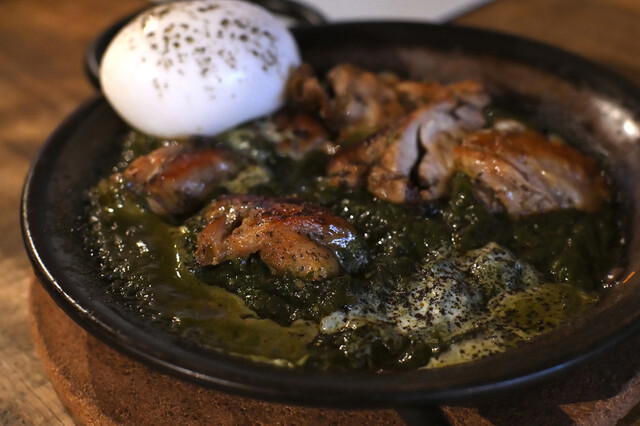
- Spinach curry
- Spinach chicken curry
- Tomato-based curry
The approach to a Tokyo curry room changes the meal before the first order. Tokyo’s street-level dining culture often makes arrival less a grand entrance than a close reading of the city around you. Curry shops in Tokyo can feel direct and practical: a focused category, quick decisions, condensed service, and a room that asks diners to follow flow rather than ceremony.
YOGORO fits that grammar. It sits closer to Tokyo’s serious everyday dining culture than its reservation-driven tasting-menu economy. That matters. In Tokyo, curry is not just a budget category; it has hierarchies, obsessive regulars, and specialist lists. Tabelog Hyakumeiten recognition for curry in 2024 puts YOGORO inside that specialist conversation, while the low spend bracket keeps the experience grounded in the city’s lunch-and-early-evening rhythms.
A compact Tokyo room built for curry, not theatre
Tokyo’s small restaurants often show intent through format before menu language. A direct curry meal changes the experience: solo diners and pairs can fit naturally into the pace, while complicated group meals feel less suited to the category. The arrangement suggests practical movement rather than lingering spectacle. In a city where premium dining can make scarcity performative, better casual specialists make constraint functional.
That spatial discipline belongs to Tokyo curry tradition. The category rewards focus: a clear kitchen rhythm, a defined dining format, and a style repeated with precision across lunch and dinner without multi-course choreography. YOGORO’s appeal is clean-lined and direct. The signal is not luxury; it is compression. The meal sits in the city’s everyday specialist tier, where clarity matters more than ceremony.
The Tokyo comparison set clarifies this. MOKUBAZA offers another curry reference point; Handmade buckwheat Matsunaga occupies the soba lane with a comparable casual-dining logic; EMILIA and Jingumae Higuchi belong to more expensive sit-down categories. Curry at this level competes less with fine dining than with other precision casual formats: soba, ramen, yakitori, tonkatsu, and small Japanese counters where repeatability marks seriousness. Compare adjacent formats across other Tokyo dining rooms.
Tokyo curry as a serious casual category
Many visitors mistake Tokyo curry for a fallback meal. The city’s curry culture is broader: Japanese curry-rice shops, spice-curry specialists, South Asian-influenced counters, café hybrids, and neighborhood institutions share a public conversation without serving the same purpose. Tabelog Hyakumeiten recognition for curry separates the specialist tier from generic lunch. It does not turn the meal into fine dining, which is the point.
YOGORO has a listing score of 3.79, and that matters locally: Tabelog ratings in Japan cluster tightly, and numbers above the mid-threes can signal sustained diner confidence rather than casual popularity. The better reading is not universal ranking, but held relevance in a crowded city category where diners have many substitutes within a short train ride.
Price reinforces that role. A JPY 1,000 to JPY 1,999 bracket for both lunch and dinner places the meal among Tokyo’s value-dense specialist lunches and casual dinners, where room, queue discipline, payment method, and turnover can matter as much as décor. This is where Tokyo differs from many luxury-food cities. Seriousness is not always tied to a tasting menu, sommelier, or design commission. It can sit in a focused curry address, with a category locals judge closely.
Travelers building a curry itinerary can compare YOGORO with other dining in Tokyo and beyond without treating every curry room as interchangeable. The contrast helps: Tokyo’s curry scene is dense, quick-moving, and city-specific, while regional specialists reveal different spice preferences, room sizes, and service habits. Other casual formats across Japan also show how everyday dining can shift by city, audience, and pace.
How to read the room before committing
The practical intelligence is simple: format defines the experience. This is not for a complicated group meal or long business dinner. It suits diners comfortable with a direct curry meal and a Tokyo casual-specialist rhythm. Tokyo’s casual specialists often make operations part of the experience, where a serious food address may remain plain in presentation and sharply focused in purpose.
Service pattern matters too. Timing is often the diner’s main tool at Tokyo specialists, especially where the kitchen runs a focused category and the room turns naturally. Opening patterns shape planning, and lunch-and-dinner rhythms mean this is not always an anytime backup. Treat it as a fixed part of a Tokyo day, not an improvised final stop after a long evening elsewhere.
For visitors using YOGORO in a larger Tokyo plan, the surrounding city pairs naturally with design retail, galleries, and low-key coffee rather than hotel dining circuits. Tokyo can make room design, service rhythm, and format feel as central as the plate itself. At YOGORO, the value is the urban condition: focused category, serious local scrutiny, and little excess around the meal.
Frequently asked questions
Is YOGORO expensive?
Pricing at YOGORO is listed as JPY 1,000 - JPY 1,999 for both lunch and dinner.
Should I book YOGORO in advance?
YOGORO is a curry room in Tokyo, so the practical move is to plan around the meal rather than treat it as a long, formal booking-driven dinner.
What's YOGORO best at?
YOGORO’s strongest draw is curry, backed by Tabelog Hyakumeiten recognition for curry in 2024. The Tokyo room is set up for a focused curry meal rather than a long, formal dinner.
How YOGORO Tokyo compares with similar nearby venues.
| Venue | Cuisine | Price | Awards |
|---|---|---|---|
| YOGOROThis venue (the venue you are viewing) | Japanese Curry | Not listed | Tabelog 100 #24 |
| EMILIA | Emilia-Romagna regional Italian with handmade pasta | $50–100 | Tabelog 100 #58 |
| Jingumae Higuchi | Modern Japanese Kappo Omakase | $300–500 | 2 Michelin Stars · Tabelog Bronze #109 |
| Handmade buckwheat Matsunaga | Handmade Soba & Japanese Sake | $20–30 | Tabelog 100 #60 |
| MOKUBAZA | Modern Japanese keema curry & bar | $20–30 | Tabelog 100 #76 |
Recognition history
Dated appearances from independent guides and award organizations, with the underlying list record or original source where available.
Tabelog 100 #24 · No. 24
Tabelog · Tabelog 100 - Curry - TOKYO - 2024