Yin Ji Chang Fen 銀記腸粉
Our verdict
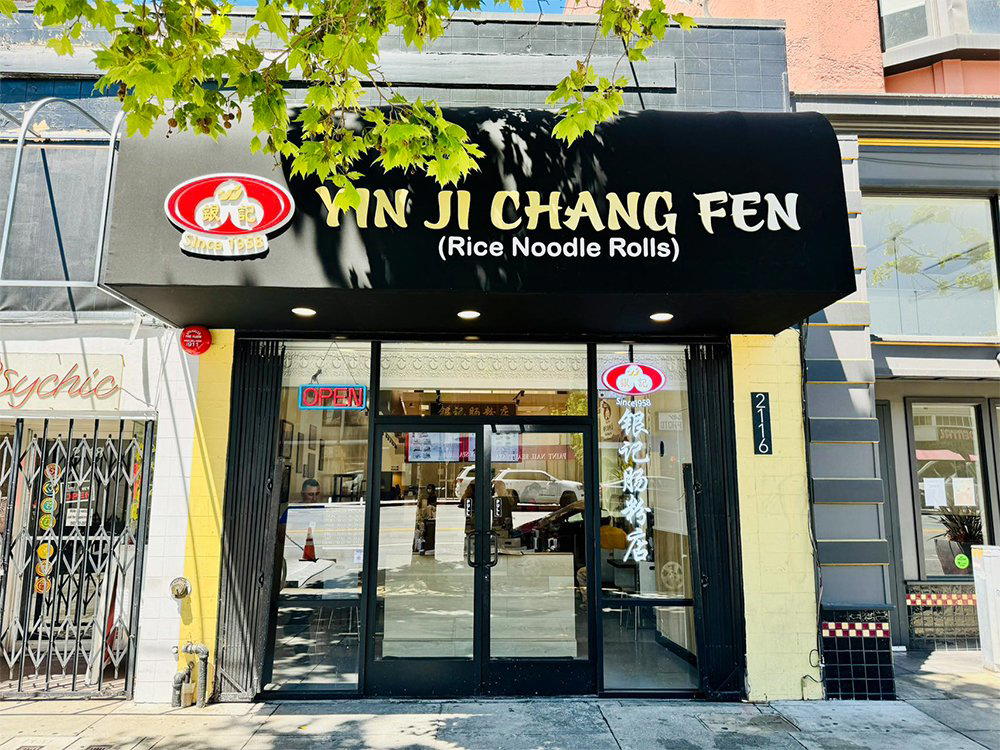
Yin Ji Chang Fen brings the Guangzhou tradition of steamed rice noodle rolls to Downtown Berkeley, operating from its Shattuck Avenue address as one of the Bay Area's clearest expressions of Cantonese breakfast and dim sum culture. The format is spare and deliberate: rice flour sheets steamed to order, folded around fillings, finished with soy and sesame oil. It is a meal built on technique rather than spectacle.

Pearl is the En Primeur Club membership app — saves, bookings, and concierge access live there. Same editors, same standards.
- Address
- 2116 Shattuck Ave (at Center St), Berkeley, CA 94704
- Website
- yinjichangfenusa.com
- Directions
- Get directions
The menu
What to order
- BBQ Pork & Dry Shrimp Rice Noodle Roll
- Marinated Shrimp & Beef Rice Noodle Roll
- Oysters Egg Rice Noodle Roll
The Cantonese Morning Ritual That Berkeley Adopted
Chang fen, the steamed rice noodle roll that anchors Guangzhou's morning tea culture, is one of the more demanding preparations in Cantonese cuisine to execute at volume. The batter — rice flour thinned to a specific viscosity — is poured onto a shallow tray, steamed for less than two minutes, then peeled and folded around fillings before it cools and loses its characteristic silkiness. The margin between correct and collapsed is narrow. It is not the kind of dish that survives inattention or shortcuts in ingredient sourcing, which is why most credible versions in the United States cluster around neighborhoods with significant Cantonese populations and the supply chains those communities sustain. Yin Ji Chang Fen 銀記腸粉, operating from 2116 Shattuck Avenue at Center Street in Downtown Berkeley, represents a deliberate extension of that tradition into a university-adjacent neighborhood where Cantonese breakfast culture has rarely had a fixed address.
The original Yin Ji in Guangzhou, operating since 1946, built its reputation on a narrow menu and an insistence on the single preparation. That lineage informs what the Berkeley location offers: a focused format centered on chang fen rather than a broad dim sum spread. In the wider context of Bay Area Chinese dining, where the dominant model has long been the large-format dim sum hall, a restaurant organized around one dish and its variations represents a deliberate counter-position. The comparison is less to Hong Kong-style dim sum palaces and more to the kind of specialist stall that would occupy a corner of a Guangzhou morning market, concentrated, purposeful, and indifferent to culinary novelty.
What the Format Actually Demands
Chang fen exists in several regional registers. The Guangzhou version, which Yin Ji represents, is thinner and more delicate than the Hong Kong street variety, and is typically served with a trio of sauces, light soy, sesame paste, and sweet soy, that the diner applies tableside. The distinction matters because it changes the textural calculus: the noodle sheet itself carries the dish, rather than functioning as a vehicle for a heavily seasoned filling. Proteins such as beef, shrimp, or char siu (barbecue pork) appear as secondary elements inside a preparation where the rice flour's clean, faintly milky flavor is the primary point.
This places Yin Ji in a different category from the kind of Cantonese-adjacent offerings that appear on dim sum carts across the East Bay. Cart dim sum often sacrifices temperature and texture precision for the logistics of service at scale. A counter-service model built around a single preparation can hold quality standards more consistently, because the gap between kitchen and table is short and the product is made to order rather than assembled in advance.
Berkeley's dining scene has historically rewarded this kind of disciplined specialization. The city's food culture, shaped partly by proximity to UC Berkeley and partly by decades of influence from the broader Bay Area ingredient-focused movement, tends to engage seriously with traditional technique across cuisines. Venues like Ajanta, which has maintained a focused regional Indian format for years, and AKEMI, operating in a similarly precise register, reflect a local appetite for restaurants that commit to a specific culinary tradition rather than broadening for mass appeal. Yin Ji fits that pattern.
Downtown Berkeley and the Shattuck Corridor
The Shattuck Avenue address places Yin Ji within Berkeley's most commercially active stretch, a few blocks from BART's Downtown Berkeley station and within walking distance of the campus's southern edge. The surrounding block accommodates a mix of student-facing casual dining, older neighborhood institutions, and newer openings. 900 Grayson and Angeline's Louisiana Kitchen operate in the broader Downtown corridor, representing the neighborhood's range from Southern comfort to California-inflected brunch. Agrodolce adds an Italian reference point nearby.
For a preparation like chang fen, which is consumed primarily during morning and midday hours in its Guangzhou context, the proximity to a dense weekday foot traffic pattern serves the format well. The dish does not lend itself to late-evening dining in the way that, say, a Sichuan hot pot or a ramen counter might. Its natural rhythm is the early meal, the mid-morning break, the quick lunch. Downtown Berkeley's pedestrian density during university hours creates exactly the kind of audience that sustains that rhythm.
The Bay Area's Cantonese dining geography has traditionally concentrated in San Francisco's Richmond and Sunset districts, and in the East Bay cities of Oakland and Richmond. Berkeley has remained a secondary node, with fewer dedicated Cantonese operations relative to its overall dining density. Yin Ji's presence on Shattuck fills a gap that many East Bay residents have historically resolved by driving to Oakland's Chinatown or across the bridge to the Sunset. That geographic context gives the location a function beyond restaurant: it anchors a Cantonese breakfast tradition in a neighborhood where it has been underrepresented.
Placing Yin Ji in the Wider Dining Conversation
Chang fen as a category sits at the opposite end of the production scale from the kind of ambitious tasting-menu restaurants that define much of the critical conversation about American dining. Venues like The French Laundry in Napa, Lazy Bear in San Francisco, or Alinea in Chicago operate in a register defined by multi-course progression, high labor input per cover, and explicit fine-dining signaling. Le Bernardin in New York City, Providence in Los Angeles, and Blue Hill at Stone Barns in Tarrytown apply similar rigor to their respective cuisines. Single Thread Farm in Healdsburg, Addison in San Diego, The Inn at Little Washington, Atomix in New York City, and 8 1/2 Otto e Mezzo Bombana in Hong Kong all operate in that upper tier. Emeril's in New Orleans represents a different American fine-dining lineage altogether.
Yin Ji does not compete with any of them, nor is it trying to. The craft in chang fen is real, but it is expressed in a fundamentally different register: speed, repetition, batter consistency maintained across a service, sauce ratios calibrated by institutional muscle memory rather than innovation. The sophistication is in the discipline, not the elaboration. That distinction is worth holding when assessing what Yin Ji contributes to Berkeley's dining range. See our full Berkeley restaurants guide for broader context on where the city's dining sits across price points and traditions.
Know Before You Go
- Address: 2116 Shattuck Ave (at Center St), Berkeley, CA 94704
- Neighborhood: Downtown Berkeley, walking distance from Downtown Berkeley BART station
- Format: Specialist counter-service focused on steamed rice noodle rolls (chang fen)
- Leading for: Morning meals, quick midday stops, Cantonese breakfast tradition
- Note: Phone, hours, and pricing, verify directly before visiting
Frequently asked questions
What's Yin Ji Chang Fen 銀記腸粉's location?
Yin Ji Chang Fen 銀記腸粉 is located at 2116 Shattuck Ave (at Center St), Berkeley, CA 94704, Berkeley.
Is Yin Ji Chang Fen in Berkeley connected to the Hong Kong-founded Yin Ji chain?
Yin Ji Chang Fen takes its name and culinary orientation from the Guangzhou chang fen tradition associated with the 銀記 lineage, which has roots tracing back to Guangzhou's established rice noodle culture. The Berkeley location on Shattuck Ave operates within that same Guangzhou-style framework, distinguishing it from Hong Kong-style chang fen operations in the Bay Area. For visitors approaching from a Cantonese dining background, that regional distinction in technique and sheet thickness is the meaningful differentiator.
What's the signature dish at Yin Ji Chang Fen 銀記腸粉?
Chang fen, the steamed rice noodle roll central to Guangzhou's morning tea tradition, is the entire focus of the menu. Yin Ji represents the Guangzhou register of the dish: thinner and more delicate than the Hong Kong street version, requiring precise steaming technique and fresh-ground rice batter. The format is narrow by design — this is a specialist operation on Shattuck Ave in Berkeley, not a broad Cantonese menu.
How hard is it to get a table at Yin Ji Chang Fen 銀記腸粉?
The 2116 Shattuck Ave location in Downtown Berkeley sits a few blocks from the BART station, which drives consistent foot traffic throughout the day. Chang fen is a fast-format dish by nature, so turnover tends to move quickly rather than requiring advance reservations. Arriving during peak morning hours is the practical consideration, as this style of Cantonese preparation draws regulars on a daily cycle.
What has Yin Ji Chang Fen 銀記腸粉 built its reputation on?
Yin Ji's reputation rests on bringing a technically demanding Cantonese preparation to Berkeley with fidelity to the Guangzhou source tradition. Chang fen in the Guangzhou style requires thin, almost translucent rice sheets that are among the more exacting benchmarks in Cantonese cuisine, and the Berkeley outpost has established itself within that specific category. The address on the Shattuck corridor places it within the city's most active dining stretch, giving it visibility alongside a range of competing cuisines while remaining singular in its focus.
Standing Among Peers
| Venue | Cuisine | Price | Awards |
|---|---|---|---|
| Yin Ji Chang Fen 銀記腸粉This venue — the venue you are viewing | Guangzhou-Style Rice Noodle Rolls | $10–20 | Not listed |
| Cafe Bolita | Heirloom Nixtamalized Corn Masa | $10–20 | Not listed |
| Cultured Pickle Shop | Fermented Vegetarian Rice Bowls | $30–50 | Not listed |
| Rose Pizzeria | Thin-Crust California Pizza | $20–30 | 50 Top Pizza USA #50 |
| Tanzie's Cafe | Northern Thai Brunch | $20–30 | Not listed |
| 900 Grayson | American Comfort Cafe | $20–30 | Diners, Drive-Ins and Dives Featured Restaurant |
Continue exploring
More in Berkeley
Restaurants in Berkeley
Browse all →
Bars in Berkeley
Browse all →
Hotels in Berkeley
Browse all →









Details
- Casual Hangout
- A La Carte
Casual and direct atmosphere focused on fresh, takeout-friendly Cantonese street food.