Michelin Bib Gourmand · Tabelog Bronze #517
Our verdict
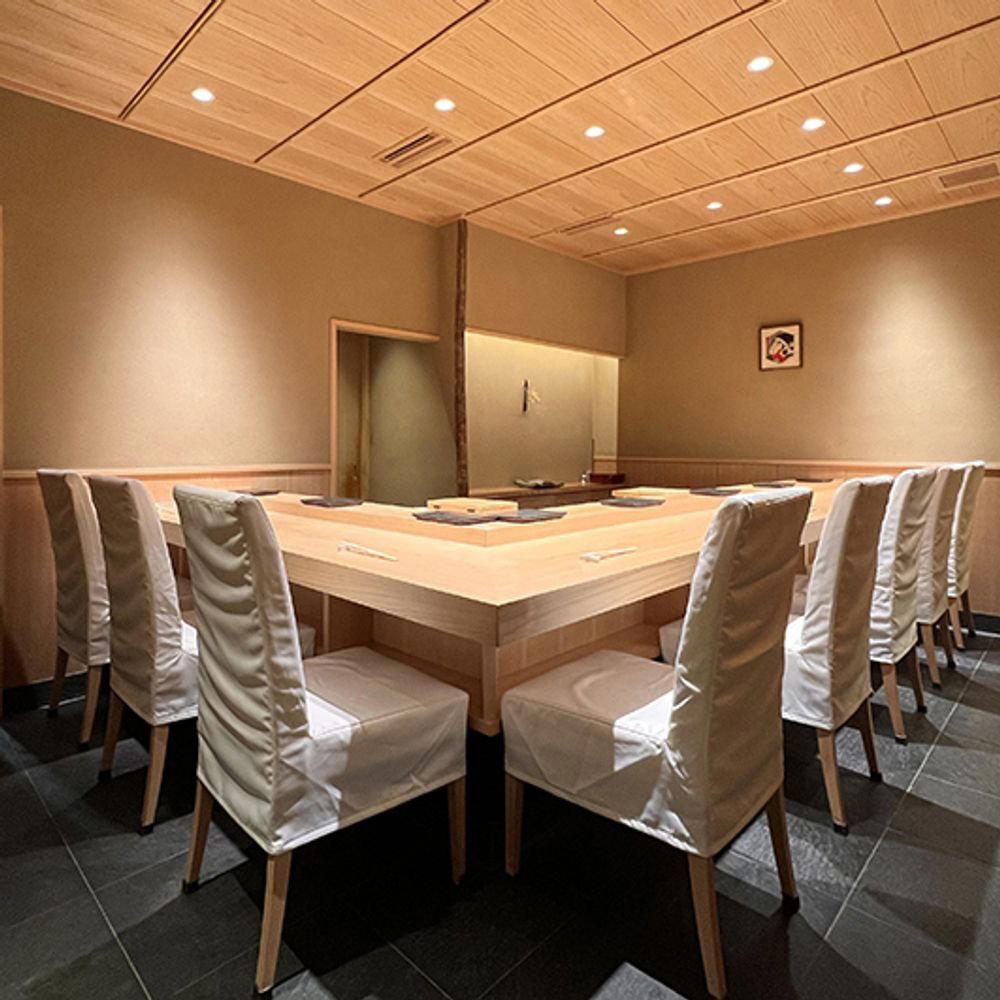
Sushi Dokoro Yamato occupies a nine-seat counter in Tsukiji, earning Tabelog Bronze Awards consecutively from 2024 through 2026 and selection to the Tabelog Sushi Tokyo 100 in both 2022 and 2025. The format is reservation-only, phone-booked on the first business day of each month for the following month, with a per-person spend of JPY 30,000–39,999. The proprietress tends the charcoal brazier herself, grilling large clams, ichiyaboshi, and seasonal produce beside the sushi counter.

Pearl is the En Primeur Club membership app, where members save venues, book tables and use the concierge.
The menu
What to order
- Chargrilled vegetables
- Chargrilled seafood
Nine seats, charcoal smoke, and the Tsukiji neighbourhood that shaped them both
Nine counter seats. That is the full capacity of Sushi Dokoro Yamato. At this scale, the counter is not a design choice so much as a structural commitment: the proprietress cannot grill, tend charcoal, and serve more guests than she can observe simultaneously. The nine-seat format has become the de facto standard for a specific tier of Tokyo counter dining, one that sits between the intimate four- and six-seat rooms reserved for a single party and the larger omakase operations seating fifteen or more. Yamato occupies that middle tier with a format that integrates open-fire cooking into what is fundamentally a sushi counter, a combination rare enough to position it in its own subcategory rather than alongside conventional edomae houses.
Tsukiji and the logic of location
The address places Yamato in Tsukiji, a neighbourhood whose relationship with seafood runs deeper than its famous outer market. Long after the inner wholesale market relocated to Toyosu in 2018, the surrounding streets retained their density of fish-focused restaurants and suppliers. For a counter built around seasonal seafood and charcoal grilling, proximity to those networks is a practical advantage. The Tsukiji area also draws a dining crowd distinct from the Ginza omakase circuit two subway stops away: guests here tend to know the neighbourhood and its rhythms, which is partly why solo dining is noted as a recommended occasion. The single-diner format works when a counter has its own internal logic and when the room does not depend on table conversation to generate atmosphere. At Yamato, the charcoal fire handles that.
Getting there is direct: three minutes on foot from Tsukiji Station on the Tokyo Metro Hibiya Line. The restaurant sits in the first floor of the Daigo Ginza West Tsukiji Building at 3-7-2 Tsukiji, Chuo Ward.
Smoke, salt, and the sensory centre of the room
The defining sensory register at Yamato is not the cool restraint of a traditional edomae counter. It is warmth, the visible heat of charcoal, the rising smoke from shellfish on the grate, the specific smell of ichiyaboshi (dried, salted fish) meeting fire. These are not incidental details. They constitute the format. Guests gather around the hearth and charcoal brazier, which means the aromatic environment is shared and cumulative: the first guest seated at service start experiences a different room from the last, as the smoke builds and the coals settle into their rhythm.
Large clams hold a central place among the grilled items. The particular appeal of bivalves on charcoal at this scale is that they are cooked to order in front of the guest, their liquor visible, their timing determined by the person holding the tongs. Dried ichiyaboshi, by contrast, brings a different texture and intensity, the concentrated salinity that comes from the drying process meeting direct heat. Seasonal delicacies extend the programme across the year: bamboo shoots in spring, mushrooms in autumn. These are not supplements to a sushi course; they are co-equal elements of the meal. The 'Yamato' name itself comes from the proprietress's family river fish shop, which frames this integration of grilled fish and sushi as a continuation of a specific food tradition rather than a contemporary innovation.
Alongside the grilled items, the sushi component sits within Tokyo's upper-mid omakase tier. A Tabelog score of 4.32, alongside consecutive Bronze Awards from 2024 through 2026 and inclusion in the Tabelog Sushi Tokyo 100 for both 2022 and 2025, places Yamato in a peer group with clear recognition signals. The Michelin Bib Gourmand award in 2024 adds a separate credentialling layer, one that typically indicates meaningful quality at a price point below the full-star tier. At JPY 30,000–39,999 per person for both lunch and dinner, Yamato prices below the leading Ginza omakase counters, which regularly reach JPY 50,000–80,000, while exceeding entry-level sushi. That positioning reflects a format where the grilling component partially substitutes for the fish-aging and premium-cut sourcing that drives costs at venues like Harutaka at the higher price bracket.
The discipline of the counter format
Counter dining at this scale requires a specific kind of attention from the guest. The maximum party size at Yamato is three people, meaning even the largest booking occupies only one-third of the counter. This is not a room for large groups or celebratory dinners with table settings and toasts. The format rewards guests who are comfortable in silence, attentive to process, and willing to let the pace be set by the fire rather than the clock.
Reservations operate on a strict monthly cycle: phone bookings open at 10 AM on the first business day of each month for the following month. The phone number on record is +81-3-3543-6311. This system is standard among Tokyo counters operating at this recognition level, and it creates predictable competition for seats. The cancellation policy ties the charge to the number of guests originally booked, and the counter will refuse entry to anyone other than the reservation holder, with identification checks at the door. Photography is permitted, but only without shutter sound, a detail that reflects the sound environment the counter is designed to maintain: the crackle of coals, the hiss of shellfish, and very little else.
The drinks list runs to sake (nihonshu) and wine. For a counter built around charcoal-grilled seafood and Edo-style sushi, this is the expected pairing structure: sake provides the clean, rice-forward complement to both grilled saltiness and vinegared rice, while wine offers an alternative for guests less familiar with Japanese pairing conventions. No electronic money or QR code payments are accepted; credit cards (VISA, Mastercard, JCB, AMEX, Diners) are taken. The counter opened on 30 August 2021, meaning it reached Bronze Award recognition within three years of opening, an accelerated trajectory by Tabelog standards.
Charcoal-focused counters in wider Tokyo context
Yamato occupies a niche that sits outside the main taxonomy of Tokyo counter dining. Pure edomae sushi counters, like those clustered in Ginza and Azabu, prioritise knife work, rice temperature, and fish sourcing above all other variables. Izakaya formats, including charcoal-grill-centred rooms like Daikanyama Issai Kassai, Hakata Hotaru, and Hakata Issou, typically carry a different price structure and atmosphere. Comparison with grilled-course rooms operating in similar registers, such as Ginza Nominokoji Yamagishi and Ginza Shimada, illustrates how much the Ginza corridor has absorbed the premium end of this format, while Yamato maintains its Tsukiji address and the neighbourhood associations that come with it.
Across Japan, the hybrid counter format appears in different regional expressions. Benikurage in Osaka and Berangkat in Kyoto demonstrate how izakaya-adjacent counters operate within their respective city contexts. Beyond the izakaya category, the wider spectrum of Tokyo's serious dining extends to kaiseki rooms, French-trained kitchens, and omakase-only sushi at prices well above Yamato's range. For context on that broader scene, see our full Tokyo restaurants guide, alongside coverage of HAJIME in Osaka, Gion Sasaki in Kyoto, akordu in Nara, Goh in Fukuoka, 1000 in Yokohama, and 6 in Okinawa for the range of counter formats across Japan's major dining cities.
Know Before You Go
- Address: 3-7-2 Tsukiji, Daigo Ginza West Tsukiji Building 1F, Chuo Ward, Tokyo 104-0045
- Access: 3-minute walk from Tsukiji Station (Tokyo Metro Hibiya Line)
- Reservations: Phone only, +81-3-3543-6311, from 10 AM on the first business day of each month for the following month
- Hours: Lunch 12:00–14:00 (some days from 11:00 or 11:30); Dinner 17:00–19:00 and 19:30–21:30
- Price range: JPY 30,000–39,999 per person (lunch and dinner)
- Seats: 9 counter seats; maximum party of 3
- Payment: Credit cards accepted (VISA, Mastercard, JCB, AMEX, Diners); no electronic money or QR payments
- Smoking: Non-smoking throughout
- Dress code: No strong fragrances (perfume or cologne)
- Photography: Silent shutter only
- ID policy: Identification may be requested at entry; reservation holder must be present
- Awards: Tabelog Bronze 2024, 2025, 2026; Tabelog Sushi Tokyo 100 (2022, 2025); Michelin Bib Gourmand 2024; Tabelog score 4.32
For more on Tokyo's dining, drinking, and hospitality scene, explore our full Tokyo hotels guide, our full Tokyo bars guide, our full Tokyo wineries guide, and our full Tokyo experiences guide.
Frequently asked questions
How much does it cost to eat at YAMATO?
Pricing at YAMATO is listed as ¥¥.
What distinctions does YAMATO have?
YAMATO has received recognition including:
What dish is YAMATO famous for?
Yamato is recognised for its charcoal-grilled seafood, particularly large clams and ichiyaboshi (dried, salted fish), served alongside seasonal produce such as bamboo shoots and mushrooms, all prepared over a charcoal brazier at the counter. This integration of live-fire grilling with a sushi counter format sets it apart from conventional edomae establishments in Tsukiji. The venue holds Tabelog Bronze Awards for 2024, 2025, and 2026, with a score of 4.32, reflecting sustained recognition for this approach.
What type of food is YAMATO known for?
How do I find YAMATO?
YAMATO is located at 16-3 Nihonbashitomizawacho, Chuo City, Tokyo 103-0006, Japan, Tokyo.
Peers in This Market
| Venue | Cuisine | Price | Awards | Notes |
|---|---|---|---|---|
| YAMATOThis venue (the venue you are viewing) | Japanese Chargrilled Dining | Not listed | Michelin Bib Gourmand · Tabelog Bronze #517 | Not listed |
| Harutaka | Edo-Style Omakase Sushi | $200–300 | 3 Michelin Stars · World's 50 Best #76 | Sushi |
| RyuGin | Modern Kaiseki | $500+ | 3 Michelin Stars · World's 50 Best #41 | Kaiseki, Japanese |
| L'Effervescence | Modern French with Japanese Influences | $200–300 | 3 Michelin Stars · World's 50 Best #69 | French |
| HOMMAGE | Modern French with Japanese Influences | $150–200 | 2 Michelin Stars · World's 50 Best #78 | Innovtive French, French |
| MAZ | Innovative Peruvian-Japanese Fusion | $150–200 | 2 Michelin Stars · World's 50 Best #28 | Innovative |
Recognition history
Dated appearances from independent guides and award organizations, with the underlying list record or original source where available.
Michelin Bib Gourmand
Michelin
Tabelog Bronze #517
Tabelog
Full recognition history (5 entries)
Tabelog Bronze
Tabelog
Tabelog 100 #98 · No. 98
Tabelog · Tabelog 100 - Sushi - TOKYO - 2025
Michelin Bib Gourmand
Michelin