
Kitashinchi’s yakiniku culture is built for after-work expense accounts, compact rooms, and serious beef programs rather than theatrical tasting-menu formality. Wagyu Matsushita Kamidoori ten fits that Osaka pattern with yakiniku, sukiyaki, and shabu-shabu under one roof, plus Tabelog 100 Yakiniku WEST 2025 recognition and a format that suits business dinners as much as family meals.
Pearl is the En Primeur Club membership app — saves, bookings, and concierge access live there. Same editors, same standards.
- Address
- 大阪府大阪市北区曽根崎新地1-3-30 北新地幸田ビル2F
- Phone
- +81663419141
- Website
- tabelog.com
 Saves & bookings on Pearl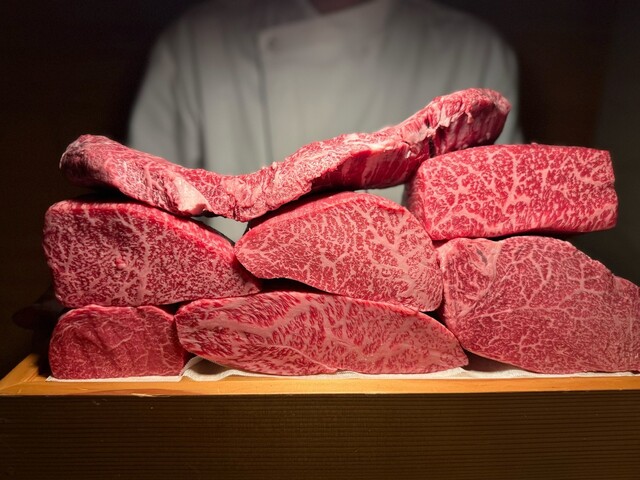
Kitashinchi announces itself in layers: office towers giving way to narrow evening streets, elevator lobbies, second-floor dining rooms, and the particular hush of a district built around reservations rather than walk-in grazing. Osaka’s beef restaurants often read the room better than its fine-dining counters do. The format is social, controlled, and modular: grill, hotpot, private room, counter, drinks, and a fixed window of time. In that setting, Wagyu Matsushita Kamidoori ten belongs to a polished local category, not the casual yakiniku end of the city’s dining spectrum.
The useful way to read this restaurant is through menu architecture. Yakiniku, sukiyaki, and shabu-shabu are not interchangeable formats; they create different relationships to wagyu. Yakiniku puts selection, cut, heat, and pacing in the foreground. Sukiyaki moves toward sweetness, soy, and shared simmering. Shabu-shabu strips the experience down to broth, timing, and the texture of thin-sliced beef. A restaurant that groups all three is making a clear offer to Osaka diners: choose the level of intervention, not just the cut of meat.
Three wagyu formats explain the Kitashinchi appeal
Kitashinchi’s dining economy rewards restaurants that can handle multiple occasions without losing their identity. That is why a beef house with counter seating, sunken seating, and private rooms makes sense here. Business dinners need containment. Family meals need enough flexibility to avoid the stiffness of a tasting-menu-only room. Celebrations need a little ceremony without requiring a chef’s counter performance. The structure at Wagyu Matsushita Kamidoori ten answers that mixed demand through format rather than décor language.
The Tabelog 100 Yakiniku WEST 2025 selection matters because yakiniku in western Japan is a crowded, opinionated category. Osaka diners are not short on grilled beef, and the region’s stronger rooms tend to compete on sourcing discipline, table management, and the ability to turn a rich meal into something paced rather than heavy. The restaurant’s score of 3.69 places it in a serious local conversation, while prior Tabelog 100 appearances in 2018, 2020, 2021, 2022, and 2024 suggest continuity rather than a single-year spike.
Menu breadth also changes the reader’s decision. Diners looking for a pure counter-led chef performance may be better served by a different Osaka genre. Those planning around beef, sake, shochu, wine, and a table that can work for colleagues or relatives will understand the value proposition faster. Compared with IAKU, which sits in a higher dinner band, this is a different kind of premium: less about luxury escalation, more about controlled wagyu formats in a nightlife district where practicality has its own status.
Osaka beef dining is less formal than it looks
Yakiniku has always carried a democratic streak in Japan, even when the beef is expensive. The diner participates: cooking, pacing, sharing, deciding when to move from grilled cuts to rice, soup, or another drink. In Osaka, that participation feels natural because the city’s dining culture has long favored appetite and immediacy over hushed reverence. Kitashinchi complicates that slightly. The neighborhood adds polish, appointment dining, and rooms designed for professional discretion, but the table remains active.
That tension is the point. A place such as Washun Taiki speaks to the city’s Japanese dining register, while BAR, K belongs to the after-dinner drinking circuit. A Kitashinchi wagyu room connects those habits: dinner can be the main event, but it also works as part of a longer evening. The presence of a sommelier and a drinks list spanning sake, shochu, and wine reinforces the hybrid character. Beef is the anchor, but the meal is built to absorb different drinking preferences without forcing everyone into the same pairing logic.
For travelers, the distinction is useful. Osaka’s restaurant map can look chaotic if reduced to famous snacks and counter reservations. The broader picture is more layered. Our full Osaka restaurants guide covers that spread, from casual staples such as 551 Horai (551蓬莱) to bakeries and cafés including 52CHO-ME BAKERY and .cafe. The city also has room for Italian detail at a canto (Italian) and 99 Pizza Napoletana Gourmet, which shows how far Osaka has moved beyond a single-note food identity.
How to place it in a wider Japan itinerary
Wagyu-focused dining changes by city. Kamakura’s beef-sukiyaki register, represented by -Grilled beef Sukiyaki- KAMAKURA TANUKIAN 鎌倉 たぬき庵 in Kamakura, reads differently from Osaka’s grill-and-room logic. Tokyo’s casual charcoal and seafood orbit, including. 鮪と炭火焼き うお炭 秋葉原店 in Tokyo, points toward another urban rhythm altogether. Kyoto’s smaller-format dining, seen through [ki:] in Kyoto, often asks for quieter attention, while.know in Kumamoto, (Shoku) Vietnam in Kawasaki, and [Curry Senmon Ten] Maruyama Kyoju. in Sapporo show how regional and immigrant influences sit alongside meat-led dining across Japan.
For an Osaka trip, the strongest use case is not a first-night crash meal. This is better placed on an evening when Kitashinchi itself is part of the plan: a measured dinner, followed by a bar or a short return to Umeda. Our full Osaka bars guide is the natural companion for that kind of night, while our full Osaka hotels guide helps keep the geography sensible. Travelers building a wider cultural schedule can also cross-reference our full Osaka experiences guide and, for cellar-minded readers, our full Osaka wineries guide.
The practical read is simple: this is a compact, reservation-led beef restaurant with 30 seats, private rooms for four or six, and private use listed for larger groups. Children are welcome, which broadens its use beyond corporate dining, but the setting and format remain more composed than casual. Overseas diners should use the English or Chinese reservation channels when available, since reservation handling is stricter than many visitors expect. In Los Angeles and Pasadena, Japanese drinking and rice formats appear through places such as Jōdo Saké Bar in Los Angeles and Onigiri Time in Pasadena; Osaka’s version is different, more tied to district ritual and the controlled pleasure of beef at the table.
- A5 Kuroge Wagyu sirloin sukiyaki
- A5 Kuroge Wagyu sirloin shabu-shabu
- Chateaubriand steak and sukiyaki
- Nagomi Course yakiniku set
- Kiwami Course rare-cut yakiniku set
- Ginsen Course premium rare-cut yakiniku set
Comparable Options
Comparable venues in the metro at similar price points.
| Venue | Cuisine | Price | Notes |
|---|---|---|---|
| Wagyu Matsushita Kamidoori tenThis venue — the venue you are viewing | Premium Wagyu Yakiniku, Sukiyaki & Shabu-Shabu | $$$ | Not listed |
| Yakitori Enami | Traditional Yakitori | $$$ | Kita |
| Tempura nuu nuu | Seasonal Tempura Omakase | $$$ | Kita |
| Hari Ju Doutonbori honten | Traditional Wagyu Sukiyaki & Shabu-shabu | $$$ | Chūō |
| Kyosho ran Minamimori chou | Japanese Yakiniku | $$$ | Kita |
| Nankai Grill Higashi ten | Teppanyaki Steakhouse | $$$ | Sakai |
Recognition history
Dated appearances from independent guides and award organizations, with the underlying list record or original source where available.
Tabelog 100 #55 · No. 55
Tabelog · Tabelog 100 - Yakiniku - WEST - 2025
Continue exploring
More in Osaka
Restaurants in Osaka
Browse all →




Bars in Osaka
Browse all →




Hotels in Osaka
Browse all →




Wineries in Osaka
Browse all →
At a Glance
- Cozy
- Elegant
- Intimate
- Romantic
- Sophisticated
- Business Dinner
- Date Night
- Group Dining
- After Work
- Celebration
- Private Dining
- Standalone
- Sake Program
- Beer Program
- Local Sourcing
Relaxed and upscale yakiniku setting with horigotatsu-style seating and a calm, polished atmosphere suited to business dinners and special occasions.