Villas Tacos — Atwater Village
Our verdict
Villas Tacos in Atwater Village operates at the serious end of Los Angeles street taco culture, where the physical space and the food both carry weight. The Atwater location draws from the same tradition as its sibling spots in Hollywood and South Pasadena, serving a neighborhood that has grown increasingly attentive to where its food comes from and how it is made.

Pearl is the En Primeur Club membership app, where members save venues, book tables and use the concierge.
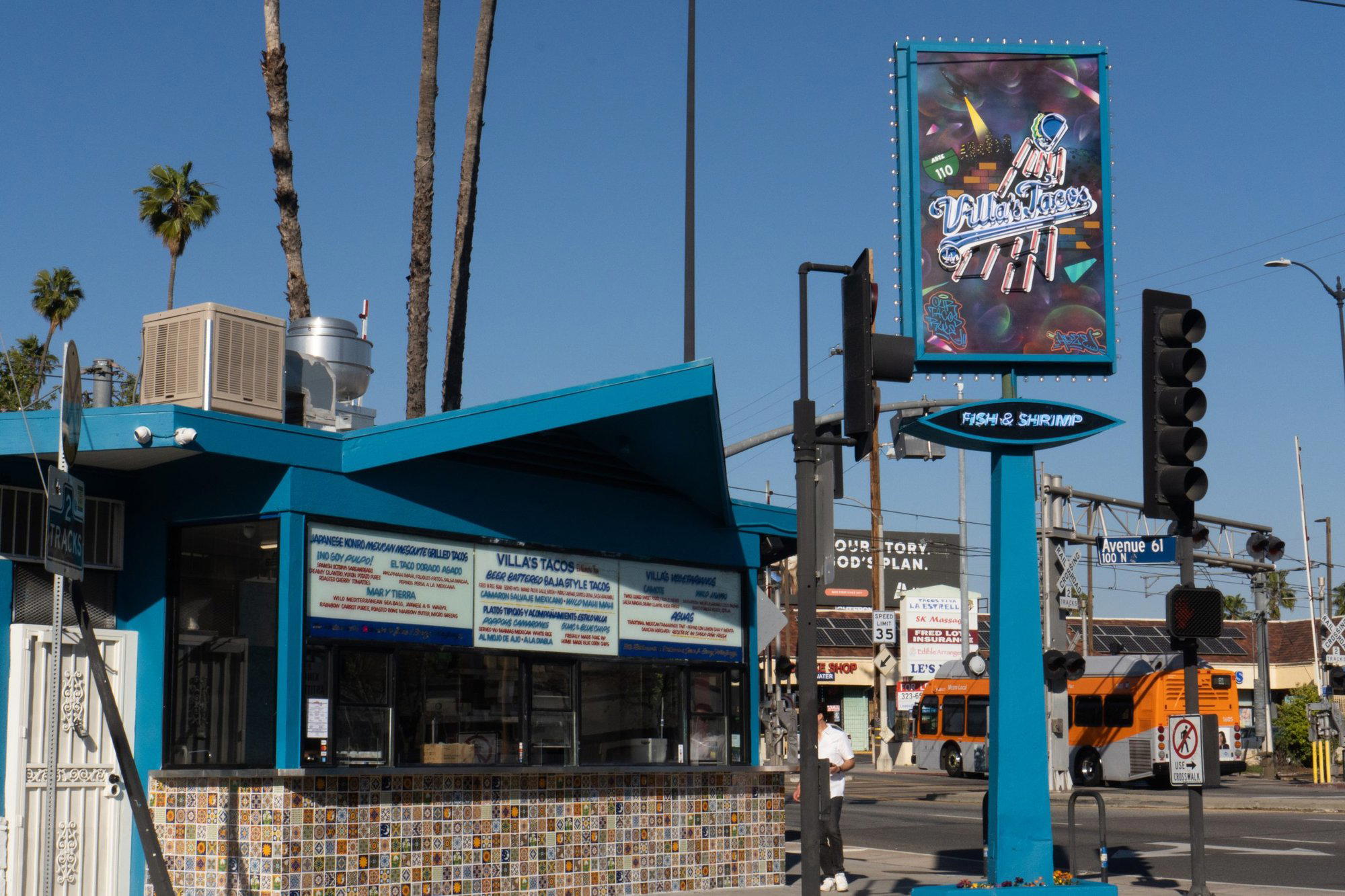
The menu
What to order
- Seven Layer Taco
- Ranchera Asada
- Papas Con Chorizo
Atwater Village and the Grammar of the Taco Stand
Atwater Village sits between the L.A. River and Glendale Boulevard in a part of the city that has spent the last decade quietly recalibrating its identity. The neighborhood's commercial strips mix decades-old Mexican grocers and automotive shops with wine bars and natural food stores, and the dining culture here reflects that layering rather than resolving it into something tidy. It is the kind of place where a serious taco operation can exist without the performance of being "a serious taco operation", the context does that work instead.
That context matters for understanding where Villas Tacos fits. Los Angeles has a more developed taco culture than almost any city outside Mexico, and within that culture there is a meaningful split between street-adjacent formats that prioritize portability and volume, and smaller operations where the physical setting, the sourcing, and the execution are treated with the same seriousness you would expect from a sit-down restaurant. Villas Tacos belongs to the latter category. Across its locations in Hollywood and South Pasadena, the operation has built a reputation that places it in a different competitive conversation than the average counter, one where regulars track the menu with the same attention that diners elsewhere in the city bring to the tasting menus at Kato or Somni.
The Physical Container: Reading the Space
The editorial angle here, following the EA-GN-13 framework, is the space itself, and at Villas Tacos in Atwater Village, the space is doing considerable cultural work. The taco format in Southern California has traditionally resisted architecture. The most celebrated al pastor in the San Fernando Valley might come from a cart with a single overhead bulb. The most technically accomplished birria in Boyle Heights might be served from a folding table. The physical container, in that tradition, is beside the point.
What operations like Villas Tacos represent is a quiet negotiation with that tradition. The Atwater location is not a white-tablecloth reinvention of Mexican street food, that move has been made elsewhere, sometimes well, sometimes with results that feel more like cultural cosplay than cuisine. Instead, the space communicates something closer to intentionality without pretension: a setting where the seating arrangement, the counter configuration, and the overall atmosphere signal that this is worth slowing down for, without insisting you dress up to do so.
That balance is harder to achieve than it looks. Across the wider Los Angeles dining scene, operations in the $$$$ bracket, including Providence in Hancock Park or Osteria Mozza on Melrose, make the connection between space and experience legible through material investment: lighting rigs, custom furniture, deliberate acoustics. A taco spot working in a lower price register has to achieve a version of that legibility through different means. At the Atwater Village location, the physical environment earns its place in the experience rather than dominating it.
Where Villas Tacos Sits in the L.A. Taco Conversation
Los Angeles taco culture is not a monolith. There are regional Mexican specialists, fusion-inflected operations, and a growing number of spots where provenance and sourcing have moved from marketing language into operational reality. Villas Tacos has positioned itself in that third category, where the discussion about ingredients and technique is substantive rather than decorative.
That positioning has national echoes. The same seriousness applied to sourcing and format at places like Blue Hill at Stone Barns in Tarrytown or Single Thread Farm in Healdsburg, where the relationship between producer and kitchen is the organizing principle, translates differently at a taco counter, but the underlying logic is recognizable. The product is the argument. The space supports it without overwhelming it.
Within Los Angeles, the Atwater Village location benefits from the neighborhood's demographics. The area's residents tend toward the kind of engaged, repeat-visit customer base that sustains quality-focused operations at modest price points. That is a different support structure than what drives volume at tourist-adjacent spots near the Westside or Hollywood proper, and it shapes what kind of operation can survive here over time. For a reference point on what sustained quality looks like across formats, see our full Los Angeles restaurants guide.
Planning Your Visit
Atwater Village is accessible from central Los Angeles via Glendale Boulevard, and the neighborhood's compact commercial strip makes it a reasonable stop before or after other commitments in the area. As with most quality-focused taco operations in the city, the practical approach is to arrive during off-peak hours, mid-afternoon on weekdays, or early on weekend mornings, to avoid the waits that develop when the neighborhood's foot traffic converges. The multi-location format of Villas Tacos means that if the Atwater spot is backed up, the Hollywood and South Pasadena locations offer the same program in different neighborhood contexts, each with its own physical character worth considering on its own terms.
For those spending time across the broader Southern California dining circuit, Villas Tacos at Atwater Village pairs naturally with a day that also includes higher-ticket stops. The Atwater location functions as a grounding reference point, a reminder that the most technically considered food in Los Angeles does not always arrive in a formal dining room. Addison in San Diego and Le Bernardin in New York represent the opposite pole of the format spectrum, where the physical container and the meal are inseparable at a structural level. The taco counter and the grand dining room are solving different problems, but both ask the same basic question: does the space serve the food, or does the food serve the space?
Frequently asked questions
What should I order at Villas Tacos, Atwater Village?
How hard is it to get a table at Villas Tacos, Atwater Village?
What do critics highlight about Villas Tacos, Atwater Village?
How does the Atwater Village location differ from Villas Tacos’ other spots?
A Pricing-First Comparison
Comparable venues nearby, for context on price, style, and recognition.
| Venue | Cuisine | Price | Awards | Notes |
|---|---|---|---|---|
| Villas Tacos, Atwater VillageThis venue (the venue you are viewing) | Tacos Estilo Los Ángeles | $10–20 | Not listed | Not listed |
| Churrería El Moro | Authentic Mexican Churrería | $10–20 | Not listed | Echo Park, Traditional Mexican Churrería |
| Tacos Don Cuco | Tijuana-Style Tacos | $10–20 | LA Taco Best Tacos in LA #50 | East Los Angeles, Tijuana-Style Tacos |
| Taco Nazo | Baja-Style Mexican Taqueria | $10–20 | LA Taco Best Tacos in LA #11 | La Habra, Baja-Style Mexican Taqueria |
| Brothers Cousins Tacos | Westside Taco Truck | $10–20 | LA Taco Best Tacos in LA #40 | Westside Village, Westside Taco Truck |
| Taquería Juquilita | Authentic Oaxacan Taqueria | $10–20 | LA Taco Best Tacos in LA #58 | Wilshire Center, Authentic Oaxacan Taqueria |
Continue exploring
More in Los Angeles
Restaurants in Los Angeles
All restaurants in Los Angeles →
Bars in Los Angeles
All bars in Los Angeles →

Hotels in Los Angeles
All hotels in Los Angeles →
Wineries in Los Angeles
All wineries in Los Angeles →
Details
- Trendy
- Cozy
- Casual Hangout
- Family
- Open Kitchen
- Local Sourcing
- A La Carte
- Small Plates
- Vegetarian Friendly
Casual hole-in-the-wall taqueria atmosphere with a trendy, down-to-earth vibe centered around fresh, flavorful tacos.