Churrería El Moro
Churrería El Moro brings its Mexico City lineage, the original El Moro has operated since 1935, to Los Angeles as the brand's first U.S. outpost. The format centers on churros and Mexican pastries, placing it in a specialist pastry tier that has no direct peer in the city. For visitors tracking the full range of L.A.'s Mexican food tradition, it is a meaningful addition to the map.

Pearl is the En Primeur Club membership app — saves, bookings, and concierge access live there. Same editors, same standards.
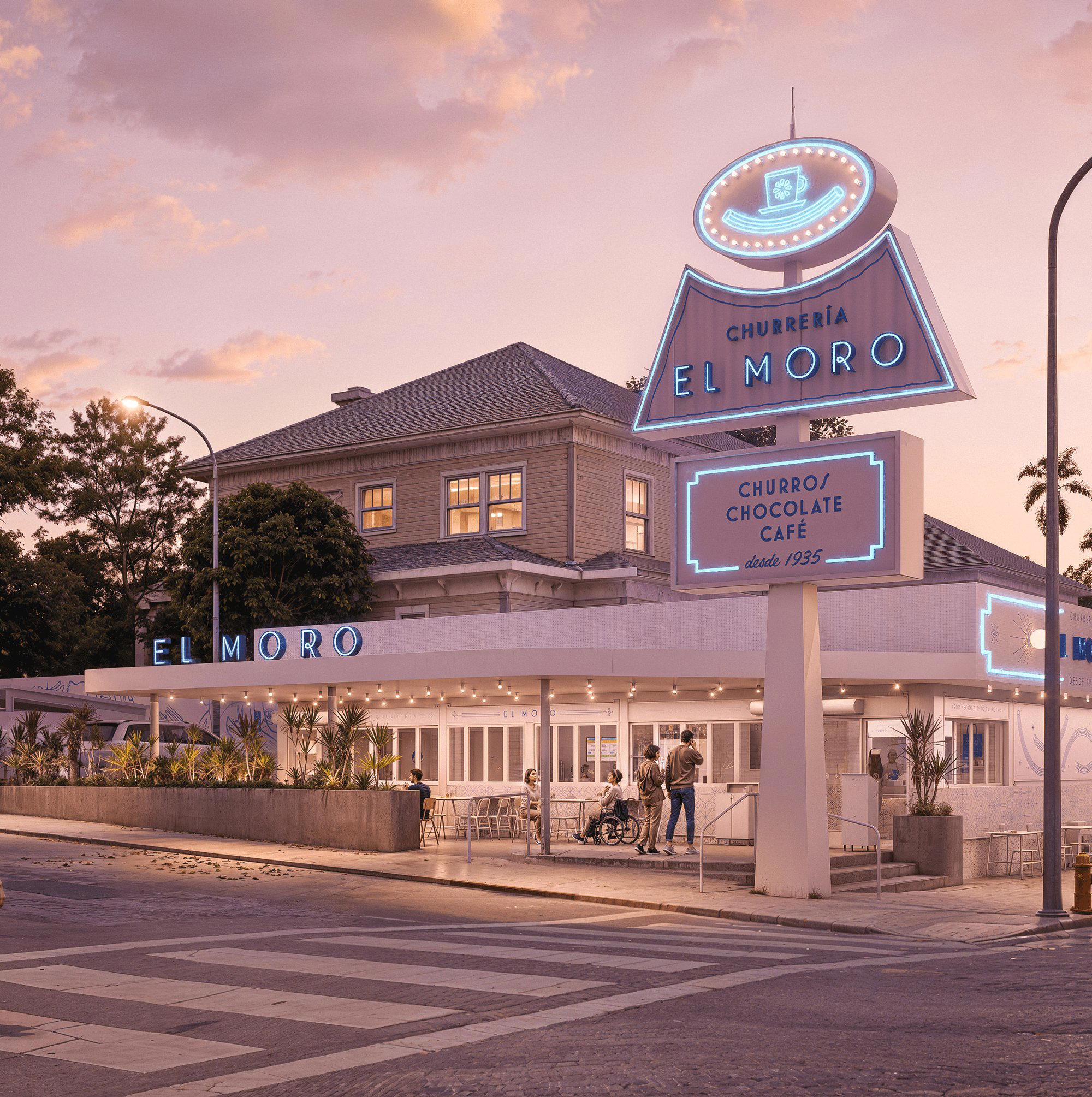
A Mexico City Institution Crosses the Border
Los Angeles has long absorbed Mexican culinary tradition through taquerias, mariscos stands, and family-run fondas, but the city's coverage of Mexican pastry and sweet formats has remained thin relative to the depth of the broader category. Churrería El Moro's arrival as its first U.S. location changes that calculus. The original El Moro opened in Mexico City in 1935, making it one of the longest-running churrerías in the country, and that institutional weight travels with the brand. In a city where Mexican food tends to be read through savory registers, a dedicated churro house with nearly nine decades of continuous operation behind it occupies a genuinely distinct position.
The churro format itself carries more culinary history than its street-food reputation suggests. The Spanish tradition of frying dough and dusting it with sugar arrived in Mexico during the colonial period and was gradually absorbed into a distinctly Mexican context: thicker dough, different frying temperatures, and chocolate dipping sauces modeled on the thick, barely-sweet drinking chocolate that bore no resemblance to its European counterparts. El Moro became, over decades, a standard-bearer for that tradition in Mexico City, a late-night fixture near the Centro Histórico where the draw was consistency rather than novelty.
Where El Moro Sits in the L.A. Scene
Los Angeles's Mexican food map is extensive and internally differentiated. At the fine-dining end, Hayato and Kato operate in the $$$$ tier with tasting menus and months-long booking windows. At the opposite end, street-format vendors and market stalls cover the accessible end of the spectrum. El Moro slots into neither of those categories. It is a specialist single-category format, churros and Mexican pastries, at a price point that puts it below full-service dining but above the grab-and-go tier. That positioning has no direct equivalent among the city's Mexican concepts.
For comparative context, consider how L.A.'s broader casual-specialist tier operates. Holbox, which focuses on Mexican seafood, demonstrates that a narrowly defined Mexican format can build a serious audience in Los Angeles when the sourcing and technique are treated with discipline. El Moro makes a similar implicit argument for the pastry category: that a focused, tradition-rooted format can hold its own in a city with as much culinary competition as Los Angeles.
The editorial angle here is less about El Moro as a single venue and more about what its presence signals. The city's restaurant conversation has historically concentrated on the tasting-menu tier, venues like Providence, Somni, and Osteria Mozza anchor the upper end of critical attention. But the specialist casual format, particularly when it carries institutional credibility, represents a different kind of cultural contribution.
The Pastry Tradition Behind the Format
Understanding El Moro requires some grounding in what a churrería actually is in the Mexican context. It is not a bakery in the European sense, nor a patisserie. It is a dedicated frying operation, with churros as the anchor product and a supporting cast of pastries that vary by region and operator. The quality markers are narrow but specific: dough hydration, oil temperature, frying time, and the caliber of the accompanying chocolate. In Mexico City, where El Moro built its reputation, the standard for what a well-executed churro tastes like is set early in most people's lives. Transplanting that tradition to Los Angeles means operating against a local audience that may not have that baseline, and an expatriate audience that absolutely does.
That dual audience dynamic is worth noting. Los Angeles has a large Mexican-origin population with direct personal references for what El Moro represents. For that group, the L.A. location functions as a point of cultural continuity. For the broader city dining audience, it functions as an introduction to a format that sits outside the usual Mexican food conversation. Both readings are legitimate, and both inform how El Moro is likely to be received.
Placing El Moro in a National Context
Across the U.S. the conversation about what constitutes serious dining has gradually widened. Venues like Le Bernardin in New York City, The French Laundry in Napa, and Smyth in Chicago represent the tasting-menu apex of American fine dining. But the category of institutionally significant, single-format specialists, places defined by depth in one tradition rather than range across many, has expanded in parallel. Lazy Bear in San Francisco, Addison in San Diego, and Frasca Food and Wine in Boulder each occupy a defined niche within their respective scenes. El Moro makes a different kind of argument, not through tasting menus or sommelier programs, but through eighty-plus years of uninterrupted practice in a single category.
That longevity is the trust signal here. The 1935 founding date of the Mexico City original is especially meaningful credential available. It places El Moro in a category of institutions that have outlasted trends, ownership changes, and economic cycles, a form of durability that no amount of press coverage can manufacture. Institutions that have survived in the same format for that length of time have done so because the product holds up across generations of customers with strong opinions about what it should taste like.
For the broader context of where Los Angeles is heading in its Mexican food conversation, venues like El Moro are significant because they extend the range of what the city can claim. The fine-dining tier, well-covered by guides and awards bodies, tells one story. The specialist casual tier, less scrutinized but often more culturally durable, tells another. Both matter to anyone trying to understand the city's food identity comprehensively.
Planning Your Visit
| Venue | Cuisine Type | Price Range | Booking Lead Time |
|---|---|---|---|
| Churrería El Moro (L.A.) | Churros / Mexican pastries | Not confirmed | Walk-in format likely |
| Kato | New Taiwanese, Asian | $$$$ | Weeks to months ahead |
| Hayato | Japanese | $$$$ | Months ahead |
| Holbox | Mexican Seafood | $$ | Walk-in or same day |
Because the L.A. location is El Moro's first outside Mexico, specific logistical details, address, hours, and confirmed price points are not included here. The format, given the Mexico City template, is likely to operate across extended hours including late-night service, which has historically been a defining feature of the original location.
Price and Recognition
Comparable venues nearby, for context on price, style, and recognition.
| Venue | Cuisine | Price | Notes |
|---|---|---|---|
| Churrería El MoroThis venue — the venue you are viewing | Echo Park, Traditional Mexican Churrería | $ | Not listed |
| Taquería Juquilita | Not listed | $ | Wilshire Center, Authentic Oaxacan Taqueria |
| La Serenata Cantina | Not listed | $$ | West L.A., Traditional Mexican Seafood |
| Lenny's Casita | South Robertson, Kosher Mexicali | $$ | Not listed |
| Bahia Hollywood | Not listed | $$ | Yucca Corridor, Latin Fusion with Mexican & Contemporary Mexican |
| Don Chuy's | Not listed | $$ | Boyle Heights, Authentic Mexican from Leon Guanajuato |
Continue exploring
More in Los Angeles
Restaurants in Los Angeles
Browse all →
Bars in Los Angeles
Browse all →

Hotels in Los Angeles
Browse all →
Wineries in Los Angeles
Browse all →
At a Glance
- Classic
- Well Known
- Casual Hangout
- Late Night
Casual stand with fresh-made churros and welcoming atmosphere for quick treats.