Versailles Restaurant Cuban Cuisine

Our verdict
On Calle Ocho in Miami's Little Havana, Versailles has operated as a community anchor and Cuban dining institution since 1971. The menu reads as a survey of the island's foundational dishes, from ropa vieja to Cuban sandwiches, served in a mirrored dining room that has hosted exile politics, family milestones, and late-night crowds alike. It occupies a category of its own in Miami dining: part restaurant, part civic record.

Pearl is the En Primeur Club membership app, where members save venues, book tables and use the concierge.
The menu
What to order
- Cuban Sandwich
- Croquetas
- Vaca Frita
A Dining Room That Doubles as a Timeline
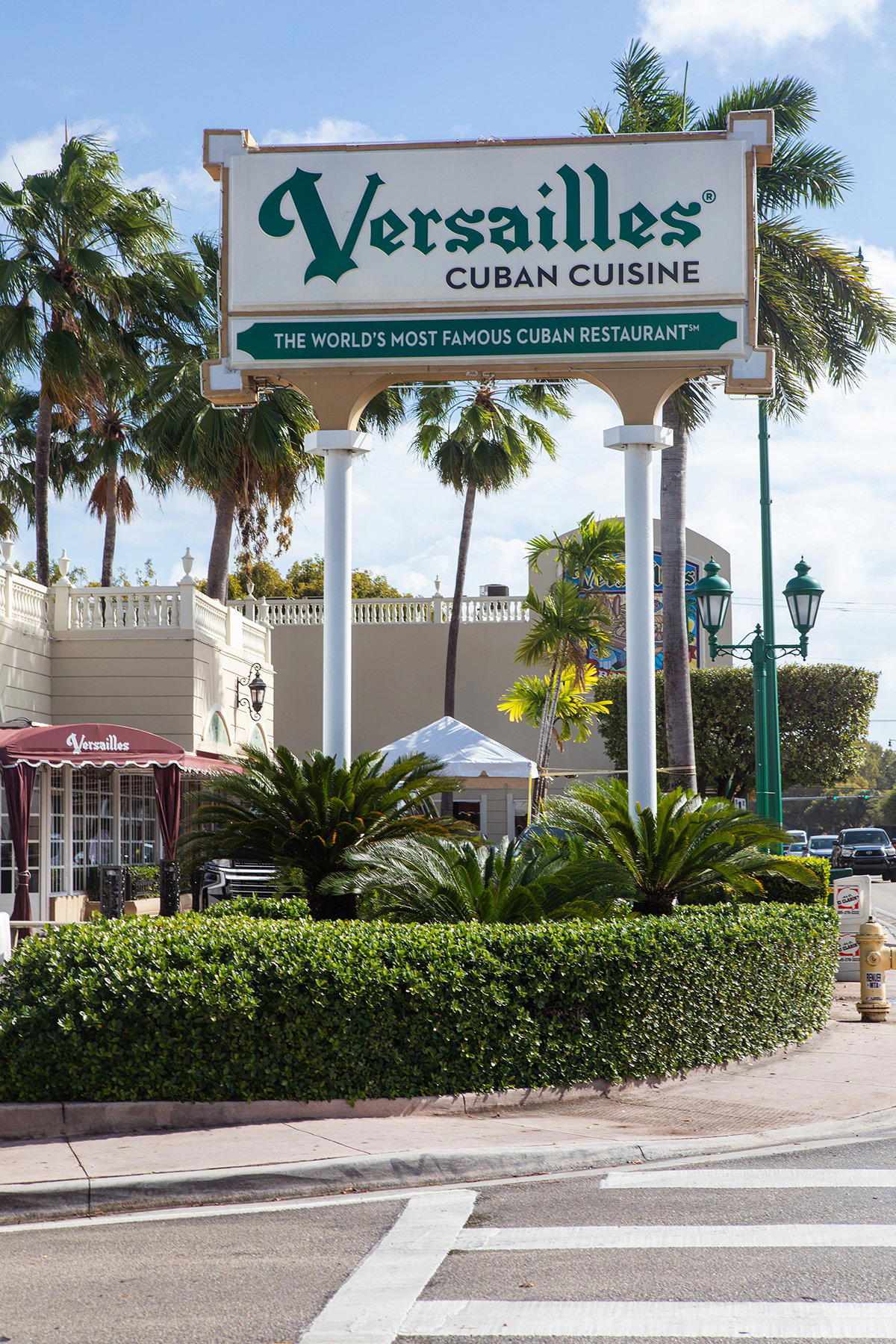
On Southwest 8th Street, the approach to Versailles tells you something before you walk through the door. The building sits in Little Havana with the weight of a landmark rather than a restaurant, its mirrored interior visible through the windows, the outdoor bakery counter drawing its own separate line of customers who have no interest in sitting down. Miami has accumulated a considerable number of Cuban restaurants over the past five decades, but Versailles, operating at this address since 1971, occupies a different position in that ecosystem. It is not the most refined expression of Cuban cuisine in the city, nor does it try to be. It is the reference point against which other expressions are measured.
The dining room itself functions as context for everything on the plate. The mirrors amplify the space, the lighting stays bright, and the noise level reflects a room that does not modulate for intimacy. This is a Cuban restaurant in the tradition where dining is communal, vocal, and extended. You come here to eat and to be present in a particular version of Miami, one that predates the city's transformation into an international design capital. For a broader orientation to where Versailles sits among the city's dining options across cuisines and price points, the full Miami restaurants guide maps the range.
What the Menu Reveals About Cuban Cooking
The architecture of the Versailles menu is itself an argument about Cuban culinary tradition. Rather than editing down to a selection or repositioning dishes for contemporary palates, the menu reads as a survey: ropa vieja, picadillo, lechon asado, vaca frita, arroz con pollo, oxtail, black beans presented as a side that carries the same importance as the main. The breadth is deliberate. Cuban home cooking does not operate on the principle of restraint, and menus at restaurants like this one reflect that, covering the full range of slow-cooked meats, rice preparations, and fried plantain variations that constitute the tradition.
Cuban sandwich, offered here with the structural conviction of a place that has been making them for decades, belongs in the context of a Miami-wide debate about which kitchen executes the format most faithfully. That debate has no clean resolution, but Versailles is consistently inside it, not on the periphery. The medianoche, the softer-roll variant made with egg bread, is a lesser-discussed entry point to the same flavor architecture, worth ordering if you are tracking the differences between the two.
What the menu does not do is reach toward fusion or seasonal adaptation. The dishes are fixed and recognizable, which is precisely the editorial point. At a moment when Miami dining is producing technically ambitious, cross-cultural menus at places like ITAMAE and Boia De, and importing European fine dining frameworks through venues like L'Atelier de Joël Robuchon Miami, Versailles operates as a counterweight: a menu that has not needed to change because the tradition it documents has not been superseded.
Little Havana and the Politics of the Table
Few restaurants in American dining carry as much documented political weight as this one. The Calle Ocho address has functioned as a gathering point for the Cuban exile community since the early 1970s, and major political figures, including presidential candidates and sitting officials, have made appearances here with a regularity that reflects the restaurant's understood status as a venue where Cuban-American sentiment is expressed publicly. This is not incidental to the dining experience; it is part of what distinguishes Versailles from other Cuban restaurants in Miami operating at comparable price levels and with comparable menus.
This civic dimension places Versailles in a category that transcends the usual restaurant evaluation frameworks. Comparing it directly against Ariete or Cote Miami on culinary ambition or ingredient precision is a category error. Those restaurants are operating in a different register, with different intentions and a different relationship to their cuisine. Versailles is doing something that neither of them attempts: preserving and performing a community's relationship to its own food history, nightly, in a bright room on 8th Street.
The Bakery Counter and the Ventanita
The restaurant proper is only part of the operation. The adjacent bakery and the ventanita, the walk-up window, function as separate entry points with their own rhythms and their own crowds. Cuban coffee ordered at the ventanita, colada or cortadito, is available at all hours and draws a clientele that does not overlap entirely with the dining room. This counter has become its own Miami institution, a place where the street-level social life of Little Havana is legible in real time. For visitors arriving outside of meal service, the ventanita provides access to the experience without requiring a table.
Pastelitos from the bakery, the guava-and-cheese pastries that appear in Cuban bakeries across Miami and South Florida, are among the most direct measures of a kitchen's fidelity to the tradition. At Versailles, the bakery output sustains the same logic as the main menu: nothing is reimagined, everything is executed according to established form.
Planning Your Visit
Versailles is located at 3555 SW 8th Street in Miami's Little Havana, accessible by car with street parking available in the surrounding blocks. The restaurant operates with extended hours that accommodate both lunch and late-night dining, and the ventanita maintains its own schedule independent of the dining room. No reservation system is required for most visits; the restaurant absorbs walk-in volume as a matter of operating practice, though weekend evenings and periods following community events can extend wait times for tables. Dress is casual and entirely informal. The price point falls well below Miami's mid-range dining tier, making it accessible across a wide range of budgets without qualification.
For context on what Versailles represents within the broader American restaurant tradition, it is instructive to consider how differently other long-standing institutions operate. Emeril's in New Orleans built its longevity on chef-driven evolution; Le Bernardin in New York City sustains a reputation through consistent technical refinement. Versailles has remained relevant through neither of those mechanisms. Its durability is documentary: the menu is the archive, and the room is the record of a community's presence in this city over more than fifty years.
Frequently asked questions
at Versailles Restaurant Cuban Cuisine?
Can I walk in to Versailles Restaurant Cuban Cuisine?
What's the defining dish or idea at Versailles Restaurant Cuban Cuisine?
Why has Versailles remained a reference point for Cuban food in Miami when newer restaurants have opened?
What It’s Closest To
Comparable venues nearby, for context on price, style, and recognition.
| Venue | Cuisine | Price | Notes |
|---|---|---|---|
| Versailles Restaurant Cuban CuisineThis venue (the venue you are viewing) | Authentic Cuban | $20–30 | Not listed |
| Mangrove | Modern Jamaican | $30–50 | Downtown |
| Manolo & Rene Grill | Authentic Cuban | $10–20 | Downtown |
| Sango | Jamaican & Chinese | $20–30 | Palmetto Bay |
| Las Olas Cafe | Authentic Cuban Cafe | $10–20 | Flamingo / Lummus |
| Cane Fire Grille | Caribbean-Latin Fusion Grill | Not listed | Flagami |
Recognition history
Dated appearances from independent guides and award organizations, with the underlying list record or original source where available.
Opinionated About Dining Cheap Eats in North America Recommended
Opinionated About Dining
Continue exploring
More in Miami
Restaurants in Miami
All restaurants in Miami →
Bars in Miami
All bars in Miami →


Details
- Lively
- Well Known
- Classic
- Family
- Casual Hangout
- Brunch
- Historic Building
- A La Carte
- Vegetarian Friendly
- Vegan Options
Current opening hours
- Monday
- 8 AM–12 AM
- Tuesday
- 8 AM–12 AM
- Wednesday
- 8 AM–12 AM
- Thursday
- 8 AM–12 AM
- Friday
- 8 AM–1 AM
- Saturday
- 8 AM–1 AM
- Sunday
- 9 AM–12 AM
Hours can change for holidays and private events. Hours as of .