Our verdict
On Adelaide Street West, where Toronto's Entertainment District gives way to King West, Tutti Matti holds a long-standing position in the city's Italian dining conversation. The restaurant draws from Tuscan tradition at a time when Italian cooking in Toronto ranges from fast-casual to formal tasting menus, occupying a particular middle register that values regional specificity over broad-stroke crowd-pleasing.

Pearl is the En Primeur Club membership app, where members save venues, book tables and use the concierge.
The menu
What to order
- Tagliatelle with Duck
- Ricotta Ravioli
- Pappardelle con Stracotta
- Gnocchi with Gorgonzola
Adelaide Street West and What It Says About Where You're Eating
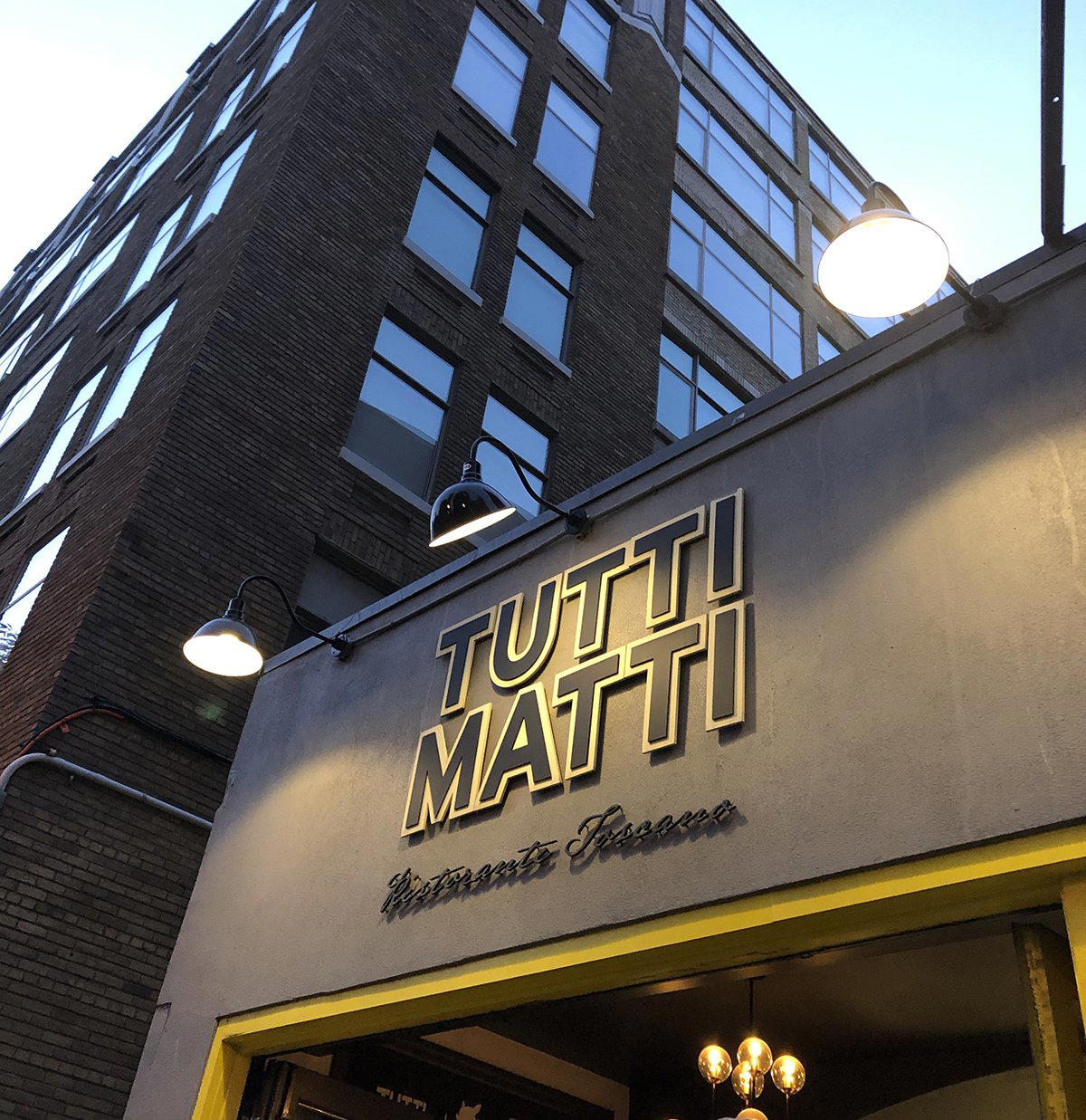
The block of Adelaide Street West between Spadina and Bathurst has always occupied an interesting position in Toronto's dining geography. It sits just west of the Entertainment District's noisier commercial pull and just east of the quieter residential pockets of Trinity Bellwoods, which means the restaurants that survive here tend to serve a more purposeful diner: someone who has chosen the neighbourhood rather than stumbled into it. Tutti Matti, at 364 Adelaide St W, fits that profile. In a city where Italian restaurants cluster heavily around College Street's Little Italy corridor and the newer King West condos, a Tuscan-leaning room on this particular stretch of Adelaide signals something deliberate about its positioning.
The Adelaide West corridor has shifted considerably over the past decade, with condo development pushing up land values and encouraging the kind of high-turnover hospitality that chases volume. The restaurants that have maintained a clear culinary identity through that shift tend to be the ones worth paying attention to. Within Toronto's broader Italian dining tier, the competitive reference points now include DaNico and Don Alfonso 1890, both operating at the $$$$ end of contemporary Italian, while Tutti Matti has historically occupied a register defined more by regional Tuscan fidelity than by tasting-menu ambition.
The Tuscan Register in a City That Often Flattens Italian Regionality
Italian cooking in Toronto has long suffered from the flattening effect that happens when a cuisine becomes popular enough to be everywhere. The city has no shortage of red-sauce houses, pasta bars, and wood-fired pizza operations, but restaurants that commit to the specificity of a single Italian region, and hold that commitment across the menu rather than gesturing at it through a few token dishes, occupy a narrower band. Tuscan cooking, in particular, is often misread outside Italy: the cuisine is about restraint and ingredient quality rather than complexity of preparation, which makes it harder to perform convincingly than more sauce-driven southern Italian traditions.
That regional specificity is where Tutti Matti has historically staked its claim in the Toronto conversation. Tuscan cooking in its proper form leans on white beans, bitter greens, game, and grilled meats, with pasta preparations that are simpler and drier than their Emilian counterparts. The risk for any Toronto kitchen working in this mode is that local diners accustomed to richer, more elaborately sauced preparations may read restraint as thinness. The reward, when it works, is a directness that the more elaborate end of the Italian market sometimes loses.
For comparison, the upper tier of Toronto Italian dining, where Don Alfonso 1890 operates with a formally structured contemporary Italian format, involves a different kind of ambition entirely. DaNico similarly works at the intersection of Italian and broader fine-dining conventions. Tutti Matti's positioning has been less about that formal register and more about the kind of trattoria-rooted seriousness that treats regional authenticity as the primary credential. These are different projects, and it is worth being clear about which one you are looking for before booking.
Toronto's Italian Dining in Context
Understanding where Tutti Matti sits requires some sense of how Italian dining in Toronto has evolved. The city's Italian-Canadian community is large and historically concentrated in neighborhoods like College Street and St. Clair West, which means the baseline familiarity with Italian food is reasonably high. That baseline, however, has also created strong local habits around what Italian food should taste and cost, habits that can make it harder for more regionally specific or ingredient-driven operators to find their footing.
The broader fine-dining conversation in Toronto increasingly runs through Japanese formats, with Sushi Masaki Saito and Aburi Hana setting a standard for high-precision omakase and kaiseki respectively, while contemporary Canadian and international formats cluster at the leading end, represented by Alo. Within that context, a regionally specific Italian room is neither the most fashionable nor the least credible choice. It occupies a durable middle position that tends to attract diners who know what they want rather than those chasing the current critical conversation.
Across Canada more broadly, the regional-specificity approach in European cuisine has found strong advocates in very different contexts: Restaurant Pearl Morissette in Lincoln applies it to wine-country cooking in Ontario's Niagara Peninsula, while Jérôme Ferrer - Europea in Montreal works a French fine-dining register with its own kind of precision. The commitment to a defined culinary tradition, rather than a hybrid crowd-pleasing menu, connects these very different operations at the level of principle.
What to Know Before You Go
Given the limited publicly available operational data for Tutti Matti, the practical planning considerations below draw on what is known about the venue's location and its positioning within the Toronto market, supplemented by general category knowledge for Italian restaurants of this type.
| Consideration | Tutti Matti | DaNico | Don Alfonso 1890 |
|---|---|---|---|
| Cuisine focus | Tuscan Italian | Italian, contemporary | Contemporary Italian |
| Price tier | Not confirmed | $$$$ | $$$$ |
| Location | Adelaide St W, Entertainment District edge | King West area | King West area |
| Format | Not confirmed | Full-service restaurant | Full-service restaurant |
For current hours, booking availability, and menu pricing, contact the restaurant directly or check recent listings. The address at 364 Adelaide St W is accessible by TTC via the Osgoode or St. Andrew subway stations, both within a fifteen-minute walk, with King streetcar service also nearby.
Placing Tutti Matti in the EP Club Roster
For context on the range of dining EP Club covers in Canada, the roster spans very different scales and settings: Eigensinn Farm in Singhampton represents the remote destination-dining end, while Fogo Island Inn Dining Room anchors the hyper-local, place-rooted end of the spectrum. Urban Italian in Toronto is a different category entirely, but the editorial principle that connects them is the same: a clear identity that you either want or you don't, rather than a menu designed to appeal to everyone simultaneously.
If you are building a Toronto itinerary around Italian specifically, the honest assessment is that the city offers a wider range of Italian formats than many visitors expect, from the high-formality of Don Alfonso 1890 to the more ingredient-focused approach that Tutti Matti represents. Neither is a substitute for the other. See our full Toronto restaurants guide for the broader picture, including comparisons with non-Italian formats that should factor into any serious planning for the city.
For readers whose interest in regional Italian cooking extends beyond Toronto, the same precision-over-breadth principle shows up in very different ways at Le Bernardin in New York City, where French seafood tradition is applied with comparable regional seriousness, and at Lazy Bear in San Francisco, which applies a different kind of culinary commitment to a communal American format.
Frequently asked questions
What part of town is Tutti Matti in?
Tutti Matti is located at 364 Adelaide St W, Toronto, ON M5V 1R7, Canada, Toronto.
How does Tutti Matti compare to other regional Italian restaurants in Toronto?
Toronto has a large Italian-Canadian dining culture, but venues that commit to a single Italian region, in Tutti Matti's case, Tuscany, rather than a generalised Italian menu remain a relatively small group. That specificity places Tutti Matti closer to the city's serious dining tier than to the neighbourhood red-sauce category. For context, EP Club's Canadian roster ranges from farm-table operations like Eigensinn Farm in Singhampton to urban fine dining, and Tutti Matti occupies a distinct position as a regionally anchored urban trattoria on Adelaide Street West.
What's the must-try dish at Tutti Matti?
Tutti Matti's kitchen works within a Tuscan regional framework, which means the focus falls on preparations tied to a specific geography rather than a pan-Italian greatest hits menu.
Can I walk in to Tutti Matti?
Walk-in availability at 364 Adelaide St W depends heavily on the night and the season. Toronto's King West and Entertainment District corridor fills up fast on Thursday through Saturday, and venues with a focused regional identity like Tutti Matti tend to draw a regular return crowd that books ahead. Calling ahead or checking for last-minute availability on the day is the more reliable approach than showing up without a reservation.
What has Tutti Matti built its reputation on?
Tutti Matti has built its standing in Toronto on a commitment to Tuscan regional specificity at a point in the city's dining evolution when most Italian restaurants defaulted to a broader, less defined Italian-Canadian register. That positioning, holding to one regional tradition rather than expanding the menu to please everyone, is what separates it from the majority of Italian dining on the Adelaide and King West stretch.
Do they accommodate allergies at Tutti Matti?
No specific allergy or dietary accommodation policy is confirmed in available venue data for Tutti Matti. check the venue's official channels at 364 Adelaide St W before your visit to confirm what can be adjusted, Tuscan cooking relies heavily on wheat, cured meats, and dairy in many of its core preparations, so advance notice matters.
Is Tutti Matti worth it?
For diners who have encountered the flattened, region-less version of Italian cooking that dominates much of Toronto's restaurant scene, Tutti Matti's Tuscan focus offers something with more culinary logic behind it. Whether the value equation works depends on current pricing, which should be confirmed directly with the restaurant. The address on Adelaide St W places it in one of Toronto's denser dining corridors, where the competition for that kind of regional specificity is limited.
Category Peers
| Venue | Cuisine | Price | Awards | Notes |
|---|---|---|---|---|
| Tutti MattiThis venue (the venue you are viewing) | Authentic Tuscan Italian | $50–100 | Not listed | Not listed |
| Alo | Modern French Fine Dining with Asian Influences | $200–300 | 1 Michelin Star · La Liste Top Restaurants | Contemporary |
| Sushi Masaki Saito | Edomae-Style Omakase | $500+ | 1 Michelin Star · La Liste Top Restaurants | Sushi, Japanese |
| Aburi Hana | Modern Japanese Kyō-Kaiseki | $300–500 | 1 Michelin Star · The Best Chef One Knife | Kaiseki, Japanese |
| Don Alfonso 1890 | Modern Italian Fine Dining | $200–300 | 1 Michelin Star · La Liste Top Restaurants | Contemporary Italian, Italian |
| Edulis | Mediterranean Seafood Tasting Menu | $150–200 | 1 Michelin Star · World's 50 Best #25 | Canadian, Mediterranean Cuisine |