
At a second-floor counter in Nishiazabu, Toumin sits at the intersection of French technique and Japan's seasonal produce traditions. Chef Kazuya Iguchi, whose training included time with vegetable-focused French chef Michel Bras, builds a single fixed menu around fermentation, meat, fish, and a depth of vegetable work that earned recognition from the We're Smart Green Guide.
 Discover on Pearl
Pearl is the En Primeur Club membership app — saves, bookings, and concierge access live there. Same editors, same standards.
- Address
- Japan, 〒106-0031 Tokyo, Minato City, Nishiazabu, 2 Chome−24−14 Barbizon 73, 2F
- Phone
- +81 3-6451-1718
- Website
- omakase.in
A Counter in Nishiazabu Where Vegetables Carry the Argument
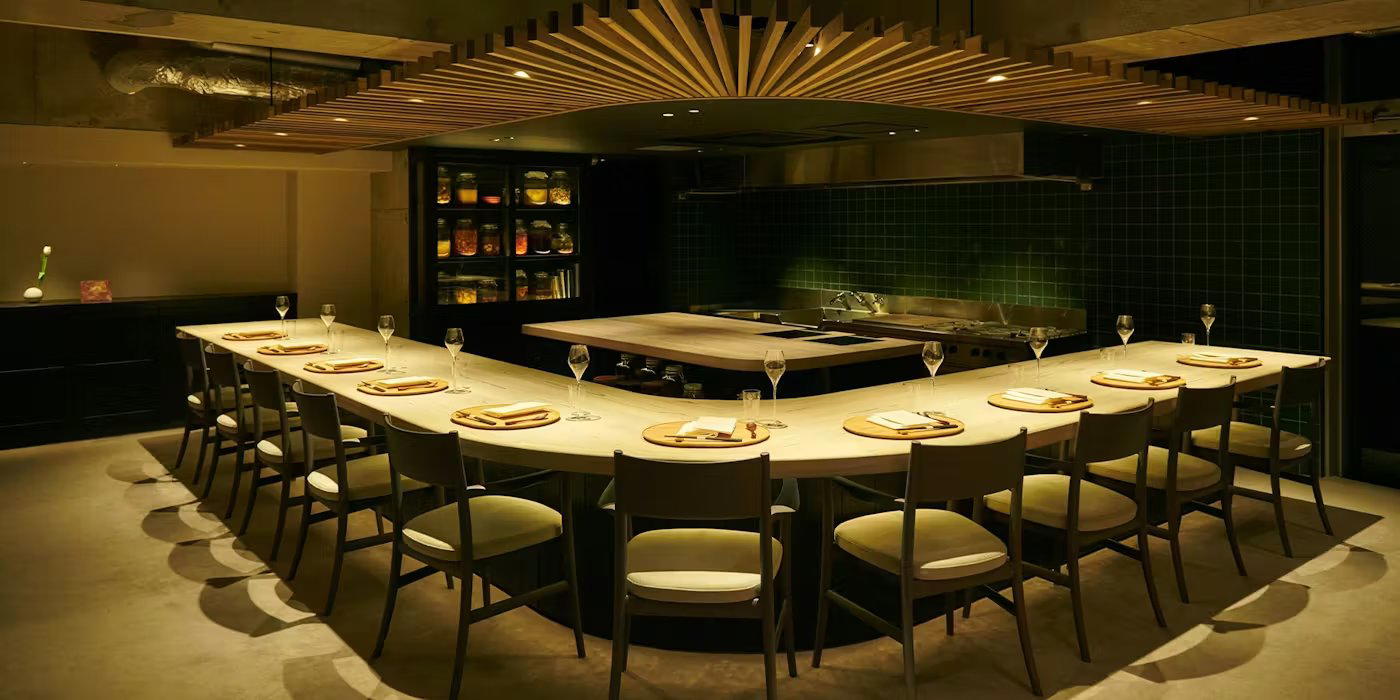
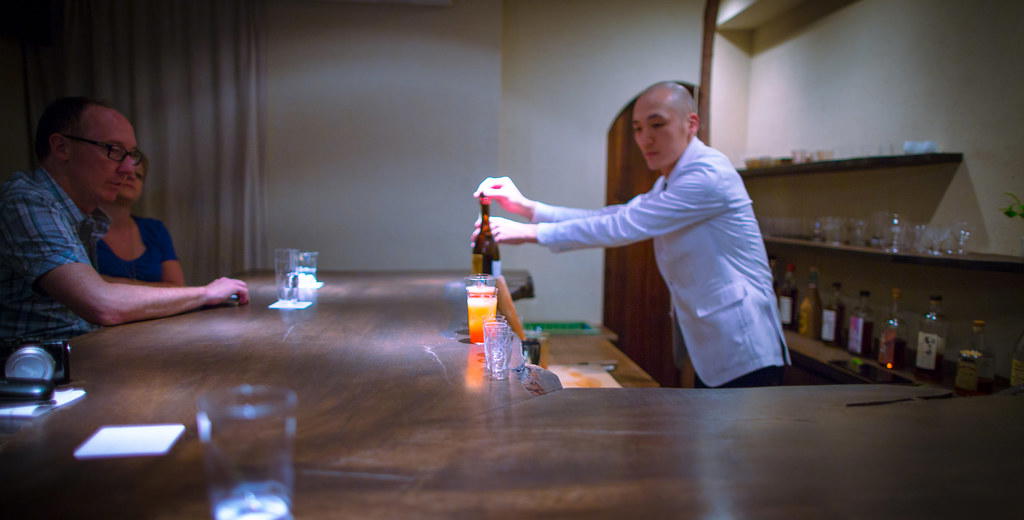
Nishiazabu occupies a quieter register than the louder parts of Minato-ku. The streets around 2-chome are residential in texture, low-rise buildings, side-lit at night, with restaurants that announce themselves modestly. Toumin sits on the second floor of Barbizon 73, a building name that gestures toward Paris without performing it. That understatement is consistent with what happens at the counter inside. The room organizes itself around the kitchen, which is visible from every seat, and the format is a single fixed menu served to guests who can watch the brigade work through each course. The atmosphere that results is attentive rather than theatrical: the cooking is the event, and the open counter design makes the kitchen's pace and intention legible throughout the meal.
This kind of counter arrangement has become a recognizable format in Tokyo's upper tier of French-Japanese restaurants. It draws on the Japanese tradition of the open kitchen as a hospitality signal, transparency as warmth, and applies it to European technique. At Toumin, the effect is warm and interactive. That recognition points to a French-Japanese counter where the vegetable program is substantive enough to attract specialist critical attention, not simply decoration around a protein course.
What Michel Bras Taught the Industry About Vegetables, and What Toumin Inherits
The culinary lineage running through Toumin connects to one of the clearest reference points in modern French vegetable cooking. Michel Bras, working from Laguiole in the Aveyron, spent decades building a vocabulary around plants, foraging, and the landscape immediately surrounding his kitchen. His gargouillou, a composition of dozens of vegetables, herbs, and flowers assembled to reflect a specific moment of the season, became one of the most referenced dishes in French gastronomy, not because it was decorative but because it argued, with precision, that vegetables could carry the intellectual and sensory weight of a serious plate.
Chef Kazuya Iguchi trained within that tradition. The consequence for Toumin's kitchen is that the vegetable work operates from a considered framework, not as a contemporary gesture toward plant-based eating. Seasonal sourcing is structural here, not incidental. The menu's identity shifts with what is available, and fermentation, which Iguchi has developed as a core technique, extends the useful life of seasonal produce while adding layers of acidity, depth, and complexity that bridge French classical logic with the Japanese appreciation for preserved and fermented ingredients. In a city where fermentation literacy has deep roots across both culinary traditions, that convergence is neither forced nor novel; it reads as the natural result of a chef who trained at the intersection of both.
For context on how this approach fits within Japan's broader fine-dining scene, the vegetable-forward counter format at Toumin occupies a different niche than the multi-starred kaiseki programs at places like Gion Sasaki in Kyoto or the innovative French-Japanese fusion approach taken at HAJIME in Osaka. It is also distinct from the Nishiazabu and Minato-ku high-end sushi tradition represented by venues like Harutaka in Tokyo. Toumin's closest comparable set is the group of French-inflected counters across Japan where vegetable sourcing and fermentation are treated as primary creative concerns, rather than supporting elements. You can trace similar commitments at akordu in Nara and, with a different regional accent, at Installation Table ENSO L'asymétrie du calme in Ishikawa.
The Menu: Fixed, Seasonal, and Not Yet Fully Plant-Based
Toumin offers one menu. There is no à la carte, no choice of format, and no abbreviated option. The single fixed menu includes meat and fish alongside its vegetable courses, which places it in the majority tier of French-Japanese tasting menus in Tokyo rather than the emerging plant-only category. The We're Smart Green Guide noted this directly, observing that a fully plant-based menu does not yet exist, and expressing confidence that one would succeed if offered. That editorial note is worth taking seriously: it implies the vegetable program is developed enough to stand independently, even if the current menu structure does not ask it to.
Fermentation appears across the menu as a technique rather than a theme. The use of preserved and fermented elements alongside fresh seasonal vegetables is consistent with the Michel Bras tradition of treating time and transformation as ingredients in their own right. The result, as the Green Guide describes it, is a menu where "flavors and textures are perfectly woven together", language that points to integration rather than the more common arrangement where vegetables serve as accompaniment to a central protein narrative.
For diners who have followed France's broader movement toward vegetable-led haute cuisine, from Bras in Laguiole to the plant-forward programs at restaurants like Le Bernardin in New York City, Toumin represents that tradition's translation into a Tokyo counter format, with Japanese seasonal produce and fermentation technique doing much of the interpretive work.
Planning a Visit to Toumin
Toumin is located at 2 Chome-24-14 Barbizon 73, 2F, Nishiazabu, Minato City, Tokyo. The address is in a low-key residential pocket of Nishiazabu, accessible from Roppongi or Hiroo stations. As a counter restaurant with a single fixed menu, booking well in advance is the expected planning posture. Current hours, pricing, and reservation method are best confirmed directly with the restaurant, as none of these details are published through third-party sources at the time of writing.
For broader planning across Minato-ku, our full Minato-ku restaurants guide covers the range of dining options across the ward, from Azabu-Juban to Shimbashi. If accommodation is part of your itinerary, the Minato-ku hotels guide maps the area's options by character and location. Those building an evening around drinking as well as eating can consult the Minato-ku bars guide. And for those extending their trip beyond Tokyo, the broader Japan circuit of vegetable-conscious and French-influenced restaurants includes Goh in Fukuoka, hiro in Gifu, giueme in Akita, Bleston Court Yukawatan in Nagano, KAI in Kagoshima, Kitagawa in Matsusaka, and Emeril's in New Orleans for those tracking how French-influenced fine dining operates across very different sourcing environments.
Comparable Venues
Comparable venues nearby, for context on price, style, and recognition.
| Venue | Cuisine | Price | Awards | Notes |
|---|---|---|---|---|
| TouminThis venue — the venue you are viewing | Fermentation × Modern French | $$$$ | ||
| Sens & Saveurs | Modern French Fine Dining | $$$$ | Chiyoda | |
| Maison Paul Bocuse | Iconic French Fine Dining | $$$$ | Shibuya | |
| レストラン エプイ EPUY | Local French Fine Dining | $$$$ | , | Onuma Park |
| ラチュレ | Seasonal French with Japanese Game Meats | $$$$ | , | Shibuya |
| Joël Robuchon | Modern French Fine Dining | $$$$ | , | Shibuya |
Continue exploring
More in Minato-ku
Restaurants in Minato-ku
Browse all →

Bars in Minato-ku
Browse all →






At a Glance
- Intimate
- Elegant
- Modern
- Sophisticated
- Special Occasion
- Date Night
- Chefs Counter
- Open Kitchen
- Farm To Table
- Local Sourcing
Intimate counter setting with serene, refined atmosphere featuring live cooking theater and meticulous plating as visual art.