Tompkins Square Bagels
Our verdict
The shop operates with the stripped-back focus of a place that has decided one thing done consistently well is enough. For the city's bagel conversation, it remains a serious address.

Pearl is the En Primeur Club membership app — saves, bookings, and concierge access live there. Same editors, same standards.
- Address
- 165 Avenue A, New York, NY 10009
- Phone
- (646) 351-6520
- Hours
- Daily 7 AM–5 PM
- Website
- tompkinssquarebagels.com
- Directions
- Get directions
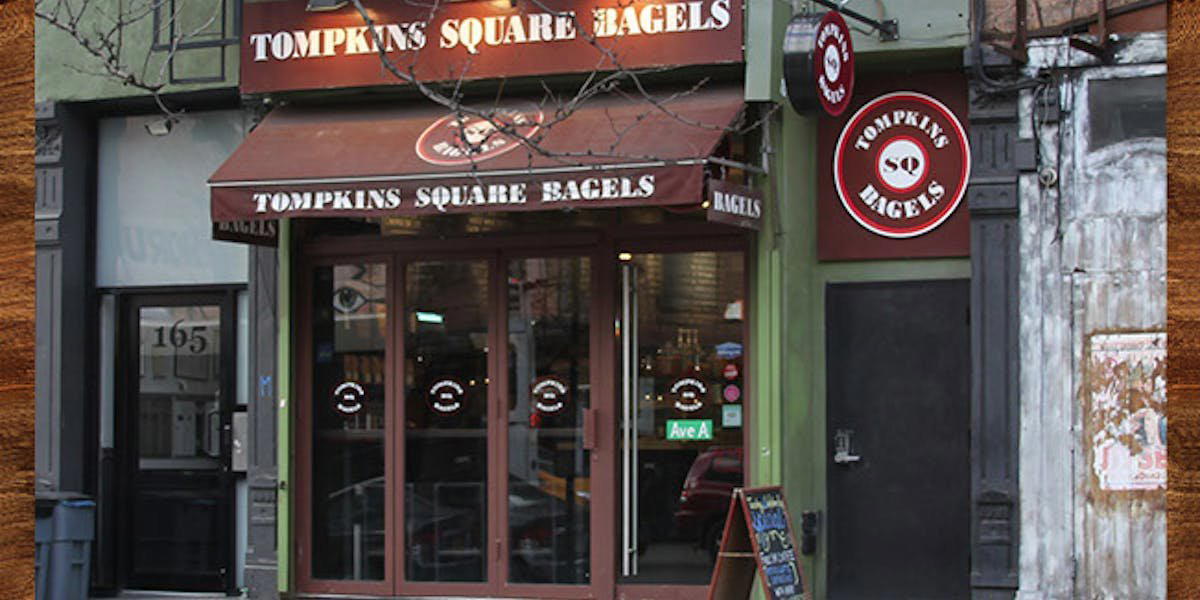
The menu
What to order
- Weezer Sandwich
- Kaitlyn Sandwich
- Bagel with lox
If You Do One Thing in the East Village, Make It This
New York's bagel culture is older than most of its celebrated restaurant institutions. While the city's fine-dining tier has fragmented into micro-genres and tasting-menu formats — from the $$$$ Japanese precision of Masa to the French-rooted ambition of Le Bernardin — the bagel remains one of the few New York food objects that resists reinvention without losing its audience.
The case for going here is not complicated: this is hand-rolled bagel production in a neighbourhood that has spent two decades oscillating between gentrification pressure and culinary drift. The shop's continued focus on process over expansion is, in the context of New York's food economy, its own kind of statement.
The East Village Bagel Tradition and Where This Fits
The East Village's food identity has always run on a different axis from the tasting-menu corridors of Midtown or the Michelin-certified Korean ambition of venues like Atomix. This is a neighbourhood shaped by immigrant provisioning, corner economies, and a durable appetite for food that is fast, cheap by New York standards, and made with genuine technique. The bagel shop sits at the centre of that tradition.
Hand-rolled bagels differ from their machine-produced counterparts in ways that are measurable rather than merely sentimental. The rolling process creates a denser, more irregular crumb; the crust develops differently under high heat; the chew is a function of both gluten development and the boiling stage, which many commercial producers have shortened or eliminated. In cities where bagel culture has weakened, where the bagel has become a vehicle for cream cheese rather than an object worth eating on its own, these distinctions have collapsed. In New York, they still matter to enough people to sustain a counter culture around them.
Tompkins Square Bagels positions itself within the hand-rolled, high-process tier of that counter culture. The format is counter service, the queue is real on weekend mornings, and the transaction is quick. For EP Club readers accustomed to planning around reservation windows at venues like Eleven Madison Park or Per Se, this is a different kind of logistics problem: the planning is about timing your arrival, not securing a table months in advance.
The Sustainability Argument in Bagel Form
It is worth reading Tompkins Square Bagels through the lens of what sustainability actually means at the level of a neighbourhood food business. The conversation in American fine dining has tilted heavily toward farm-to-table sourcing, zero-waste kitchens, and supply chain transparency, principles that places like Single Thread Farm in Healdsburg and Lazy Bear in San Francisco have built into their formal positioning. At the other end of the price spectrum, the sustainability argument looks different but is no less real.
A bagel shop that produces to order, operates a short menu with minimal ingredient complexity, and generates low food waste by virtue of its format is, structurally, a more sustainable operation than a full-service restaurant with broad menus and long prep cycles. The bagel itself, flour, water, malt, salt, is one of the lower-impact food objects in the New York food system. When production stays local and volume stays calibrated to demand, the waste profile shrinks further. None of this is a marketing position for Tompkins Square Bagels; it is simply what small-format, process-focused food production looks like when it works.
The broader pattern is visible across American cities where artisan food producers have resisted the logic of scaling up. The operations that endure, that maintain queue culture and neighbourhood loyalty, tend to be the ones that treat production discipline as a fixed constraint rather than a variable to trade against growth. This is the model Tompkins Square Bagels inhabits, whether or not it frames it in those terms.
Compare this with the resource architecture of the city's high-end kitchens. Venues like Alinea in Chicago or The French Laundry in Napa have invested significantly in reducing waste and tightening supply chains, but they operate at a fundamentally different scale of complexity. The bagel shop's sustainability is built in at the format level, which is both its limitation and its advantage.
What to Order and When to Go
The standard recommendation at a counter like this is to orient around the bagel itself before the toppings. The cream cheese program at New York's serious bagel shops is typically strong, house-made or sourced from producers who understand the product, but the quality of the boil and bake is what separates a serious shop from a serviceable one. At Tompkins Square Bagels, the sesame and everything varieties are consistently cited as the base cases for evaluating the operation.
Weekend mornings between roughly 9am and noon represent the peak window: the bagels are moving fast, the queue is at its longest, and the product is at its freshest. Arriving before 9am or after the mid-morning rush on a weekday shifts the experience without changing the product. There is no booking system and no reservation requirement, this is a walk-in counter. Cash and card are both typically accepted at shops of this type, though confirming on arrival is sensible. Weekend mornings draw the longest queues; if you are working around a tight schedule, a weekday morning is the more efficient option.
For broader orientation across the city's food and hospitality offer, EP Club's New York City guides cover the full range: our full New York City hotels guide, our full New York City bars guide, our full New York City wineries guide, and our full New York City experiences guide are all available. For comparable neighbourhood-focused food operations in other American cities, see Emeril's in New Orleans and Providence in Los Angeles for reference points on what serious regional food culture looks like at different price points. Internationally, the discipline visible in high-process, format-focused venues like 8 1/2 Otto e Mezzo Bombana in Hong Kong and Alain Ducasse at Louis XV in Monte Carlo reflects the same underlying principle: knowing what you are and not diluting it.
Frequently asked questions
What kind of setting is Tompkins Square Bagels? There are no table reservations and no tasting menus; the format is walk-in, order at the counter, and go. It sits at a different price point and register from the city's $$$$-tier fine dining, but the production seriousness places it in the same conversation about what New York food culture values.What do people recommend at Tompkins Square Bagels?
Is Tompkins Square Bagels considered one of New York's serious hand-rolled bagel operations?
Standing Among Peers
Comparable venues nearby, for context on price, style, and recognition.
| Venue | Cuisine | Price | Notes |
|---|---|---|---|
| Tompkins Square BagelsThis venue — the venue you are viewing | New York Bagels & Breakfast Sandwiches | $10–20 | Not listed |
| 16 Handles | Frozen Yogurt & Soft Serve | $1–10 | East Village |
| Culture | Cafe | $10–20 | Park Slope |
| Remedy Diner | Classic American Diner | $20–30 | East Village |
| Nathan's Famous | Classic American Hot Dogs | $10–20 | Coney Island-Sea Gate |
| Blank Street Coffee | Modern coffee & matcha cafe | $10–20 | Greenwich Village |
Continue exploring
More in New York City
Restaurants in New York City
Browse all →
Bars in New York City
Browse all →
Hotels in New York City
Browse all →





Details
- Cozy
- Trendy
- Casual Hangout
- Brunch
- Open Kitchen
- A La Carte
- Counter Dining
- Vegetarian Friendly
- Vegan Options
- Gluten Free Options
Current opening hours
- Monday
- 7 AM–5 PM
- Tuesday
- 7 AM–5 PM
- Wednesday
- 7 AM–5 PM
- Thursday
- 7 AM–5 PM
- Friday
- 7 AM–5 PM
- Saturday
- 7 AM–5 PM
- Sunday
- 7 AM–5 PM
Hours can change for holidays and private events. Last verified .
Busy, efficient counter-service spot with open kitchen views of fresh bagel making, creating a lively neighborhood atmosphere.