


A former fishermen's hut on the sand at Aiguablava, Toc al Mar serves Catalan seafood and rice dishes in one of the Costa Brava's most immediately readable settings. Wild fish arrives grilled over holm oak wood; rice dishes for two anchor the menu alongside catch sold by weight. Ranked #844 on Opinionated About Dining's Casual Europe list in 2025, it books up fast in high season.
Pearl is the En Primeur Club membership app — saves, bookings, and concierge access live there. Same editors, same standards.
- Address
- Carrer Platja d'Aiguablava, 8, 17255 Begur, Girona, Spain
- Phone
- +34 972 11 32 32
- Website
- tocalmar.cat
- Directions
- Get directions
 Saves & bookings on Pearl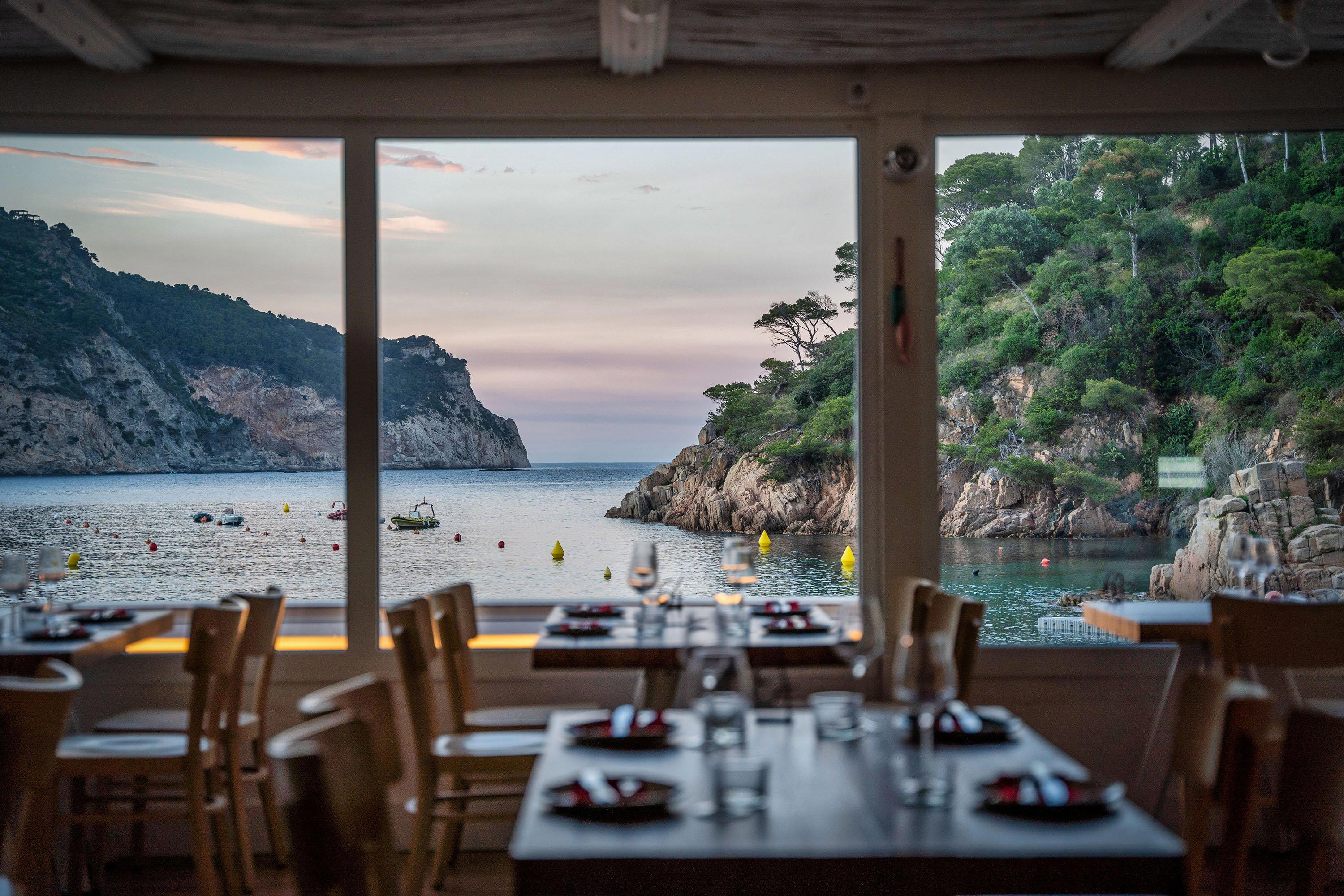
Sand, Salt Air, and the Aiguablava Shore
The Costa Brava has many restaurants claiming a sea view. Toc al Mar has the sea itself. Sitting at Carrer Platja d'Aiguablava on the edge of among the more photographed coves on the Girona coastline, the restaurant occupies a position that practically dissolves the boundary between terrace and beach. The building's origins as a fishermen's hut have shaped its character more durably than any renovation could: the scale stays human, the feel stays local, and the proximity to the water is not a design choice but a geographic fact.
That physical immediacy sets the terms for everything that follows. This is not a venue dressed up to suggest the sea; it is a place where the sea is the actual context. Sunbathers spread out beyond the terrace. The light off the water reaches the tables directly. Understanding that frame is the starting point for reading the menu correctly.
How the Costa Brava Approaches Seafood at This Register
Catalan coastal cooking at the casual end of the market operates on a different logic from the tasting-menu tradition associated with Girona province's most decorated address, El Celler de Can Roca in Girona. Where that register compresses technique and reference into multi-course sequences, the beach-restaurant tradition works through directness: catch handled simply, heat applied with restraint, ingredients allowed to declare themselves. The prestige marker here is sourcing and timing, not transformation.
Grilling over holm oak wood (alzina in Catalan) sits inside a long Mediterranean tradition of using local hardwood to add a low, clean smokiness without overwhelming the protein. The wood burns hotter and slower than fruitwoods, which makes it well suited to whole fish, it delivers colour and a faint aromatic char without drying out delicate flesh. At Toc al Mar, wild fish sold by weight and grilled this way represents the cleaner end of that tradition: you are paying for the quality of the catch and the judgment of the grill, not for a sauce.
Rice dishes for two follow a different but equally codified local logic. The Empordà and Costa Brava region has its own rice vocabulary, distinct from Valencian paella orthodoxy. Recipes here often incorporate local seafood combinations, and the format of a shared pan for two is both practical and social. Across comparable beach-facing restaurants in Catalonia, this format has become a reliable anchor for tables wanting something more structured than grilled fish alone.
The Role of Raw and Near-Raw Preparation
Spain's coastal restaurants at this level tend to treat raw preparation as a starting point rather than a centrepiece, in contrast to, say, the crudo-forward programmes at Alici Restaurant on the Amalfi Coast or the technique-led seafood minimalism at Gambero Rosso in Marina di Gioiosa Ionica. In the Catalan beach-restaurant tradition, rawness is more likely to appear through lightly dressed shellfish or simple preparations that emphasise the freshness of the catch rather than through formal crudo or ceviche structures.
At a restaurant positioned this close to the water, the argument for quality rests on supply chain brevity. Catch that travels less time between sea and table requires less intervention to read well on the plate. The editorial interest at Toc al Mar lies not in elaborate raw technique but in the fundamental conditions that make simplicity credible: location, sourcing, and the discipline to leave good fish alone.
For reference on what Spanish coastal cooking looks like when it moves into a more technically ambitious register, Aponiente in El Puerto de Santa María and Quique Dacosta in Dénia both demonstrate how far the tradition can extend under fine-dining conditions. The restaurant operates at the other end of that spectrum, where the goal is fidelity rather than invention.
Where Toc al Mar Sits in the Broader Scene
The 2025 Opinionated About Dining Casual Europe ranking places the restaurant at #844. OAD's casual list draws on critic and professional votes across the continent, and placement on it at any position signals a level of consistent quality that distinguishes a restaurant from the generic beach-tourism tier. At that ranking, a place is not being measured against Disfrutar in Barcelona or Arzak in San Sebastián; it is being recognised as a serious address within its own category.
More than five thousand reviews at that average, for a beach restaurant in a town of Begur's size, indicates a combination of genuinely satisfied customers and a consistent product. Ratings of this scale are difficult to maintain without reliability in execution.
For local comparison, AlKostat del Mar represents another angle on Begur's seafood offering, and the town's full dining context is mapped in our full Begur restaurants guide.
Planning Your Visit
Aiguablava is among the more frequently visited coves on the Costa Brava during July and August, and the restaurant's position directly on the beach means that summer demand is acute. Advance booking is the appropriate approach from late June through early September; turning up without a reservation in peak season, particularly for lunch, carries meaningful risk. The review volume on Google reflects the scale of seasonal traffic the location attracts.
The by-weight fish format means the final bill depends partly on what is available on a given day and how much you order, which adds a degree of variability to the spend. This is standard practice at this type of coastal restaurant and worth factoring into budget expectations before arriving.
Begur itself rewards time beyond the meal. The town's position above its coves, its medieval castle tower, and its network of paths down to beaches like Aiguablava and Sa Riera make it one of the more architecturally and geographically coherent stops on the Costa Brava. For accommodation, bars, wine, and local experiences, see our Begur guides.
A Pricing-First Comparison
Comparable venues nearby, for context on price, style, and recognition.
| Venue | Cuisine | Price | Awards | Notes |
|---|---|---|---|---|
| Toc al MarThis venue — the venue you are viewing | Aiguablava, Beachfront Catalan Seafood | $$ | Michelin Plate | Not listed |
| AlKostat del Mar | Sa Riera, Contemporary Catalan | $$$$ | Michelin Plate | Not listed |
| Barquet Tarragona | Not listed | $$ | Michelin Plate | Centre, Traditional Catalan Seafood & Rice Dishes |
| Cheche | Not listed | $$$ | Michelin Plate | Passeig Marítim, Modern Seafood & Mediterranean |
| Tunateca Balfegó | Not listed | $$$ | Michelin Plate | l'Antiga Esquerra de l'Eixample, Bluefin Tuna Fusion |
| Guethary | Not listed | $$$ | Michelin Plate | Platja de Palma, Mediterranean Grilled Seafood |
Recognition history
Dated appearances from independent guides and award organizations, with the underlying list record or original source where available.
Macarfi 7.7 Food Rating
Macarfi
Michelin Plate
Michelin
Opinionated About Dining Casual in Europe Recommended
Opinionated About Dining
Opinionated About Dining Casual in Europe Ranked #844
Opinionated About Dining
Continue exploring
More in Begur
Restaurants in Begur
Browse all →
Bars in Begur
Browse all →
Hotels in Begur
Browse all →
Wineries in Begur
Browse all →
At a Glance
- Scenic
- Rustic
- Casual
- Casual Hangout
- Family
- Terrace
- Open Kitchen
- Local Sourcing
- Waterfront
Current opening hours
- Monday
- 1–3:15 PM
- Tuesday
- 1–3:15 PM
- Wednesday
- 1–3:15 PM
- Thursday
- Closed
- Friday
- 1–3:15 PM
- Saturday
- 1–3:15 PM
- Sunday
- 1–3:15 PM
Hours can change for holidays and private events. Last verified .
Relaxed beachside terrace atmosphere right on the sand with sea breezes and casual seafaring decor.