The Saga
.png)

From Enrique Limardo of Imperfecto, The Saga brings a Spanish-Latin American lens to Washington's West End, earning a Michelin Plate and consecutive Opinionated About Dining rankings through 2025. The minimalist cream-and-beige dining room lets the food carry the drama, with arroz dishes, reimagined tapas, and sharing-format mains that suit a deliberate, occasion-paced meal.
 Discover on Pearl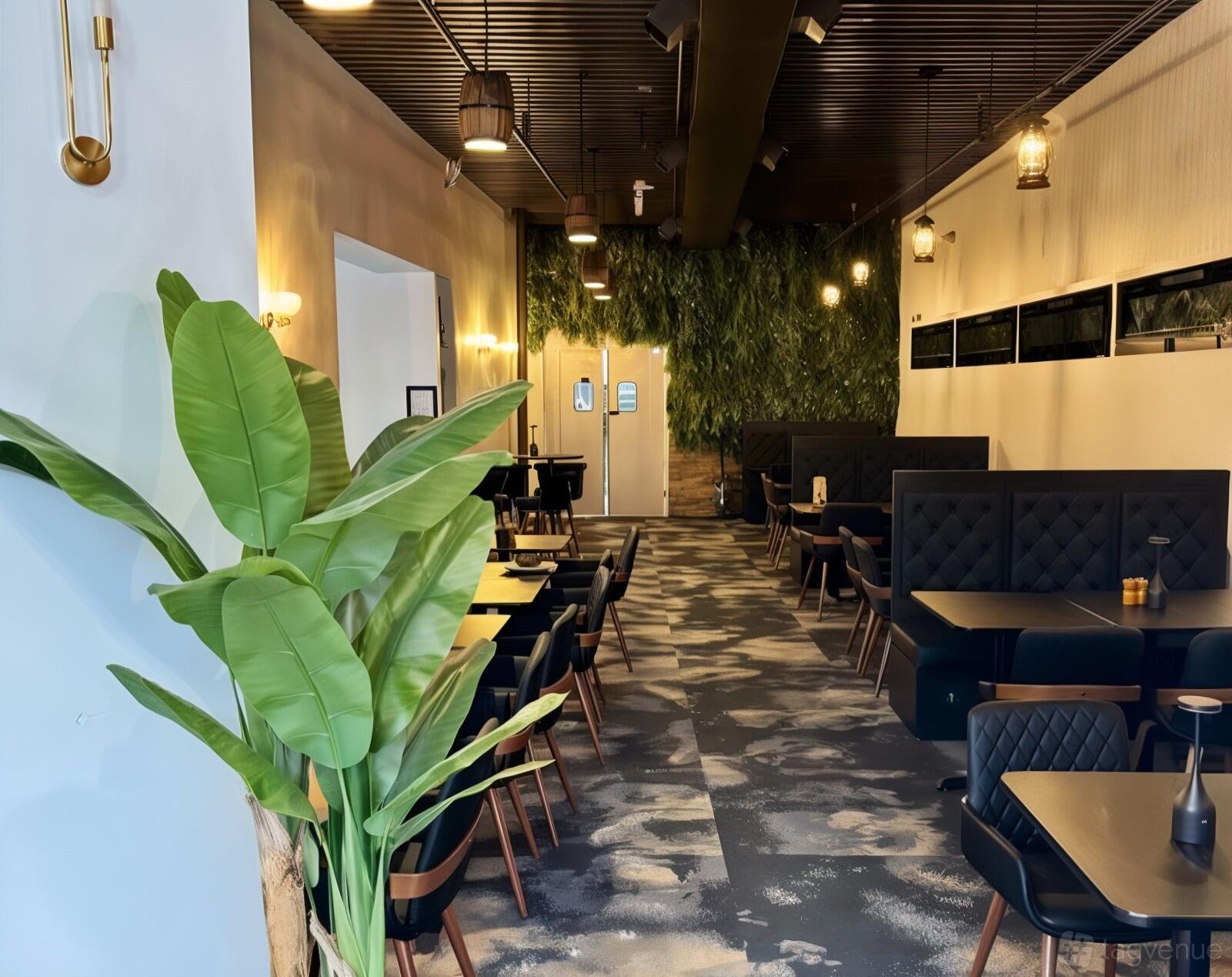
Where the Room Yields to the Plate
Walking into The Saga, the restraint is immediate. Cream walls, pale wood, and glass surfaces absorb rather than compete — a deliberate counterweight to the food's ambition. The restaurant occupies a position just beside The Ritz-Carlton on 22nd Street NW, in Washington's West End, a neighbourhood that skews toward expense-account dinners and diplomatic-circuit entertaining. The Saga fits that geography without surrendering its culinary argument to it.
This kind of spatial minimalism — clean palette, diffused light, little visual noise , has become a recognisable choice among restaurants that want their food to do the explaining. It concentrates attention. At The Saga, that concentration is earned: the kitchen has enough going on that the room would only distract from it.
A Spanish Tradition, Redrawn
Spanish cooking in the United States has a complicated competitive position. At one end, tapas bars chase accessibility and volume; at the other, a smaller cohort of restaurants attempts to do something more considered with the tradition. The Saga sits in that second group, working Spanish classics through a Latin American filter that sharpens rather than dilutes them.
The pan con tomate and patatas bravas arrive in updated form , familiar enough to orient a diner, altered enough to signal intent. These are not novelty rewrites; they are recalibrations. For comparison, Xiquet by Danny Lledo and Del Mar represent the other directions D.C.'s Spanish-adjacent dining has taken, each with its own relationship to authenticity and invention. The Saga's position is distinct: the Latin American influence is structural, not decorative.
The menu devotes an entire section to arroz , rice preparations that function as a centrepiece category rather than a side consideration. This is an unusual structural choice in a city where rice dishes rarely anchor a tasting arc. The arroz morada illustrates the kitchen's approach directly: salt-baked beet purée gives the rice its pink colour, roasted vegetables and fava beans add texture, and a pine nut vinaigrette provides acidity to bind it. The result is technically considered and visually arresting without relying on spectacle for its effect.
Main dishes are sized for sharing and skew toward meat. The lamb shoulder is a reliable anchor for a table splitting multiple courses , a format that suits the deliberate, unhurried pace the room encourages.
The Occasion Argument
Washington's top-tier restaurant list increasingly divides between places built around a single chef's tasting progression and places designed for the rhythm of a shared meal across the table. The Saga belongs to the latter category. The small-plates opening, the arroz section as a navigational midpoint, and the sharing-format mains create a structure that rewards lingering and conversation rather than passive reception of a fixed sequence.
That structure makes a material difference for occasion dining. Celebrations, milestone meals, and significant dinners benefit from agency , the ability to order another round, redirect toward a dish someone at the table wants to revisit, control the pace. The Saga's format allows for that. Compare this against restaurants like Alinea in Chicago or The French Laundry in Napa, where the tasting-menu structure controls the evening's arc entirely. Both models have merit; the choice depends on what kind of celebration a table wants to have.
Within Washington, occasion-calibre restaurants at the $$$$ price point include Albi and Causa, each working a different culinary tradition with comparable seriousness. Oyster Oyster occupies adjacent ambition at a slightly lower price tier. The Saga's competitive set is that first group: full-commitment dinners where the occasion warrants it.
Credentials and Track Record
The Saga holds a Michelin Plate for 2024 and has appeared on the Opinionated About Dining Leading Restaurants in North America list for three consecutive years: ranked 32nd in 2023, 77th in 2024, and 46th in 2025. The 2025 ranking represents a significant upward move after a dip, which is a more informative signal than a static position , it suggests the kitchen is performing at a higher level now than it was a year ago.
Opinionated About Dining's methodology relies on a large panel of informed diners rather than a single critic's visit, which means rankings reflect a sustained pattern of experience rather than a single exceptional night. For a restaurant operating at this price point, consistent panel recognition across three years is a more durable trust signal than a single season's placement.
The restaurant comes from Enrique Limardo, whose other Washington project, Imperfecto, established his credibility in the city's upper dining tier. That lineage matters less as biographical detail and more as evidence that The Saga operates within an already-tested framework of kitchen discipline and front-of-house expectation.
For international context on how Spanish cuisine translates at this level in other cities, ZURRIOLA in Tokyo and Arco by Paco Pérez in Gdańsk offer useful reference points , each representing a Spanish culinary tradition operating far outside its home geography, with the attendant questions about what adapts and what holds.
Among the broader category of occasion-calibre American restaurants, Le Bernardin in New York, Lazy Bear in San Francisco, Single Thread Farm in Healdsburg, and Emeril's in New Orleans each demonstrate how differently the concept of a destination meal can be structured. The Saga's contribution to that conversation is a sharing-led Spanish format that performs credibly at the national level without trying to replicate any of them.
For further context on where The Saga sits within Washington's full dining picture, see our Washington, D.C. restaurants guide. The city's bars, hotels, wineries, and experiences guides round out the picture for visitors planning around a dinner reservation here.
Know Before You Go
- Address: 1190 22nd St NW, Washington, DC 20037
- Cuisine: Spanish with Latin American influence
- Price: $$$$
- Awards: Michelin Plate (2024); Opinionated About Dining Leading Restaurants in North America , #46 (2025), #77 (2024), #32 (2023)
- Google Rating: 4.5 (298 reviews)
- Format: Tapas, small plates, arroz section, sharing mains
- Location: West End, adjacent to The Ritz-Carlton on 22nd St NW
What should I order at The Saga?
The arroz section is the kitchen's most distinctive contribution , the arroz morada, built around salt-baked beet purée with roasted vegetables, fava beans, and pine nut vinaigrette, gives the clearest sense of what the restaurant is doing with its Spanish-Latin American framework. Among the tapas, the reimagined pan con tomate and patatas bravas are sound entry points that establish the kitchen's approach before the heavier courses arrive. For a table sharing across the full menu, the lamb shoulder is a reliable main. The format rewards ordering in rounds rather than mapping out a fixed progression in advance , the arroz dishes in particular benefit from arriving at the table's own pace, not rushed between courses.
Where It Fits
A compact peer set to orient you in the local landscape.
| Venue | Cuisine | Awards | Notes |
|---|---|---|---|
| The Saga | Spanish | The Saga is the latest from Enrique Limardo of Imperfecto. Just to the right of… | This venue |
| Albi | United States, Middle Eastern | Michelin 1 Star | United States, Middle Eastern, $$$$ |
| Causa | Peruvian | Michelin 1 Star | Peruvian, $$$$ |
| Oyster Oyster | New American, Vegetarian, Vegetarian (Sustainable) | Michelin 1 Star | New American, Vegetarian, Vegetarian (Sustainable), $$$ |
| Bresca | Modern French, Contemporary | Michelin 1 Star | Modern French, Contemporary, $$$$ |
| Gravitas | New American, Contemporary | Michelin 1 Star | New American, Contemporary, $$$$ |