The Food Market
Our verdict
The Food Market operates from Columbia Town Center, representing the kind of American market-dining concept that has taken root in planned suburban communities across the mid-Atlantic. With a setting inside a mixed-use retail corridor and a format oriented around accessible, ingredient-forward cooking, it positions itself as a casual anchor in a dining scene that stretches from Vietnamese and Turkish kitchens to Italian wine bars like Di Vino Rosso.

Pearl is the En Primeur Club membership app — saves, bookings, and concierge access live there. Same editors, same standards.
- Address
- 10480 Little Patuxent Pkwy G150, Columbia, MD 21044
- Phone
- (410) 997-7000
- Hours
- Mon–Thu 10 AM–3 PM, 4–9 PMFri 10 AM–3 PM, 4–10 PMSat 10 AM–2:30 PM, 4–10 PMSun 10 AM–2:30 PM, 4–9 PM
- Website
- the-food-market.com
- Directions
- Get directions
- Booking
- Book on OpenTable
Market Dining in a Planned City
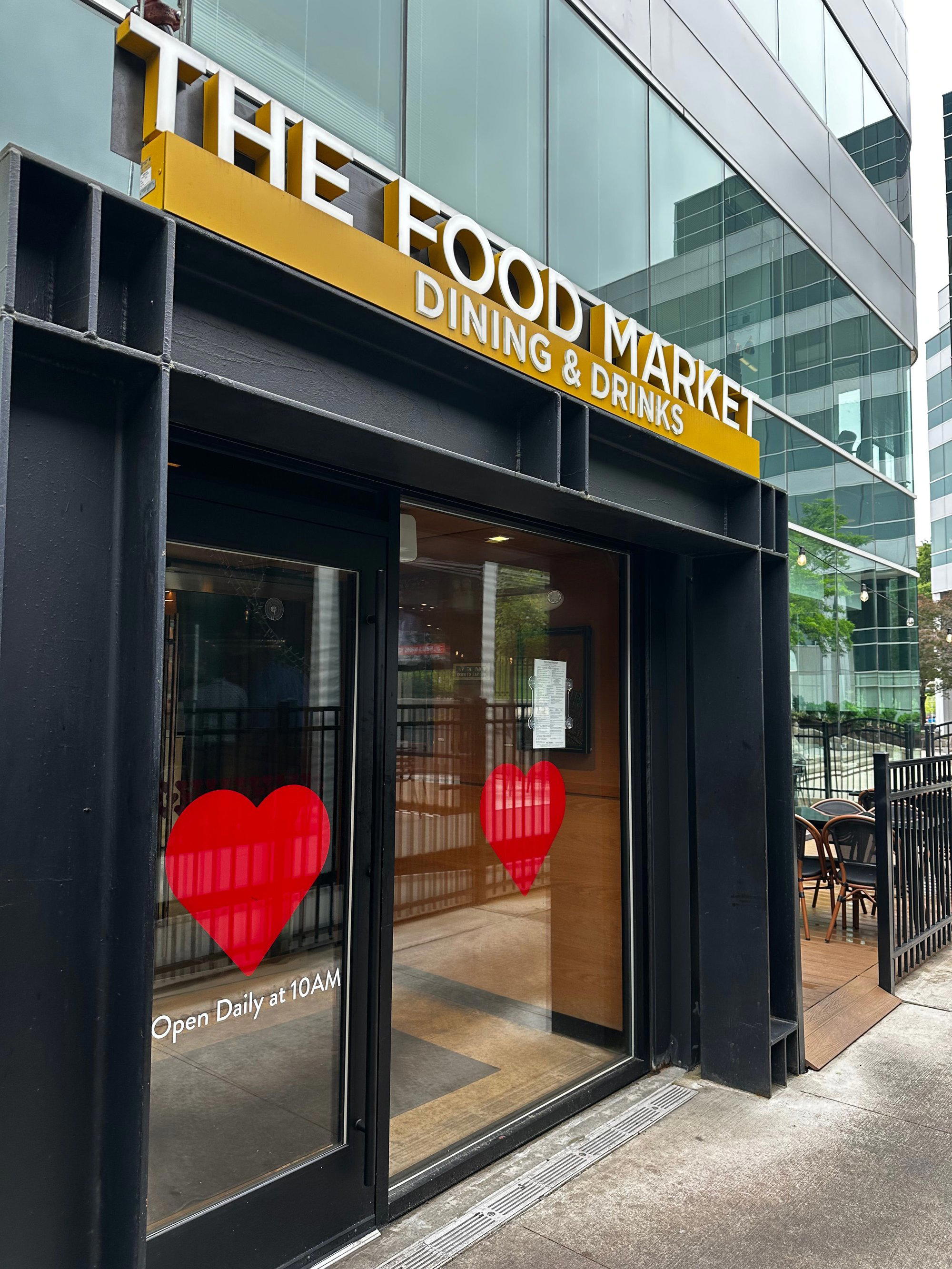
Columbia, Maryland was designed from scratch in the late 1960s as a model planned community, and its retail and dining infrastructure has always reflected that architectural intentionality. The Town Center corridor along Little Patuxent Parkway functions as the city's closest approximation of a downtown, anchoring a mix of casual restaurants, regional chains, and independent dining rooms that serve a dense, educated suburban population. The Food Market sits inside this footprint at 10480 Little Patuxent Pkwy, suite G150, occupying ground-floor retail space within a mixed-use development that characterizes the Town Center's built environment.
The physical approach tells you what kind of dining you are dealing with before you walk through the door. Ground-floor restaurant spaces in Columbia's Town Center share an aesthetic logic: high visibility from the pedestrian level, proximity to parking structures, and a format calibrated for repeat neighborhood visitors rather than destination-driven travel. This is not the kind of room that asks you to make a journey. It is the kind of room that earns its place by being consistently good at the things a neighborhood actually needs.
The American Market Format and What It Signals
Across the mid-Atlantic and into the broader Northeast, the "food market" restaurant format has evolved considerably over the past two decades. At one end of the spectrum, the format implies something like a European-style covered market hall, with multiple vendor stalls and a shared-seating floor. At the other end, it describes a single-kitchen restaurant that positions itself as ingredient-led, seasonal, and market-sourced in its cooking philosophy, borrowing the vocabulary of farmers' market culture and applying it to a sit-down dining context.
The latter model has proven durable in suburban mid-Atlantic communities precisely because it threads a needle that pure fine dining cannot: it offers a sense of care and provenance without demanding the formality or price commitment of a destination tasting menu. Compare this to the more ambitious end of American cooking, where restaurants like Blue Hill at Stone Barns in Tarrytown or Single Thread Farm in Healdsburg have built entire identities around farm-to-table provenance at a very different price point and commitment level. The market-dining format in suburban Maryland exists at a more accessible register, and that is not a criticism. It reflects a different brief.
Columbia's Dining Scene as Context
Columbia's restaurant options have diversified significantly over the past decade. The city's demographics, notably its above-average household income and strong international population, have supported a range of independent restaurants that would be unusual in a planned suburban community of comparable size. An Loi brings Vietnamese cooking to the mix; Cazbar Columbia covers Turkish; Clove and Cardamom handles South Asian; and Cafe Poland by Iwona occupies the Eastern European corner. Di Vino Rosso ($$$, Italian) represents the city's most wine-forward Italian option at a higher price tier.
Against this backdrop, an American market-format restaurant occupies a specific role: it functions as the neighborhood's anchor for domestic cooking traditions, the place where the reference point is produce and protein sourcing rather than a specific regional cuisine. This is the dining category that Columbia's Town Center, with its mix of office workers, residents, and retail visitors, consistently needs to fill.
On Wine Programs in Suburban American Dining
One of the more interesting fault lines in American restaurant wine culture runs between urban destination dining and suburban neighborhood restaurants. At the destination end, wine programs have become increasingly ambitious: Le Bernardin in New York City and Alinea in Chicago maintain deep cellars and dedicated sommelier teams whose work is as much a part of the experience as the food. At The French Laundry in Napa, the wine list effectively functions as a separate research project.
Suburban restaurants in Maryland's Howard County are working from a different set of assumptions. The wine list in this context is more likely to be curated for breadth than depth, prioritizing recognizable regions and approachable price points over rare allocations or vertical collections. This is not a failure of ambition so much as a correct reading of the room. A dining room positioned for neighborhood regulars and casual business lunches does not need a 400-label cellar; it needs a list that pairs reliably with what the kitchen is sending out and does not intimidate a table that came in for a weeknight dinner.
The comparison venues operating in Columbia's mid-price tier reflect this pattern. Di Vino Rosso, which occupies the Italian wine-bar end of the local spectrum, is the closest local analog to a program with real wine identity. American market-format restaurants typically sit adjacent to that niche, covering domestic and international bottles with enough range to satisfy without requiring specialist knowledge to order from.
Within Columbia's dining options, the market-format American restaurant competes most directly with other casual-to-mid-range independents rather than with the more distinctive ethnic specialists or the wine-led Italian operators.
For readers interested in how this format plays at its most ambitious nationally, the distance between a suburban Maryland market restaurant and a room like Lazy Bear in San Francisco, Providence in Los Angeles, or Emeril's in New Orleans is instructive. These are restaurants where the same market-sourcing vocabulary is deployed at a much higher technical and financial register. Addison in San Diego and Atomix in New York City represent an even further remove, where the format has essentially become fine dining with a different narrative frame. The Inn at Little Washington, less than an hour's drive from Columbia, sits at the apex of this spectrum in the mid-Atlantic region specifically.
The Food Market does not compete in those tiers. It serves a community that needs reliable, ingredient-aware cooking at an accessible register, inside a Town Center development that functions as Columbia's civic dining room. That is a narrower but legitimate brief, and proximity to Washington D.C. means the local diner has a sharp frame of reference for what quality looks like.
Planning Your Visit
The restaurant is located at 10480 Little Patuxent Pkwy, G150 in Columbia, MD 21044, within the Town Center mixed-use development. Parking is available via the adjacent structured lots serving the Town Center retail corridor. Given the null availability of verified hours, pricing, and booking policy data readers should confirm current operating hours and reservation availability directly before visiting. Columbia's Town Center draws consistent foot traffic on weekday evenings and weekend afternoons, so peak-time availability at neighborhood restaurants can tighten without much notice. For a broader picture of where this restaurant fits among Columbia's independent dining options, see our full Columbia restaurants guide. For international context on how market-dining concepts translate at the highest level globally, 8 1/2 Otto e Mezzo Bombana in Hong Kong offers a useful reference point on what ingredient-led cooking looks like when it operates without any geographic or format constraints.
Frequently asked questions
Where is The Food Market in Columbia?
The Food Market is located at 10480 Little Patuxent Pkwy G150, Columbia, MD 21044, Columbia.
Is The Food Market a good option for a weekday lunch near Columbia's Town Center offices?
The Food Market's address at 10480 Little Patuxent Pkwy G150 places it inside the Town Center mixed-use development, which is walkable from several of Columbia, MD's office and co-working clusters. The market-dining format common to this restaurant type generally supports faster table turns at lunch without pushing diners toward a fixed-course structure. Parking is available within the Town Center complex, which reduces friction for midday visits from nearby business parks.
What's the signature dish at The Food Market?
The Food Market's market-format American positioning, common to this Town Center corridor in Columbia, MD, typically centers on ingredient-driven plates designed for broad appeal rather than a single anchor dish. Contacting the restaurant directly before your visit is the most reliable way to get current menu details.
Is The Food Market reservation-only?
Restaurants in this mixed-use development generally operate a walk-in option alongside advance bookings, particularly for weekday lunch.
What's The Food Market best at?
Within Columbia's independent dining scene, The Food Market is oriented toward accessible, ingredient-aware American cooking in a market-dining format. That positions it differently from the fast-casual chains that dominate Town Center's ground-floor retail, and from the handful of destination restaurants drawing Howard County diners from outside the immediate area. It occupies the mid-range independent tier where the format encourages sharing plates and flexible meal pacing.
Do they accommodate allergies at The Food Market?
For any dietary requirements, reaching out to the restaurant at its Town Center Columbia location before arriving is the most dependable approach, as policies and kitchen capabilities can shift with menu changes.
Comparison Snapshot
Comparable venues nearby, for context on price, style, and recognition.
| Venue | Cuisine | Price | Notes |
|---|---|---|---|
| The Food MarketThis venue — the venue you are viewing | Modern American Gastropub | Not listed | Not listed |
| The Collective Offshore | Coastal Seafood with Local Flair | $30–50 | Columbia Lakefront |
| lāk Columbia | Upscale New American | $50–100 | Merriweather |
| The Periodic Table | American Fusion with Global Twists | Not listed | Columbia |
| The Corner Stable | American Barbecue & Pub | $20–30 | Columbia |
| Cazbar - Columbia | Authentic Turkish Kebabs and Mezes | $30–50 | Columbia |
Continue exploring
More in Columbia
Restaurants in Columbia
Browse all →
Bars in Columbia
Browse all →
Hotels in Columbia
Browse all →
Wineries in Columbia
Browse all →
The Food Market
The wine
- Wine program
- Curated wine list
- Craft cocktails
Details
- Cozy
- Trendy
- Brunch
- Casual Hangout
- Open Kitchen
- Craft Cocktails
- A La Carte
Current opening hours
- Monday
- 10 AM–3 PM, 4–9 PM
- Tuesday
- 10 AM–3 PM, 4–9 PM
- Wednesday
- 10 AM–3 PM, 4–9 PM
- Thursday
- 10 AM–3 PM, 4–9 PM
- Friday
- 10 AM–3 PM, 4–10 PM
- Saturday
- 10 AM–2:30 PM, 4–10 PM
- Sunday
- 10 AM–2:30 PM, 4–9 PM
Hours can change for holidays and private events. Last verified .
Moderate noise level with down-to-earth, chef-driven vibe.