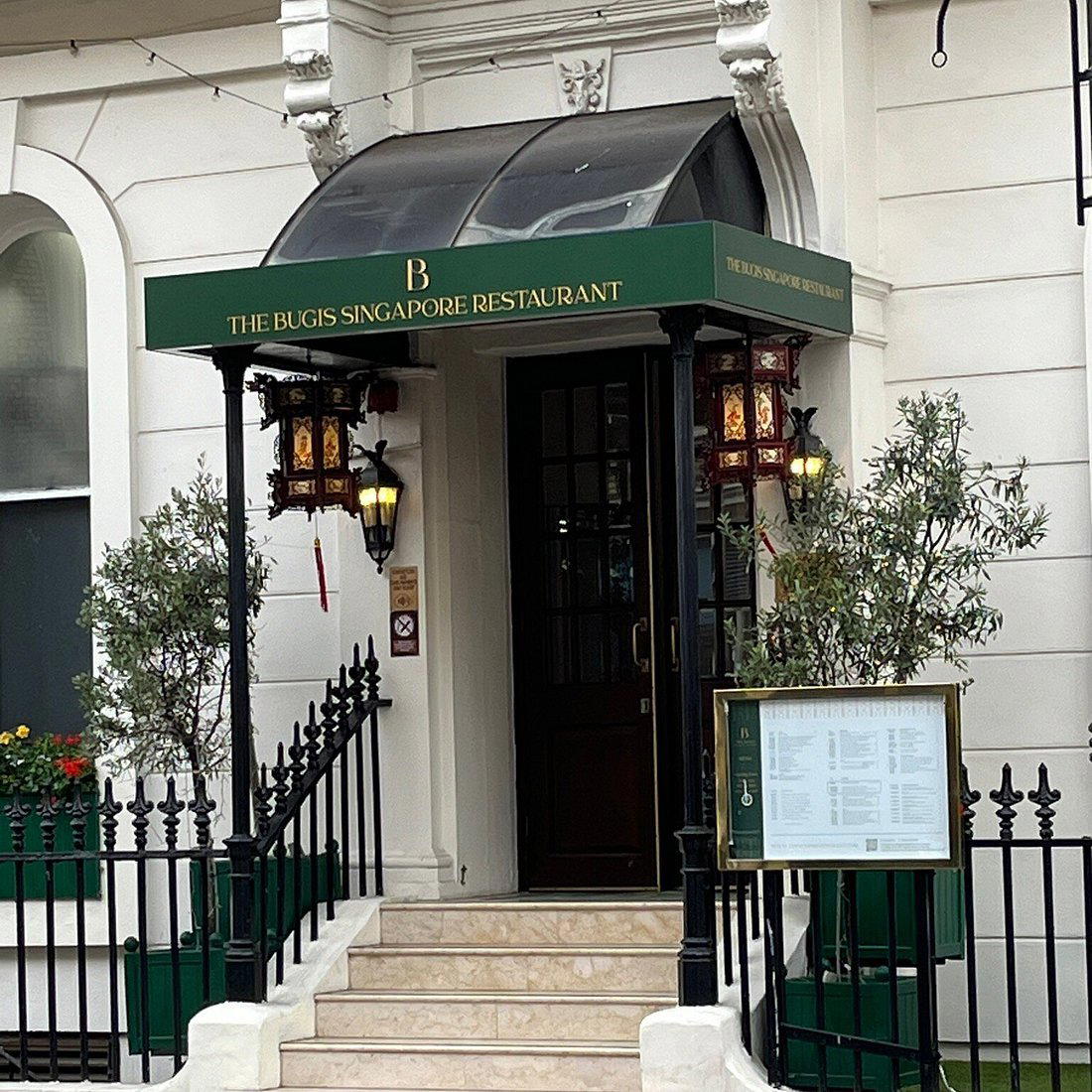
The Bugis Singapore Restaurant
Our verdict
On Gloucester Road in South Kensington, The Bugis Singapore Restaurant brings the cooking traditions of the Bugis Street hawker scene to one of London's most transit-friendly neighbourhoods. The address places it squarely in a pocket of the city that has long supported South and Southeast Asian dining. For Singaporean food in SW7, it occupies a specific and underserved niche.

Pearl is the En Primeur Club membership app, where members save venues, book tables and use the concierge.
The menu
What to order
- Hainanese Chicken Rice
- Salt and Pepper Squid
- Singaporean Laksa
- Kway Teow
- Dim Sum
- Aromatic Crispy Duck
Singapore's Hawker Tradition in South Kensington
London's relationship with Southeast Asian cooking has always been uneven. The city has a well-documented depth of Malaysian and Thai restaurants, particularly in the inner boroughs, but Singaporean food, which draws from Chinese, Malay, and Indian traditions simultaneously, has never achieved the density it deserves given Singapore's outsized influence on global food culture. That scarcity gives context to The Bugis Singapore Restaurant on Gloucester Road, which takes its name from one of Singapore's most historically layered food districts.
Bugis Street in Singapore ran as an open-air hawker market from the postwar years through the early 1980s, when urban redevelopment displaced it. The name carries weight in Singaporean food history: it was a place where rojak vendors, char kway teow stalls, and laksa hawkers operated in close proximity, and where the logic of Singaporean eating, namely, variety, immediacy, and communal sharing, was most visible. A London restaurant borrowing that name is making an implicit claim about its cooking philosophy, situating itself within a tradition of inclusive, multi-dialect Singaporean street food rather than the more formal Peranakan or modern Singaporean restaurant formats that occasionally appear in the capital.
The South Kensington Address
At 140 Gloucester Road, the restaurant sits in a stretch of SW7 that functions as a transit corridor between the museums quarter and the Earls Court Road. South Kensington tube station is roughly a five-minute walk, making the location accessible from central London without requiring a destination-specific journey. The neighbourhood supports a mixed dining economy: there are reliable French bistros, a few Italian establishments, and a scattering of international options that reflect the area's historically high proportion of expatriate residents. Singaporean food in this postcode is not competing with a cluster of peers; it occupies ground largely on its own terms.
That positioning matters for the reader trying to calibrate expectations. South Kensington is not where London's most talked-about Southeast Asian cooking tends to surface, which is usually further east or in Soho and Covent Garden. A Singaporean restaurant here is likely serving a local repeat clientele, embassy workers, and visitors staying in the surrounding hotels, rather than the food-media crowd that drives coverage of comparable cuisines elsewhere in the city. That local-anchor dynamic tends to produce menus with a reliable core rather than a rotating creative programme.
How a Singaporean Meal Sequences
Understanding the tasting arc of a Singaporean meal requires setting aside the European model of distinct courses moving from light to heavy. The Singaporean table traditionally arrives all at once, or in rapid succession, with dishes ordered to create contrast: something broth-based alongside something dry-fried, something sour-dressed alongside something rich and coconut-heavy. The meal builds through texture and temperature as much as through flavour progression.
At a restaurant working in this tradition, the early choices tend to anchor the table. A bowl of laksa, the spiced coconut broth with rice noodles that exists in multiple regional dialects across Singapore and Malaysia, functions as a tonal statement: it signals whether the kitchen is leaning toward the richer, coconut-forward Katong style or the more pungent, shrimp-paste-driven Penang variation. Char kway teow, flat rice noodles wok-fried with egg, beansprouts, and Chinese sausage, is the technical benchmark dish; the quality of wok hei, the breath of the wok, visible in the slight smokiness and caramelisation, tells you immediately about the kitchen's heat management. Rice dishes like Hainanese chicken rice, which has earned recognition in global food writing as one of the most precisely calibrated comfort dishes in Asian cuisine, depend almost entirely on the quality of the poached chicken and the aromatic rice cooked in the poaching liquid.
This is a cuisine where the complexity is hidden in process rather than in elaborate plating, and where a London diner unfamiliar with the reference points might underestimate what they are eating.
London's Broader Fine Dining Frame
For readers who use South Kensington as a base and are considering the full spectrum of London dining, the neighbourhood is well-placed for the city's higher-end European restaurants. Dinner by Heston Blumenthal in Knightsbridge, which traces British culinary history through its menu, is accessible from Gloucester Road. Across the city, the restaurants that occupy London's most-discussed tier include CORE by Clare Smyth in Notting Hill, Restaurant Gordon Ramsay in Chelsea, Sketch, The Lecture Room and Library in Mayfair, and The Ledbury in Notting Hill, all operating in the ££££ bracket with Michelin recognition.
Beyond the city, the UK's most decorated destination restaurants include Waterside Inn in Bray, Le Manoir aux Quat'Saisons in Oxford, L'Enclume in Cartmel, Moor Hall in Aughton, Gidleigh Park in Chagford, Hand and Flowers in Marlow, hide and fox in Saltwood, Midsummer House in Cambridge, Opheem in Birmingham, and Restaurant Andrew Fairlie in Auchterarder. For comparative context outside the UK, Le Bernardin in New York City and Atomix in New York City represent how Korean and French-influenced cooking at the highest tier operates in a different market. See our full London restaurants guide for the wider picture.
Planning a Visit
The restaurant's address at 140 Gloucester Road, SW7, places it within walking distance of South Kensington and Gloucester Road tube stations, both on the District and Circle lines, with Piccadilly line access at Gloucester Road. For visitors staying in the South Kensington, Earls Court, or Kensington hotel corridor, this is a practical neighbourhood option rather than a cross-city commitment. As specific booking policies, hours, and pricing data are not available in verified form, prospective diners should confirm current hours and reservation requirements directly with the restaurant before visiting.
Frequently asked questions
Is The Bugis Singapore Restaurant a family-friendly restaurant?
The South Kensington address at 140 Gloucester Road puts it in one of London's most family-trafficked corridors, given the proximity to the Natural History and Science Museums. Singaporean hawker-style eating, built around shared dishes placed at the centre of the table, suits groups of mixed ages well. The communal format removes the pressure of individual ordering, which tends to work in families' favour.
How would you describe the vibe at The Bugis Singapore Restaurant?
The SW7 location on Gloucester Road sits in a stretch that functions as a connector between the museum quarter and Earls Court, so the room draws a mix of locals, hotel guests, and visitors rather than a destination-dining crowd. Singaporean hawker cooking has always carried an informal, high-turnover energy, and that tradition shapes the atmosphere here more than any fine-dining register. Expect something closer to a neighbourhood room than a special-occasion address.
Is The Bugis Singapore Restaurant one of the few places in London serving authentic Singapore hawker cooking?
London has a documented depth of Malaysian restaurants but far fewer kitchens specifically anchored to the Singaporean hawker tradition, which draws on Chinese, Malay, and Indian influences within a single menu. The Bugis name itself references one of Singapore's most historically significant street-food districts, signalling an intent to position within that specific culinary lineage rather than a broader pan-Asian frame. For anyone based in South Kensington seeking that particular register, the 140 Gloucester Road address is among the more geographically accessible options in the city.
What do regulars order at The Bugis Singapore Restaurant?
Singapore's hawker canon centres on a short list of dishes that define the cuisine internationally: laksa, Hainanese chicken rice, char kway teow, and chilli crab. Any kitchen operating under a Singaporean identity in London is measured against how it handles at least two or three of those benchmarks. For specific current dishes, checking directly with the restaurant is the only reliable method, as menus shift with supply and season.
Where is The Bugis Singapore Restaurant in London?
The Bugis Singapore Restaurant is located at 140 Gloucester Rd, South Kensington, London SW7 4QH, United Kingdom, London.
Do I need a reservation for The Bugis Singapore Restaurant?
The Gloucester Road address in SW7 draws consistent foot traffic from the museum quarter, particularly at lunch and early evening. Reservations are worth arranging ahead for dinner, especially on weekends when the surrounding neighbourhood fills with visitors.
Side-by-Side Snapshot
Comparable venues nearby, for context on price, style, and recognition.
| Venue | Cuisine | Price | Notes |
|---|---|---|---|
| The Bugis Singapore RestaurantThis venue (the venue you are viewing) | Singaporean & Malaysian | $50–100 | Not listed |
| House of Ming | Sichuan & Cantonese Chinese with Modern London Twist | $50–100 | Victoria |
| Bao Fitzrovia | Modern Taiwanese Bao Buns | Not listed | Fitzrovia |
| Royal China Baker Street | Cantonese Dim Sum | $30–50 | Marylebone |
| Noble Palace | Modern Regional Chinese Fine Dining | $50–100 | Westminster |
| Four Seasons | Cantonese Roast Meats | $20–30 | Queensway |