On a narrow Alfama lane, Tasca do Chico is one of Lisbon's most closely held fado venues, where the music runs intimate and the room stays small. It sits at the traditional end of the fado spectrum, prioritising atmosphere and acoustic immediacy over scale. Booking well ahead is standard practice for a venue where the list of those waiting exceeds the number of seats available on any given night.
Pearl is the En Primeur Club membership app — saves, bookings, and concierge access live there. Same editors, same standards.
- Address
- 451, R. dos Remédios 83, 1100-443 Lisboa, Portugal
- Phone
- +351961339697
- Directions
- Get directions
 Saves & bookings on Pearl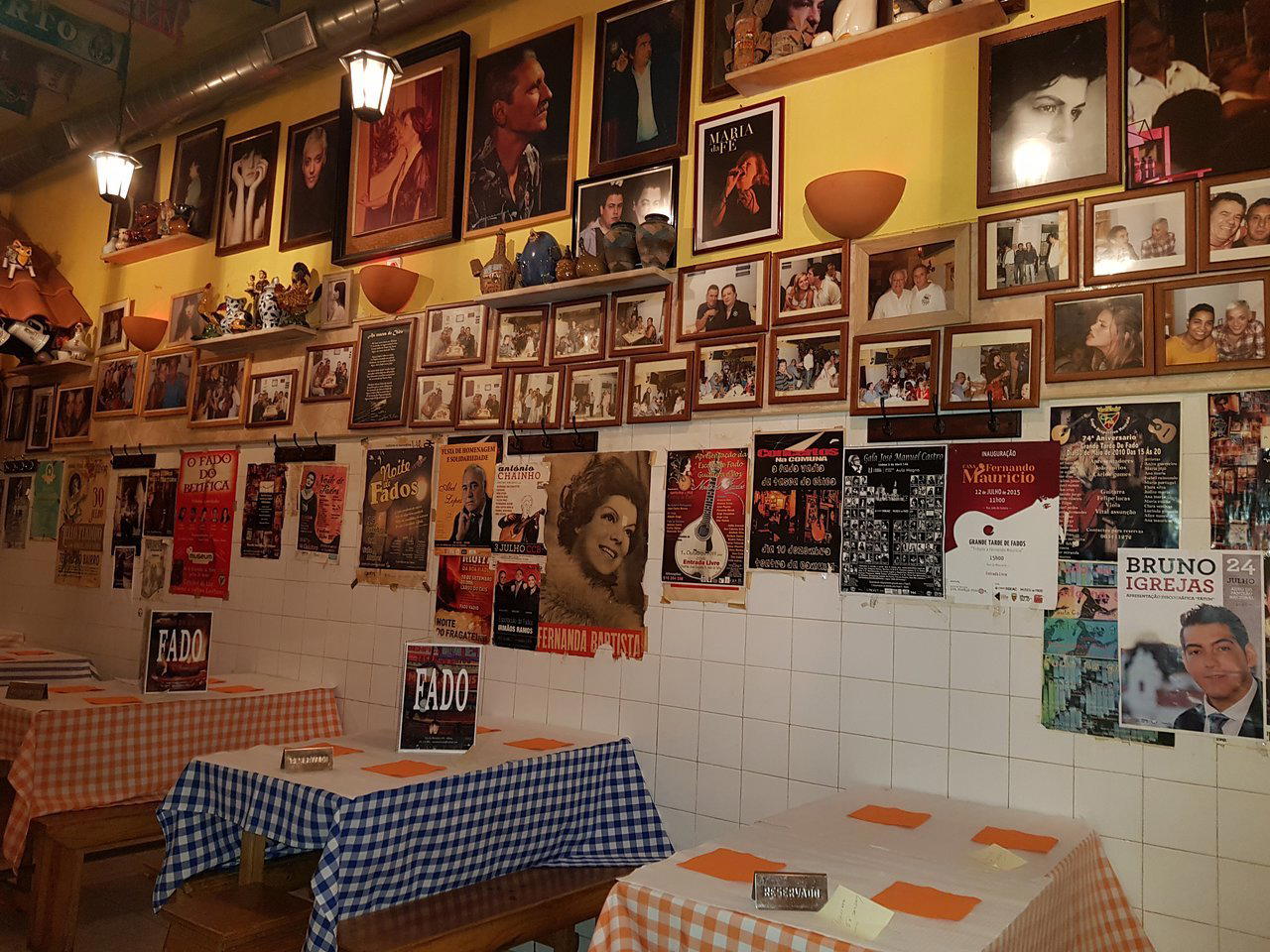
The Physical Container: What the Room Tells You Before the Music Starts
Rua dos Remédios runs through the lower slopes of Alfama, Lisbon's oldest surviving neighbourhood, with the kind of gradient and crooked geometry that resists any kind of urban planning logic. Tasca do Chico sits along this street in a format that belongs to an older typology of Lisbon eating and listening: the tasca. These are venues engineered for locals first, even when tourism has found them. They are small-roomed, tile-faced, communally seated spaces where the distinction between dining room and performance space collapses entirely. There is no stage. There is no separation. The guitarist and the fadista move through or beside the tables, and the acoustics are whatever the stone walls and low ceiling provide, which, in practice, is an intimacy that a formally designed concert hall cannot replicate.
Alfama produces this kind of venue because the neighbourhood's built fabric allows for it. The street widths, the property footprints, the residential mix, all of it resists the large-format expansion that has reshaped the Bairro Alto fado houses further west. That physical constraint is, paradoxically, what makes places like Tasca do Chico matter: the room cannot be scaled without ceasing to be itself.
Where Tasca do Chico Sits in the Fado Spectrum
Lisbon's fado scene now occupies at least three distinct tiers. At one end sit the large, professionally produced houses on Rua do Diário de Notícias and its surrounds, full menus, ticketed entry, 80-plus covers, and a rotation of performers calibrated to a mixed tourist audience. At the other end is the informal casas de fado tradition, where the music is participatory and embedded in neighbourhood social life. Between them sits a smaller tier of intimate, reputation-led venues where the performance is professional, the room is small, and the booking process filters out casual visitors who haven't thought ahead.
Tasca do Chico operates in this middle tier, and it is a competitive one. Venues at this scale, typically under 30 covers, with a limited number of seatings per week, tend to accumulate word-of-mouth standing faster than press coverage. Lisbon's premium dining scene, represented by addresses like Belcanto, CURA, and Eleven, operates on booking windows and demand signals. Fado venues at this scale operate on a similar scarcity logic.
For context on how Portugal's broader hospitality culture frames intimate, tradition-rooted experiences, it is worth knowing the country's fine-dining tier prioritises a specific, contained experience over broad accessibility. That sensibility carries into the fado tradition's more serious venues.
The Fado Tradition Itself: Why the Format Matters
Fado is not background music. That distinction is structural, not sentimental. The traditional fado format demands silence from an audience while the fadista performs, followed by collective attention and emotional release. In a large venue with a dinner-service format running simultaneously, that demand is diluted. The clatter of cutlery, the ambient conversation of 80 covers, the movement of waitstaff, all of it works against the acoustic and psychological conditions fado requires to land properly.
In a room of 20 or 25 people, with the performer close enough that you can see the physical effort of the singing, the format reasserts itself. The music is accompanied by the Portuguese guitarra, with its twelve steel strings and characteristic pear-shaped body, plus the baixo, a standard acoustic guitar providing harmonic foundation. The combination produces a resonance that in a small stone-walled room becomes something close to physical. This is not a claim about quality. It is a claim about physics and proportion.
Alfama's tasca-format venues preserve this proportion by necessity. The street addresses on Rua dos Remédios and its immediate surrounds were built for smaller hospitality volumes. They were built for neighbourhood life, and the rooms reflect that. Tasca do Chico's address at number 83 places it within a stretch of the street that remains primarily residential, which sets the expectations correctly before you arrive.
Lisbon's Broader Creative Dining Context
Understanding where a fado tasca sits requires understanding what else Lisbon's visitors are choosing. The city's creative and technically ambitious dining scene, 2Monkeys, 50 Seconds from Martin Berasategui, and the Michelin-decorated addresses already mentioned, operates on a format logic entirely different from the fado tasca. Those venues are about precision, progression, and designed sensory sequences. A fado evening at a place like Tasca do Chico is about duration, accumulation, and a format that has not changed structurally in decades because it does not need to. The comparison point is less the tasting menu counter and more what happens at intimate late-night formats in other cities, the small jazz room in New York, the standing wine bar in Lyon, where the constraint of the space is the product. Internationally, venues like Le Bernardin in New York City and Atomix in New York City demonstrate how intimate, curated formats command their own demand tier regardless of the broader market around them. The principle holds in Alfama.
Planning Your Visit
Rua dos Remédios 83 is reachable on foot from the Alfama tram stops or via a short walk from Santa Apolónia. The neighbourhood's steep terrain means comfortable shoes are a practical consideration, not a cliché. Given the venue's scale, booking in advance is the correct approach. This is not a venue where walk-ins represent a reliable strategy, particularly on weekends or during Lisbon's peak tourism months of May through September. Contact should be made directly and early.
A Pricing-First Comparison
Comparable venues nearby, for context on price, style, and recognition.
| Venue | Cuisine | Price | Notes |
|---|---|---|---|
| Tasca do Chico - fadoThis venue — the venue you are viewing | Not listed | $ | Not listed |
| Beira Gare | Not listed | $ | Baixa, Traditional Portuguese Street Food |
| Damas | Mouraria, Modern Portuguese Tapas | $$ | Not listed |
| Taberna Sal Grosso | Not listed | $$ | Santa Apolonia, Modern Portuguese Petiscos |
| Chapitô à Mesa | Not listed | $$$ | Castelo, Traditional Portuguese with City Views |
| Pateo - Bairro do Avillez | Chiado, Modern Portuguese Seafood | $$$ | Not listed |
Continue exploring
More in Lisbon
Restaurants in Lisbon
Browse all →
Bars in Lisbon
Browse all →
Hotels in Lisbon
Browse all →
At a Glance
- Cozy
- Intimate
- Rustic
- Well Known
- Lively
- Special Occasion
- Late Night
- Date Night
- Live Music
- Historic Building
- Local Sourcing
Current opening hours
- Monday
- Closed
- Tuesday
- Closed
- Wednesday
- 8:30 PM–2 AM
- Thursday
- 8:30 PM–2 AM
- Friday
- 8:30 PM–2 AM
- Saturday
- 8:30 PM–2 AM
- Sunday
- 8:30 PM–2 AM
Hours can change for holidays and private events. Last verified .
Cozy and intimate with walls covered in paintings, posters, and clippings, featuring live soulful Fado music in a warm, crowded setting.