
Taiwan Shokitsu Ten Chinron gives Funabashi a serious Taiwanese-Chinese address outside Tokyo’s usual gravity field. Its Tabelog 100 Chinese cuisine EAST selections in 2023, 2024, and 2026 point to a small-format, everyday-price restaurant where rice porridge, Taiwanese cooking, and counter seating carry more weight than ceremony.
Pearl is the En Primeur Club membership app — saves, bookings, and concierge access live there. Same editors, same standards.
- Address
- 千葉県船橋市湊町3-6-24
- Phone
- +81474377088
- Website
- tabelog.com
 Saves & bookings on Pearl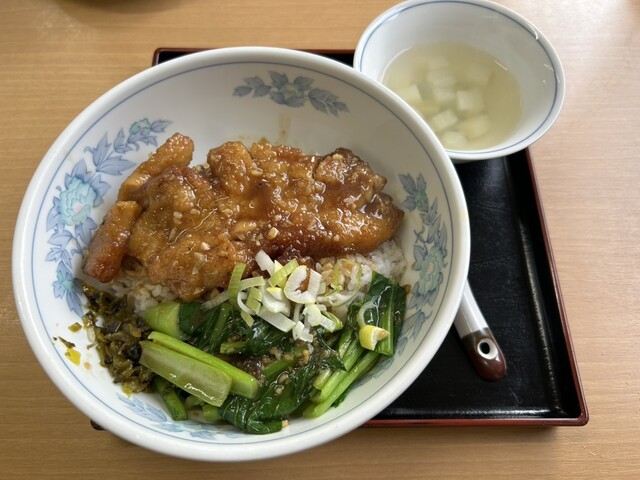
Approach this corner of Funabashi expecting the scale of a neighborhood house restaurant rather than the theatre of a metropolitan dining room. The room’s counter seating matters: Taiwanese and Chinese cooking in Japan often becomes sharper at close range, where heat, timing, and portion rhythm are visible, and where rice porridge can sit beside more familiar Chinese-restaurant categories without being treated as an afterthought.
Taiwan Shokitsu Ten Chinron belongs to a quieter part of Chiba’s dining map, the tier of small restaurants that locals use regularly but that award lists occasionally pull into a wider conversation. Its selection for Tabelog 100 Chinese cuisine EAST in 2023, 2024, and 2026 gives the restaurant a credential that changes how to read it. This is not Tokyo luxury Chinese transplanted to the suburbs; it is a Funabashi address being measured against a broad eastern Japan field for Chinese cooking.
Taiwanese-Chinese cooking built around rice, comfort, and heat control
The useful frame here is ingredient dependence rather than luxury sourcing. Taiwanese cooking, especially when rice porridge is part of the identity, rewards kitchens that understand texture, salinity, and restraint. Rice is not a filler in this tradition; it is the structure that lets pickled, braised, fried, and simmered elements make sense at the table. In Japan, where Chinese restaurants often drift toward set-meal convenience or banquet-style Cantonese cues, a Taiwanese category with Chinese rice porridge signals a different center of gravity.
That distinction matters for travelers using Funabashi as more than a commuter stop. The city’s casual dining range is broad, from low-price local counters to regional Asian restaurants, and the comparison set is instructive. Akasaka Ajiichi sits at a lower everyday spend, while Ayutthaya pushes the local map toward Thai cooking. BHOYE CHHEN adds another South Asian reference point. Against that spread, Taiwan Shokitsu Ten Chinron reads less like a generic Chinese option and more like a specific Taiwanese-Chinese lane with enough consistency to register beyond the neighborhood.
Funabashi’s advantage is price and frequency. Tokyo’s Chinese dining conversation often splits between high-end course menus and quick station-area meals; Chiba’s better small restaurants can occupy the middle with less performance. This restaurant’s Tabelog score of 3.63 and repeat Hyakumeiten recognition place it in that useful zone: serious enough to plan around, casual enough that the cooking remains the subject.
A house-restaurant format, not a destination dining performance
The house-restaurant designation gives the experience its limits and its appeal. There is counter seating, no private rooms, no smoking, and a family-friendly note that includes school-age children. Those facts point to a room built for regular meals rather than staged occasions. For solo diners, that is a strength; counter seating reduces the awkwardness of a table for one and suits food that arrives in smaller rhythms.
The setting also explains why the restaurant sits differently from Funabashi’s broader food circuit. Funakko speaks to another strand of local eating, while Boulangerie Queue shows how non-restaurant specialists help define the city’s daily food habits. For a wider view of the area, our full Funabashi restaurants guide is the natural companion, with our full Funabashi hotels guide, our full Funabashi bars guide, our full Funabashi wineries guide, and our full Funabashi experiences guide covering the rest of the trip architecture.
Recognition is the editorial hook, but the category is the reason to go. Taiwanese restaurants in Japan often operate with fewer formal signals than sushi, kappo, or French-influenced tasting counters. That makes external recognition more useful: it helps distinguish a specialist from the many Chinese-labeled restaurants clustered around stations and shopping streets. Here, the award history does not promise ceremony. It suggests that a modest-format restaurant has earned attention for execution inside a crowded regional field.
How to place it within a Japan-wide eating itinerary
For travelers moving across Japan, Taiwan Shokitsu Ten Chinron works as a corrective to the usual prestige route. A trip built only around Tokyo counters and Kyoto tasting menus misses the suburban restaurants where regional appetite is more visible. The same logic applies elsewhere: -Grilled beef Sukiyaki- KAMAKURA TANUKIAN 鎌倉 たぬき庵 in Kamakura anchors a beef-focused day outside Tokyo. 鮪と炭火焼き うお炭 秋葉原店 in Tokyo points back to the capital, and.cafe in Osaka or.know in Kumamoto widen the map beyond the standard restaurant hierarchy.
That broader map is useful because Taiwanese-Chinese cooking rarely travels under a single luxury banner. It appears in rice dishes, porridge, small plates, family meals, and late lunches, often with more emphasis on repeatability than spectacle. In that sense, Funabashi is not a compromise location; it is part of the argument. The city’s lower-pressure dining economy allows a specialist kitchen to be taken seriously without dressing itself up as a formal course-menu room.
For comparative eating across Asian casual formats, (Shoku) Vietnam in Kawasaki and [Curry Senmon Ten] Maruyama Kyoju. in Sapporo offer different regional lenses, while overseas references such as Jōdo Saké Bar in Los Angeles and Onigiri Time in Pasadena show how Japanese and East Asian comfort formats change when exported. Funabashi’s Taiwanese-Chinese address belongs on that same practical map: not grand, not anonymous, and stronger for being specific.
A Quick Peer Check
Comparable venues by cuisine and price in the same metro.
| Venue | Cuisine | Price | Notes |
|---|---|---|---|
| Taiwan Shokitsu Ten Chinron | Taiwanese-Chinese comfort food | $$ | Funabashi |
| Shogetsu En | Traditional Yakiniku (Japanese BBQ) | $$ | Keisei Nishifuna |
| Akasaka Ajiichi | Classic niboshi ramen shop | $ | / Funabashi |
| Tomonomoto | Ramen shop | $$ | Higashi Kaijin |
| Teppanyaki Kuku | Teppanyaki & Wagyu Steakhouse | $$$ | Nishi-Funabashi |
| Gandhi | Indian Curry House | $$ | Funabashi |
Recognition history
Dated appearances from independent guides and award organizations, with the underlying list record or original source where available.
Tabelog 100 #85 · No. 85
Tabelog · Tabelog 100 - Chinese cuisine - EAST - 2026
Continue exploring
More in Funabashi
Restaurants in Funabashi
Browse all →


Bars in Funabashi
Browse all →




At a Glance
- Cozy
- Classic
- Casual Hangout
- Family
- Solo
- Group Dining
- After Work
- Standalone
A nostalgic, house-like Taiwanese-Chinese eatery with counter seating and a compact dining room, non-smoking and relaxed, drawing families, solo diners, and friends for casual, home-style meals rather than formal occasions.