Szechuan Gourmet


Michelin Plate
Our verdict
A long-running Midtown staple for Sichuan cooking, Szechuan Gourmet on West 39th Street survived a 2018 fire and returned with the same kitchen precision intact. Ranked on Opinionated About Dining's Cheap Eats list for North America in both 2023 and 2024, it draws a loyal crowd with chile oil dumplings, braised fish with bean curd, and the numbing heat of Sichuan peppercorn that defines the region's cuisine.

Pearl is the En Primeur Club membership app, where members save venues, book tables and use the concierge.
The menu
What to order
- Ma Po Tofu
- Pork Dumplings
- Double-cooked Pork
Sichuan Cooking in Midtown: An Unlikely Address With a Documented Track Record
New York's Chinese restaurant geography tends to cluster predictably: Flushing for northern and regional Chinese, Manhattan's Chinatown for Cantonese staples, and a handful of scattered outposts doing serious regional work in neighborhoods that don't advertise it. West 39th Street, one block from Bryant Park and surrounded by garment-district offices, belongs firmly in the last category.
That distinction matters in a city where Sichuan food ranges from the perfunctory (thick, sweetened sauces labeled as mapo tofu) to the technically serious (proper ratio of dried chilies to Sichuan peppercorn, fermented black bean paste, aged doubanjiang). The OAD Cheap Eats list draws from the same critical infrastructure that informs its full restaurant rankings, which makes the recognition a meaningful signal about where Szechuan Gourmet sits in the broader field of affordable regional Chinese in the United States.
The Role of Sichuan Peppercorn: Why the Ingredient Defines the Cuisine
The editorial angle on Sichuan cooking almost always returns to one ingredient: the Sichuan peppercorn, which is not a peppercorn at all but the dried husk of the prickly ash shrub, a member of the citrus family native to Sichuan province. Its effect is the mala sensation, the combination of numbing (ma) and spicy heat (la), and it cannot be replicated by substitution. For decades, Sichuan peppercorns were banned from import into the United States due to citrus canker concerns; the ban was lifted in 2005, but only for peppercorns that had been heat-treated. The practical effect was that Sichuan restaurants in the US through the 1980s and 1990s often produced a muted version of the cuisine by necessity. The lifting of that restriction, combined with a broader wave of post-2000 immigration from Sichuan province, recalibrated what New York diners could expect from the cuisine.
Szechuan Gourmet's kitchen works within this tradition. The braised fish fillets with bean curd represent one of the more demanding preparations in the Sichuan repertoire, the fish must hold texture in a sauce that balances fermented spice against silken tofu without collapsing into uniform heat. Spicy hot and sour cellophane noodles (a preparation built on black vinegar, white pepper, and often lily buds or wood ear mushroom) sit in a different register: the sourness cuts the fat of the broth rather than amplifying heat, which is a structural distinction that separates careful execution from rote cooking. The thin, crispy scallion pancakes and plump pork dumplings in chili oil that open the meal are foundational Sichuan-adjacent dishes, the kind that reward repetition, each visit calibrating your expectation of what the kitchen does with aromatics at room temperature versus in hot oil.
After the Fire: Continuity and a Remodeled Room
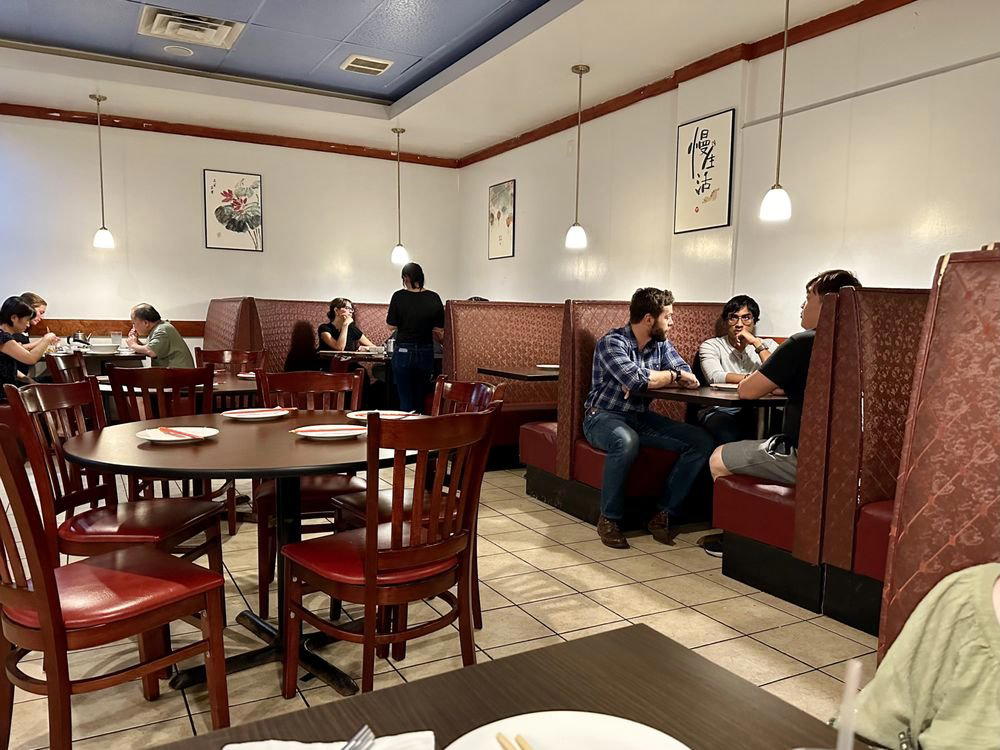
A fire in 2018 closed the restaurant for a period of rebuilding. The reopening produced a remodeled interior that represents a material upgrade from the original space, while the kitchen's approach returned without observable deviation. That continuity is not trivial. In restaurant terms, a forced rebuild offers the risk of disruption and the temptation to reposition. Szechuan Gourmet returned to the same neighborhood, the same cuisine, and the same pricing tier, and was subsequently recognized again by Opinionated About Dining.
For comparison, consider where this restaurant sits against New York's broader high-end dining tier. The city's $$$$ Chinese options, from the Cantonese dim sum of Asian Jewel Seafood Restaurant to regional formats at venues like Alley 41, occupy a different segment entirely. Szechuan Gourmet's $$ price range places it in accessible-everyday territory, which is exactly where OAD's Cheap Eats framework is designed to recognize. That framework also places it in a different conversation from the destination tasting menu circuit: institutions like Alinea in Chicago, The French Laundry in Napa, or Lazy Bear in San Francisco are all doing something formally distinct. The critical infrastructure that produced those rankings and the one that produces OAD Cheap Eats recognition are aligned in rigor but calibrated to different kinds of merit.
Chinese Cooking Beyond New York: A Brief Context
New York remains the most consequential US city for Chinese regional cooking, but it is not the only address worth tracking. Mister Jiu's in San Francisco represents the California-Chinese intersection, with a tasting menu format that sits at the opposite end of the price and format spectrum from a Midtown lunch counter. In Europe, Restaurant Tim Raue in Berlin reinterprets Chinese flavor logic through a fine-dining lens. These venues demonstrate that Chinese cuisine, and Sichuan specifically, operates across a wide register globally. Szechuan Gourmet does not attempt fine-dining synthesis; it executes Sichuan technique at accessible price points, and its sustained recognition suggests it does so reliably.
For readers tracking Chinatown-anchored Cantonese, Big Wong and Blue Willow offer a different regional reference, while Chongqing Lao Zao pulls from a Chongqing tradition that overlaps with but diverges from classic Sichuan in notable ways, Chongqing's hot pot culture emphasizes tallow-based broth and a rawer spice intensity that differs from Chengdu's more complex, layered approach.
Planning Your Visit
Szechuan Gourmet is located at 21 W 39th St, New York, NY 10018, one block from Bryant Park and the 42nd Street Bryant Park subway station (B, D, F, M lines). The address puts it within walking distance of Midtown's office corridor, which means the lunch window fills with the surrounding professional crowd; arriving slightly outside peak lunch hours is a practical consideration. Budget: The $$ price tier makes this one of Midtown's more accessible options for a full meal, and given the OAD Cheap Eats recognition, the value-to-execution ratio is well-documented. Reservations: Dress: No dress code applies; this is a neighborhood-register dining room, not an event space.
For broader New York City planning, see our full New York City restaurants guide, our full New York City hotels guide, our full New York City bars guide, our full New York City wineries guide, and our full New York City experiences guide.
Frequently asked questions
Who is the chef or culinary lead at Szechuan Gourmet?
The chef associated with Szechuan Gourmet is Various.
Where do I go for Szechuan Gourmet?
Szechuan Gourmet is located at 21 W 39th St, New York, NY 10018, New York City.
What dish is Szechuan Gourmet famous for?
Pork dumplings in chili oil and braised fish fillets with bean curd draw the most consistent recognition, and both appear in the restaurant's OAD Cheap Eats listing. Spicy hot and sour cellophane noodles and thin, crispy scallion pancakes round out the dishes most frequently cited by regulars. Salt and pepper prawns are worth adding to any order.
What type of food is Szechuan Gourmet known for?
What does dinner at Szechuan Gourmet typically cost?
Pricing at Szechuan Gourmet is listed as $$.
Nearby-ish Comparables
| Venue | Cuisine | Price | Awards | Notes |
|---|---|---|---|---|
| Szechuan GourmetThis venue (the venue you are viewing) | Authentic Szechuan | $20–30 | Michelin Plate | Not listed |
| Le Bernardin | French Seafood Fine Dining | $300–500 | 3 Michelin Stars · World's 50 Best #13 | French, Seafood |
| Atomix | Modern Korean Tasting Menu | $300–500 | 2 Michelin Stars · World's 50 Best #7 | Modern Korean, Korean |
| Masa | Seasonal Hokkaido Tempura Omakase | $150–200 | Tabelog 100 #34 | Sushi, Japanese |
| Per Se | French Fine Dining Tasting Menu | $300–500 | 3 Michelin Stars · World's 50 Best #40 | French, Contemporary |
| Eleven Madison Park | Contemporary Plant-Based Fine Dining | $300–500 | 3 Michelin Stars · World's 50 Best #4 | French, Vegan |
Recognition history
Dated appearances from independent guides and award organizations, with the underlying list record or original source where available.
Michelin Plate
Michelin
Opinionated About Dining Cheap Eats in North America Ranked #474
Opinionated About Dining
Full recognition history (3 entries)
Opinionated About Dining Cheap Eats in North America in Recommended
Opinionated About Dining